

Late Ming Bamboo Brush Pot with Cabbage and Insects, Zhu Sansong Mark
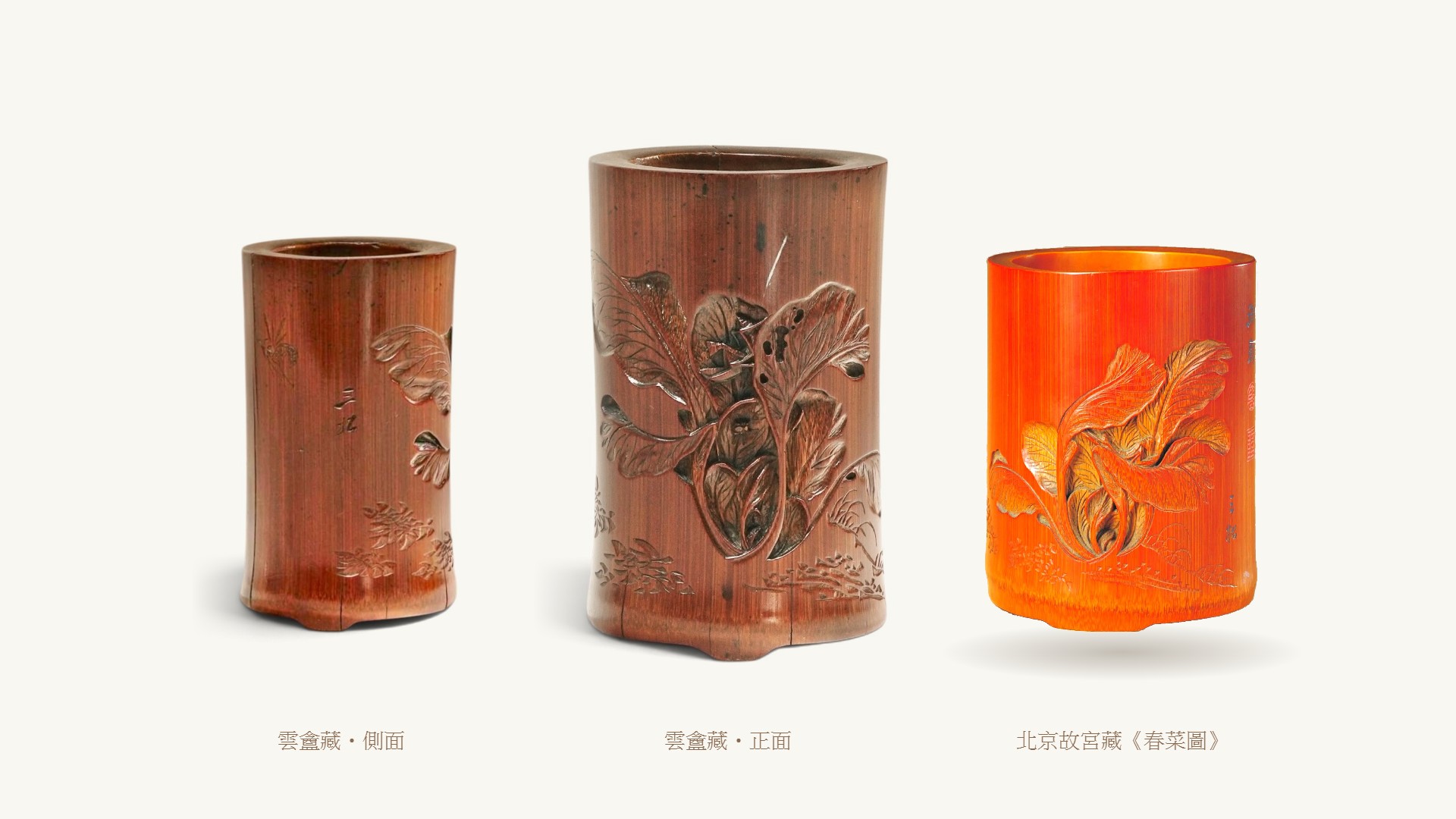
Zhu Sansong Mark | With a comparison to the “Spring Cabbage” brush pot in the Palace Museum, Beijing
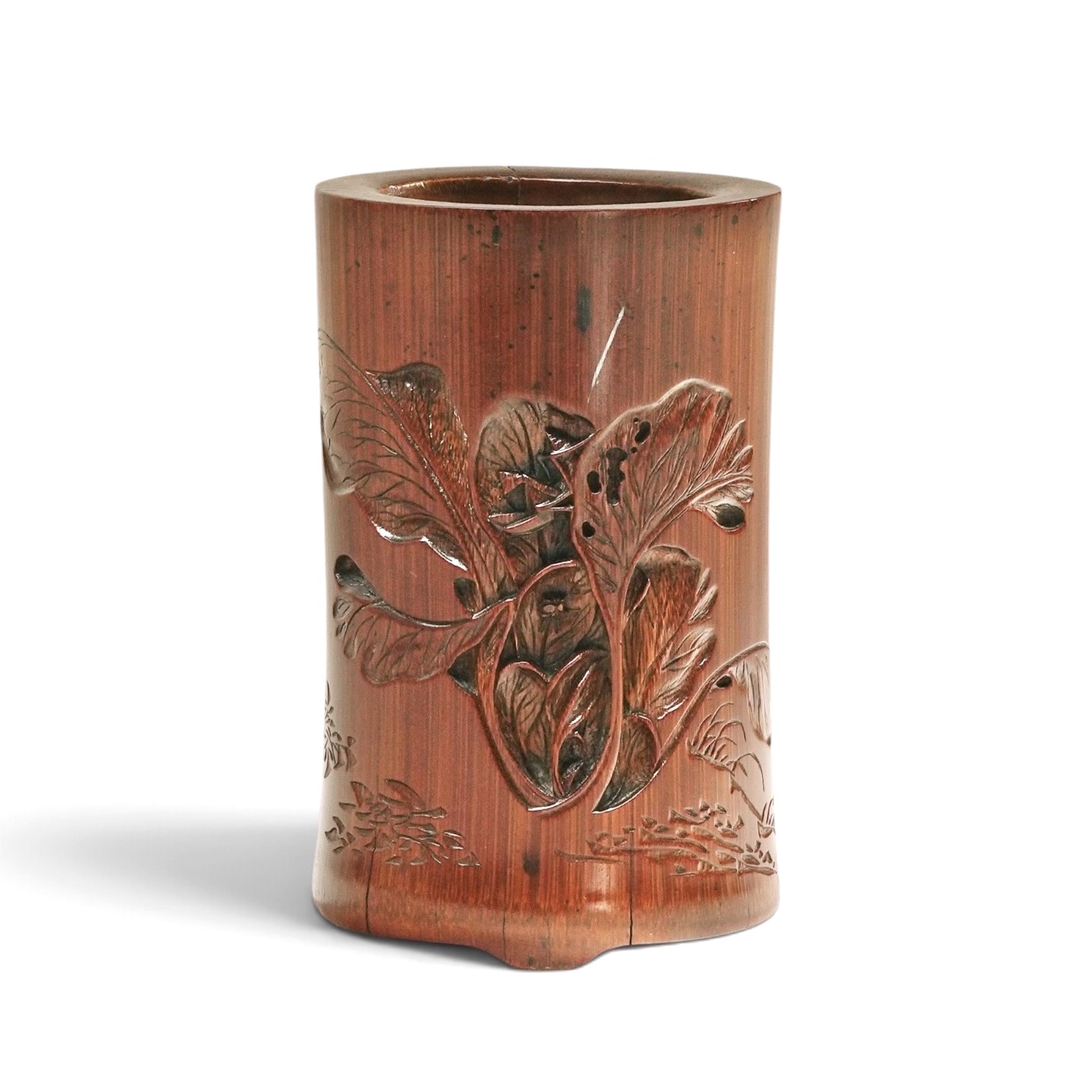
Late Ming bamboo brush pot with cabbage and insects (front)
A head of cabbage and a small grass insect. This brush pot turns the humblest vegetable on a scholar’s desk into a three-dimensional picture meant to be read by turning it in the hand. It bears the signature “Sansong” and the family name “Zhu”, and shares much with the “Spring Cabbage” brush pot in the Palace Museum, Beijing, which carries an inscription by the Qianlong Emperor. This article introduces the Yun Museum piece, then compares it with two Qing-court brush pots signed Zhu Sansong in the Palace Museum, Beijing (“Spring Cabbage” and “Court Ladies”), looking in turn at subject, composition, carving technique and signature, and weighing the question of attribution with care.
1. The Yun Museum piece
| Title | Bamboo brush pot with cabbage and insects |
| Period | Late Ming dynasty |
| Maker | Attributed to Zhu Sansong (Zhu Zhizheng) |
| Medium & technique | Bamboo; high relief, low relief, openwork and incised line |
| Inscription | “Sansong”, with the character “Zhu” (the family name) in outline (shuanggou) incision beneath |
The brush pot is made from a section of bamboo culm with an open, flat mouth and a slightly waisted wall; short feet are cut at the base. The fine vertical fibres of the bamboo skin have, over centuries of handling, deepened to a rich jujube red with a natural patina. Several vertical age cracks and scattered dark spots are visible on the wall, all marks of its age.
2. The “Spring Cabbage” brush pot in the Palace Museum, Beijing
The Palace Museum, Beijing, holds a late-Ming bamboo brush pot signed Zhu Sansong, titled “Spring Cabbage”, from the Qing imperial collection. According to published records it is 13.7 cm high, with a mouth diameter of 10.8 cm and a foot diameter of 10.5 cm; it is cylindrical, brownish red, and stands on three short feet.
The front shows a tender, upright head of spring cabbage whose leaves rise and bend as if stirred by the wind; a mantis rests on a leaf and a few tufts of grass dot the surroundings. The ground is cut away most deeply at the heart of the cabbage, with flowing lines and a knife that moves like a brush. The back bears a seven-character regulated poem in blue-filled clerical script, signed “Inscribed by imperial order in mid-autumn of the jihai year of Qianlong (1779)”, with two seals, and the signature “Sansong” in intaglio cursive script.
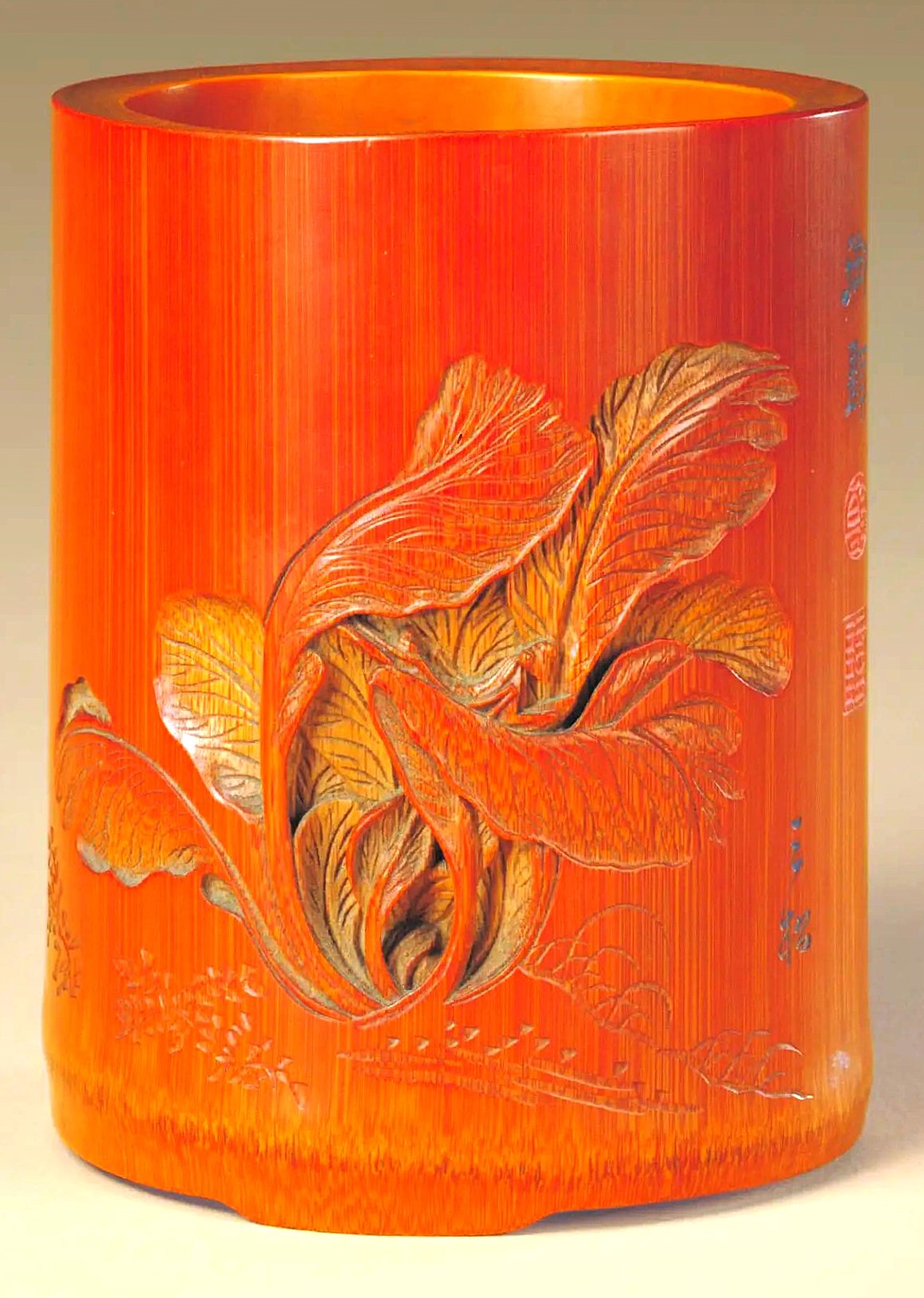
“Spring Cabbage” brush pot, late Ming, signed Zhu Sansong, Palace Museum, Beijing (front)
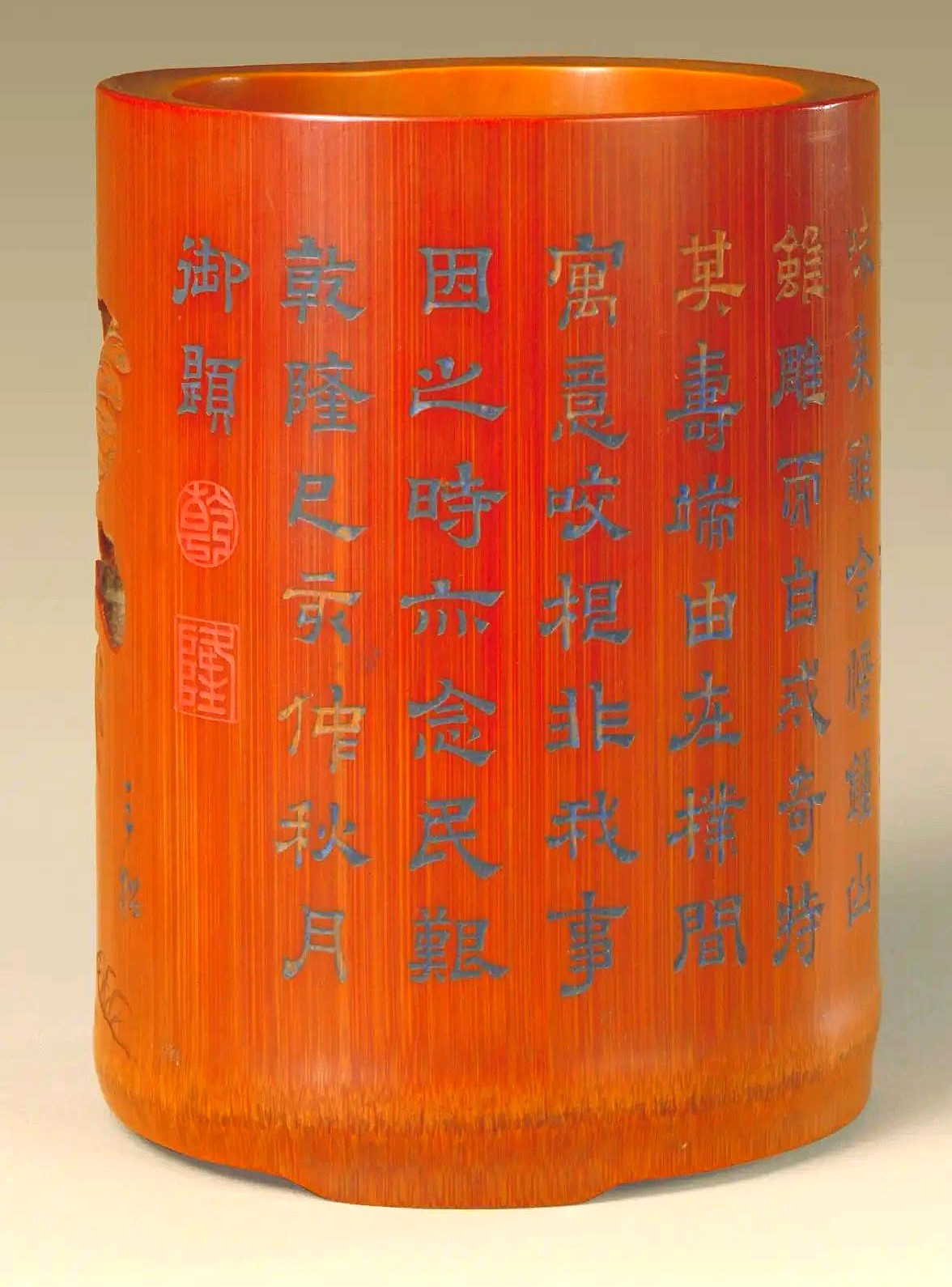
The same piece, back: Qianlong’s poem in blue-filled clerical script
From the published plate, the lines “Its meaning, gnawing roots, is none of my concern; and so, in time, I think of the people’s hardship” can be made out (read from the image; the remaining lines remain to be checked). The reference to “gnawing roots” most likely draws on the old saying “One who can chew vegetable roots can accomplish anything”: what the emperor saw in a single cabbage was not a scholar’s plaything but the hardship of ordinary people. The cabbage here is therefore more than an elegant motif; it carries associations of purity and frugality.
3. Subject and composition: from a head of cabbage to a small world
Both pieces take the cabbage as their subject. In each, the plant stands at the centre of the wall, with large leaves folding around the heart, forming the deepest and most sculptural focus of the whole vessel.
The Beijing piece is built around a single head of spring cabbage and is simply composed: one plant, one mantis and a few tufts of grass. The picture is open and airy; the back is a plain, uncarved surface onto which Qianlong’s poem was later cut and filled in blue, so that picture and text answer each other.
The Yun Museum piece is fuller. The leaves spread to left and right; a large leaf on the left curls around the bamboo wall and is pierced with an opening, while the leaf on the right is carved with worm-eaten holes, a lifelike touch of everyday damage. Another small insect hides at the heart of the cabbage, peering out between the leaves. Around the vessel, grass and small flowers are added to both sides and beneath the plant, and on the side a grass insect with long, slender antennae rests among the grass, with the signature “Sansong” carved just below it. Turning the brush pot, the eye passes from cabbage to grass to insect in sequence.
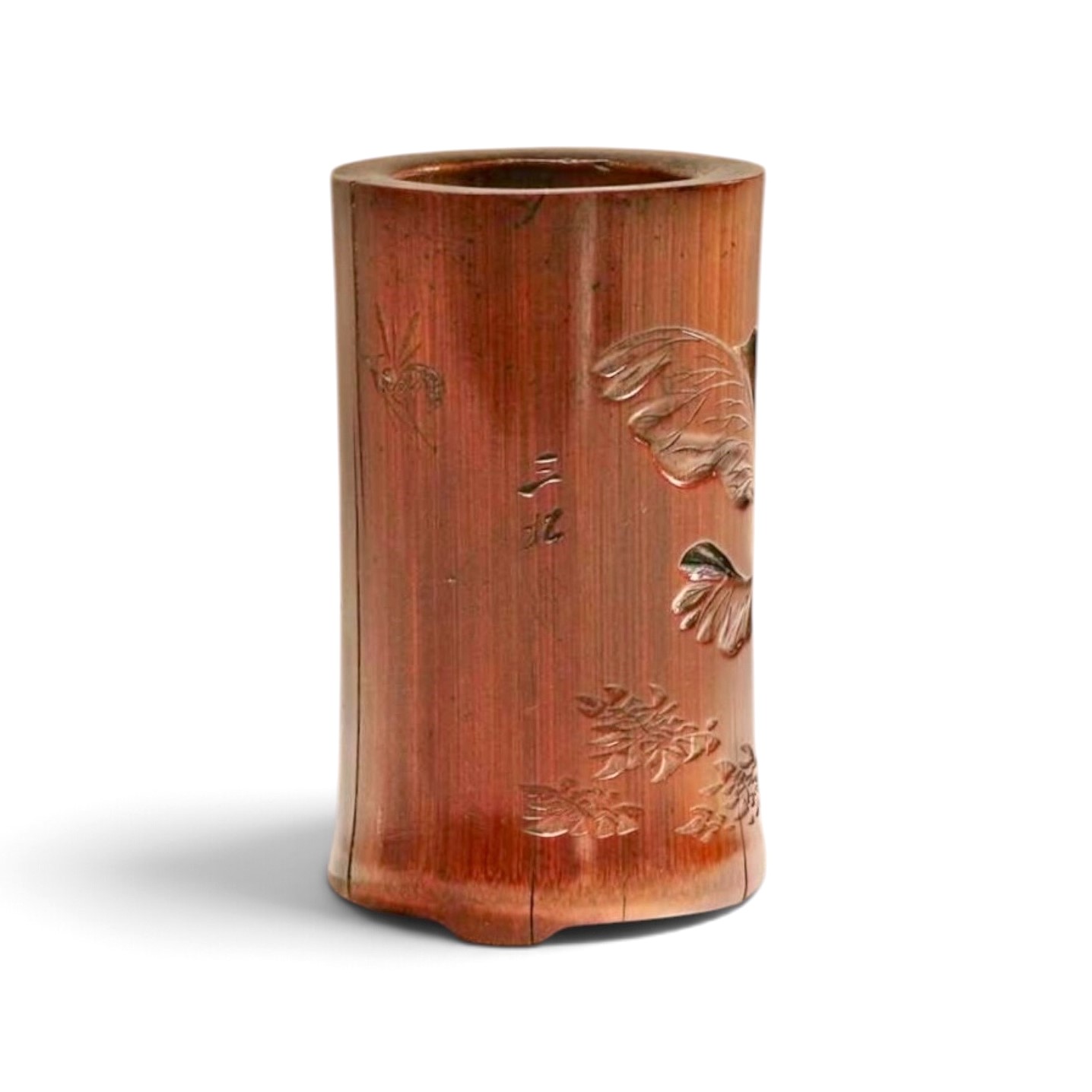
Yun Museum piece, side: grass insect and the “Sansong” signature
4. Comparison of technique
| Point of comparison | Yun Museum piece | Palace Museum, Beijing, “Spring Cabbage” |
| Form | Open, flat mouth; short feet cut at the base | Cylindrical, on three short feet |
| Main relief | High-relief leaves with curling edges; heart deeply undercut | High-relief leaves; ground cut away most deeply at the heart |
| Openwork | Openings at the heart and in the left leaf; worm-eaten holes in the right leaf | Delicate, pierced-looking heart |
| Leaf veins | Incised veins, well-spaced and crisp | Incised veins, fine and flowing, like brush lines |
| Insects | A small insect at the heart; a grass insect on the side | A mantis resting on a leaf |
| Ground and grasses | Grasses and small flowers at the base and sides in low relief and incision | A few tufts of grass beside the cabbage |
| Inscription | “Sansong” with “Zhu” beneath; no poem | Qianlong’s poem on the back in blue-filled clerical script, with the “Sansong” signature |
| Patina and colour | Deep jujube red, thick patina | Brownish red tending to orange; bright tone in the plate |
In summary: the two pieces follow the same line of thought: high relief for the main form, the heart cut deepest, grasses lightly incised, and an insect to bring the scene to life. The differences lie in a fuller composition and lively naturalistic details such as worm holes in the Yun Museum piece, against the open, economical composition of the Beijing piece, which also carries an imperial inscription and so a court character. In craftsmanship the two are on a par, each excelling in its own way. As for colour, it depends on patina, storage and photographic lighting, and should not be used alone as grounds for dating or authentication.
5. Detailed comparison
To examine the carving more closely, five areas were cropped from the plates: the heart, a leaf, the grasses, the foot and the signature. The Yun Museum piece is at the left (or top) and the Palace Museum “Spring Cabbage” at the right (or bottom). (The crops are enlarged at different scales and are for comparing carving only, not actual size.)
(1) The heart: ground cut away deeply
Yun Museum piece
Palace Museum, Beijing
In both pieces the heart of the cabbage is where the ground is cut most deeply. In the Yun Museum piece the leaves unfold layer upon layer from within, with a small insect lying at the centre, its eyes and head clearly defined; in the Beijing piece large leaves embrace the heart, and the inner leaves, finely veined, are undercut right down to the bottom. The approach is the same and the craftsmanship equally fine: the Yun piece is layered and full of life, while the Beijing piece is calm and weighty.
(2) The leaves: veins and edges
Yun Museum piece
Palace Museum, Beijing
In both, the veins are incised, fanning out feather-like from the midrib, with the edges of the leaves gently curling. The Yun Museum leaf has rounded worm-eaten holes and a damaged tip, giving a feeling of drawing from life; in the Beijing leaf the veins are laid out densely, with a deep, assured knife stroke, and the leaf surface is intact, with a clear wavelike undulation. Each has its strengths and shows the same skill.
(3) Grasses and ground
Yun Museum piece: grasses and small flowers on the lower wall
Palace Museum, Beijing: grasses and small flowers beside the cabbage
In both pieces the grasses are set down lightly in low relief and fine incision so as not to compete with the main subject. In the Yun Museum piece the blades are pointed and cut with a brisk, firm stroke, and a crack in the bamboo runs through the grass on the left; in the Beijing piece, slender incised lines draw the blades and small flowers like a sketch in loose brushwork.
(4) The foot
Yun Museum piece: short foot
Palace Museum, Beijing: short foot
In both, the foot is made by cutting a curved notch into the lower edge of the bamboo wall to leave short feet, without adding a separate base and keeping the natural structure of the bamboo; the method is the same. The Yun Museum foot is softly rounded, and its cracks and patina record its age; the Beijing foot has a smooth, polished edge. Each has its own charm.
(5) The signature: “Sansong” and “Zhu”
Yun Museum piece
Palace Museum, Beijing
Both pieces are signed “Sansong”, but in different manners: on the Yun Museum piece the characters are large and cut deeply with a visible knife edge, with no colour fill; on the Beijing piece they are small, incised and filled in blue, with Qianlong’s inscription in blue-filled clerical script on the back. In addition, the Yun Museum piece carries the character “Zhu” beneath “Sansong”, in outline incision: the maker’s family name, forming a “Sansong” and “Zhu” signature. In the plates and records seen, the two Beijing pieces carry only “Sansong” (the “Court Ladies” brush pot also bears a dated inscription, “Made by Sansong in the autumn of the jiayin year of Wanli”), with no separate “Zhu”. The differences in size, technique and colour-filling of the signatures show that the signature alone cannot be relied upon; form, carving style and provenance must be weighed together.
Summary of the detailed comparison: in the deep undercutting of the heart, the incised veins, the light carving of the grasses and the making of the feet, the two pieces follow a similar path. The differences are that the Yun Museum piece favours the charm of drawing from life (worm holes, a small insect), while the Beijing piece has a calm, open and deep character, and the signatures are carved differently; the two are equal in craftsmanship, and it is hard to say which is finer. Taken together, the Yun Museum piece and the Beijing “Spring Cabbage” share the same subject and the same line of carving, but it is still wiser to call the Yun piece “attributed to Zhu Sansong”.
6. A reference for the signature: the “Court Ladies” brush pot in Beijing
The Palace Museum, Beijing, also holds a bamboo brush pot with court ladies signed Zhu Sansong, likewise from the Qing court collection: 14.6 cm high, with a mouth diameter of 7.8 cm (the court collection records also give a foot diameter of 7.7 cm). It is brownish red, on three short feet, and its wall is carved with pine, rock, orchid and a lady: she wears a hooded cap and holds an orchid, standing against a rock wall from which an old pine grows; on a stone platform beneath the pine are a cup and an inkstone. On the rock wall, Qianlong’s poem of the dingyou year (1777) is incised in clerical script, and on the other side is the inscription “Made by Sansong in the autumn of the jiayin year of Wanli”, the jiayin year being the 42nd year of Wanli (1614).
This piece is useful here in two ways. First, its dated inscription offers an example of how the “Sansong” signature was written, and like “Spring Cabbage” it is a small cylindrical brush pot on three short feet, about 14 cm high. Second, Qianlong composed poems for brush pots signed Zhu Sansong in both 1777 and 1779, showing the esteem in which the court held works by Sansong. On the Yun Museum piece the two characters “Sansong” are cut deep and bold, in a brush manner close to running-cursive script, with the character “Zhu” in outline incision beneath. Naming the maker and then adding his family name is not seen in the plates and records of the two Beijing pieces, and is a distinctive feature of the Yun Museum signature.
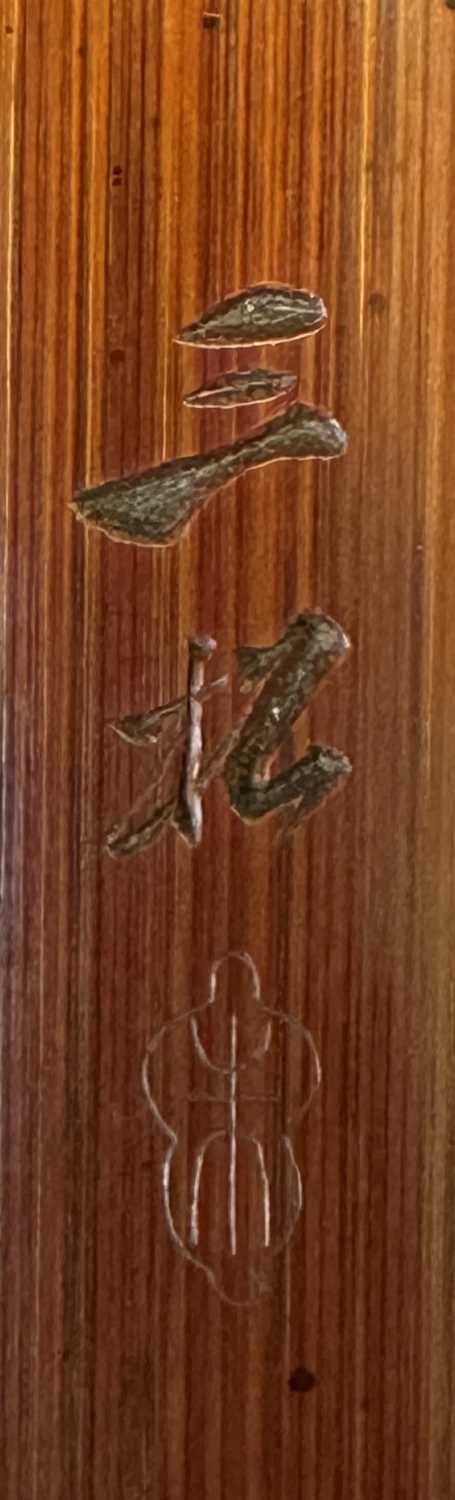
Close-up of the “Sansong” signature and the “Zhu” beneath it, Yun Museum piece
7. On the maker and attribution: a note of caution
Zhu Zhizheng, courtesy name Shuzi, art name Sansong, was a native of Jiading in Jiangsu and came from a family of bamboo carvers. With his grandfather Zhu He (Songlin) and his father Zhu Ying (Xiaosong), he is known as one of the “Three Zhus of Jiading”, and was active in the Wanli period (c. 1573–1619). Pieces signed “Sansong” survive in large numbers, and the National Palace Museum in Taipei, cataloguing its own “Sansong” brush pot with ladies, notes that it has certain features of Zhu Zhizheng’s work but may also be by a later hand using his name. In other words, a “Sansong” signature does not in itself prove that a piece is by his hand; it must be considered together with form, carving technique, composition and patina.
For this reason the Yun Museum piece is described here as “attributed to Zhu Sansong”. It does share a good deal with the Beijing “Spring Cabbage” in subject, in the deep cutting of the heart and in the use of a small insect, enough to place it within the Sansong line of bamboo carving. Its signature adds the character “Zhu” beneath “Sansong”, giving both name and family name, which deserves attention; but a signature may have been added later, and the piece has no imperial inscription or court provenance, and shows its own character in composition and in the treatment of leaf veins. To establish it as the work of Zhu Sansong himself would require more comparison with surviving pieces and scientific testing.
8. Conclusion
Cabbages and insects are a familiar sight on scholars’ desks of the Ming and Qing, valued for their purity, frugality and vitality. The Yun Museum brush pot combines high relief, openwork and incision to carve the curling of a cabbage, its worm-eaten leaves and a resting insect with life and charm. Set beside the Beijing “Spring Cabbage”, inscribed by Qianlong, one is open and economical, the other full and lively, equally accomplished and each excelling in its own way, and together they offer a rare pair for understanding late-Ming Jiading bamboo carving, and in particular the “Sansong” line.
References
Palace Museum, Beijing: Bamboo brush pot with a lady, by Zhu Sansong (inv. 故00121114); “Palace furnishings and imperial collections: bamboo carvings from the Qing court” (dimensions, form and inscription of the “Spring Cabbage” brush pot); “36 brush pots from the Qing court collection”; National Palace Museum, Taipei, collection database: “Bamboo brush pot with ladies” and “Bamboo brush pot with a lady peeping at a letter”.