

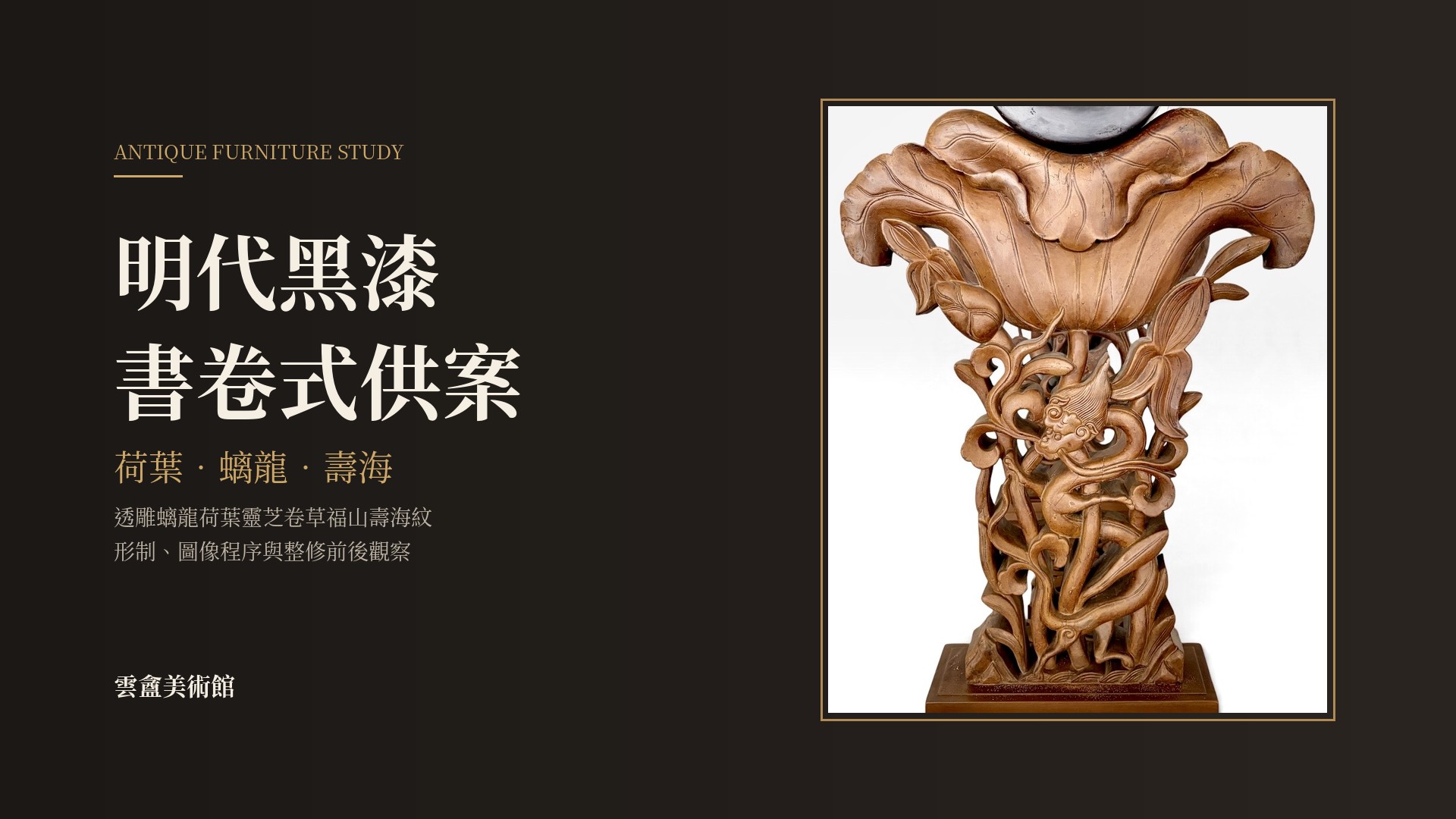
ANTIQUE FURNITURE STUDY
Form, Iconographic Program, and Observations Before and After Restoration
Dimensions | L 248 cm × W 64 cm × H 90 cm
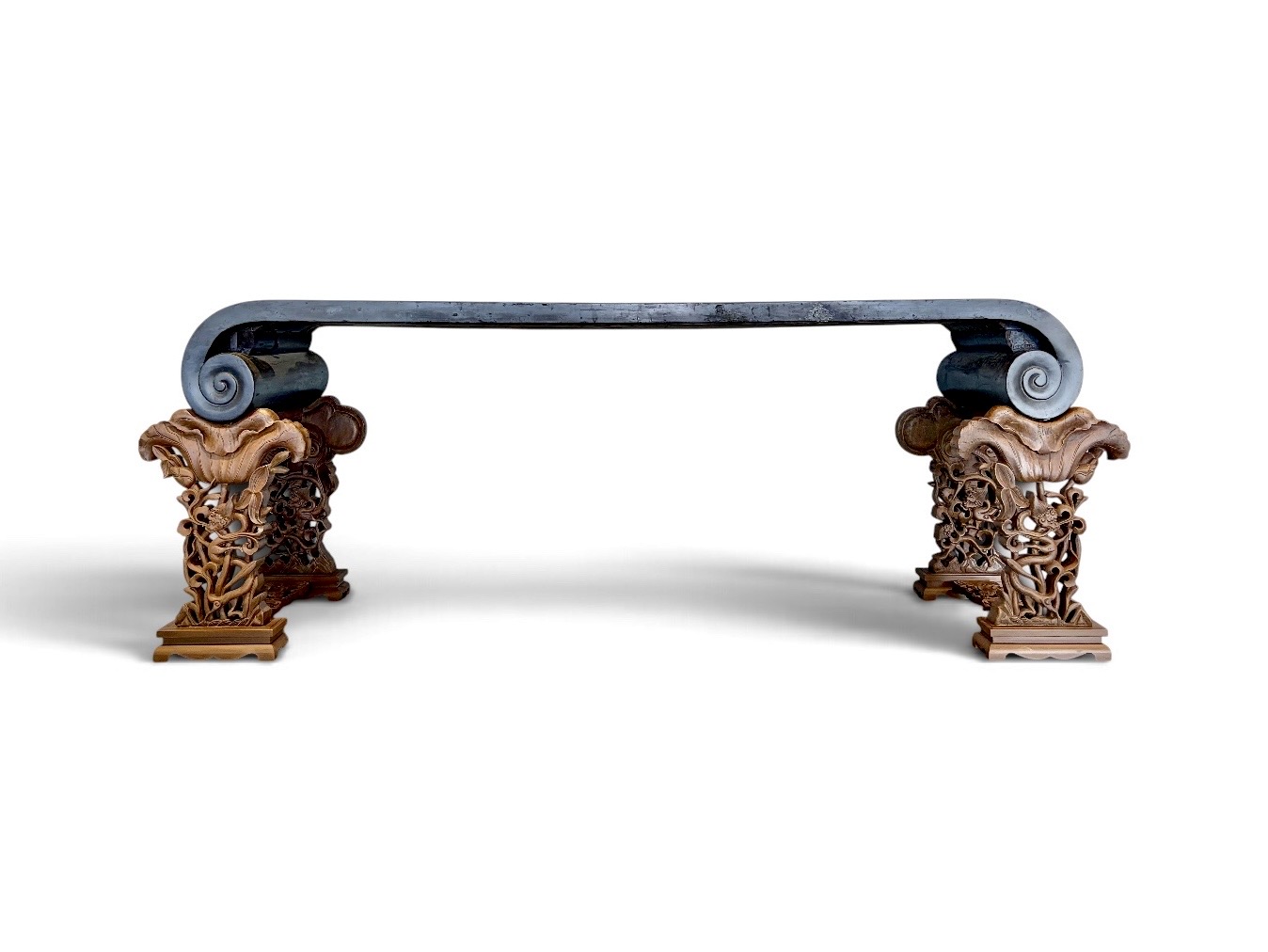
“A single scroll bears the lineage of letters, with chi dragons roaming between its folds; a lotus leaf in front, the Sea of Longevity below, lingzhi behind, the Mountain of Fortune at its back.”
Abstract
Drawing on the object’s title, dimensions, and photographs taken before and after restoration, all provided by the museum, this paper offers a preliminary examination of the form, ornament, iconographic program, and condition of a large black-lacquer scroll-form offering table. The table measures 248 cm in length, 64 cm in width, and 90 cm in height. Its upper part is a broad, horizontal scroll-shaped top whose two ends curl downward; below it, four legs are carved in deep relief, openwork, and pierced carving into chi dragons, scrolling foliage, flowers and leaves, and mountain-and-sea imagery. Its most distinctive feature is that the front and back do not repeat the same pattern: on the front, a lotus leaf supports the scroll, with a chi dragon and the “Sea of Longevity” (shou hai) beneath; on the back, a lingzhi fungus supports the scroll, with a chi dragon and the “Mountain of Fortune” (fu shan) beneath. Together they compose the blessing theme of “Mountain of Fortune and Sea of Longevity.” Photographs taken before restoration show pronounced crazing, abrasion, and local losses in the black lacquer of the top and scroll ends, as well as dust, a dulled tone on the carved wood, and wear to the base; photographs taken after restoration show a more upright structure and improved legibility of the carved layers and wood grain, while the mottling, cracks, and traces of use on the tabletop are still retained.
This paper also stresses that photographs alone are not sufficient for independent dating or material identification. The “Ming dynasty” attribution therefore follows the designation recorded in the museum’s collection; the focus here is on artistic form, iconographic meaning, and a visual comparison before and after restoration.
Keywords: Ming dynasty furnitureoffering tableblack lacquerscroll formchi dragonlotus leaflingzhiMountain of Fortune and Sea of Longevityopenwork carvingantique furniture restoration
I. Object Data and Method
| Object | Ming Dynasty Black-Lacquer Scroll-Form Offering Table with Openwork Chi Dragons, Lotus Leaf, Lingzhi, Scrolling Foliage, and “Mountain of Fortune and Sea of Longevity” Motifs |
|---|---|
| Dimensions | L 248 cm; W 64 cm; H 90 cm |
| Main techniques | Woodwork, black lacquer, deep carving, openwork / pierced carving |
| Main motifs | Scroll, chi dragon, lotus leaf, lingzhi, scrolling foliage, Mountain of Fortune, Sea of Longevity |
| Image materials | Photographs from before restoration and multiple-angle photographs after restoration, all provided by the museum |
| Limitations | Not examined in person; no scientific testing of the wood, lacquer layers, or date; this paper offers no independent authentication conclusion |
As to method, this paper first identifies the form of the object through its overall scale and outline, then compares the decoration of the four legs using photographs of the front, back, and sides, and finally uses the photographs from before and after restoration to observe changes in surface condition, damage, wood color, and the legibility of the carving. Because no restoration work records are available, the paper describes the restoration only as “results directly visible in the photographs” and does not presume treatment steps unsupported by images or documents.
II. The Scroll-Form Top: Function Joined with Scholarly Spirit
What first draws the eye on this table is not the dense carving of the legs but the extremely restrained horizontal scroll above. The top is 248 cm long, flat and thick in its main body; at left and right the ends fold downward and then roll inward, forming concentric spirals at the scroll heads. This outline turns a table originally meant to bear offerings into a symbolic image of an “unrolled scroll.” In terms of pictorial language, a scroll naturally evokes reading, literary expression, learning, and cultural lineage; when it is enlarged into the principal silhouette of the entire piece, the offering table gains, beyond ritual and display, a more scholarly and refined character.
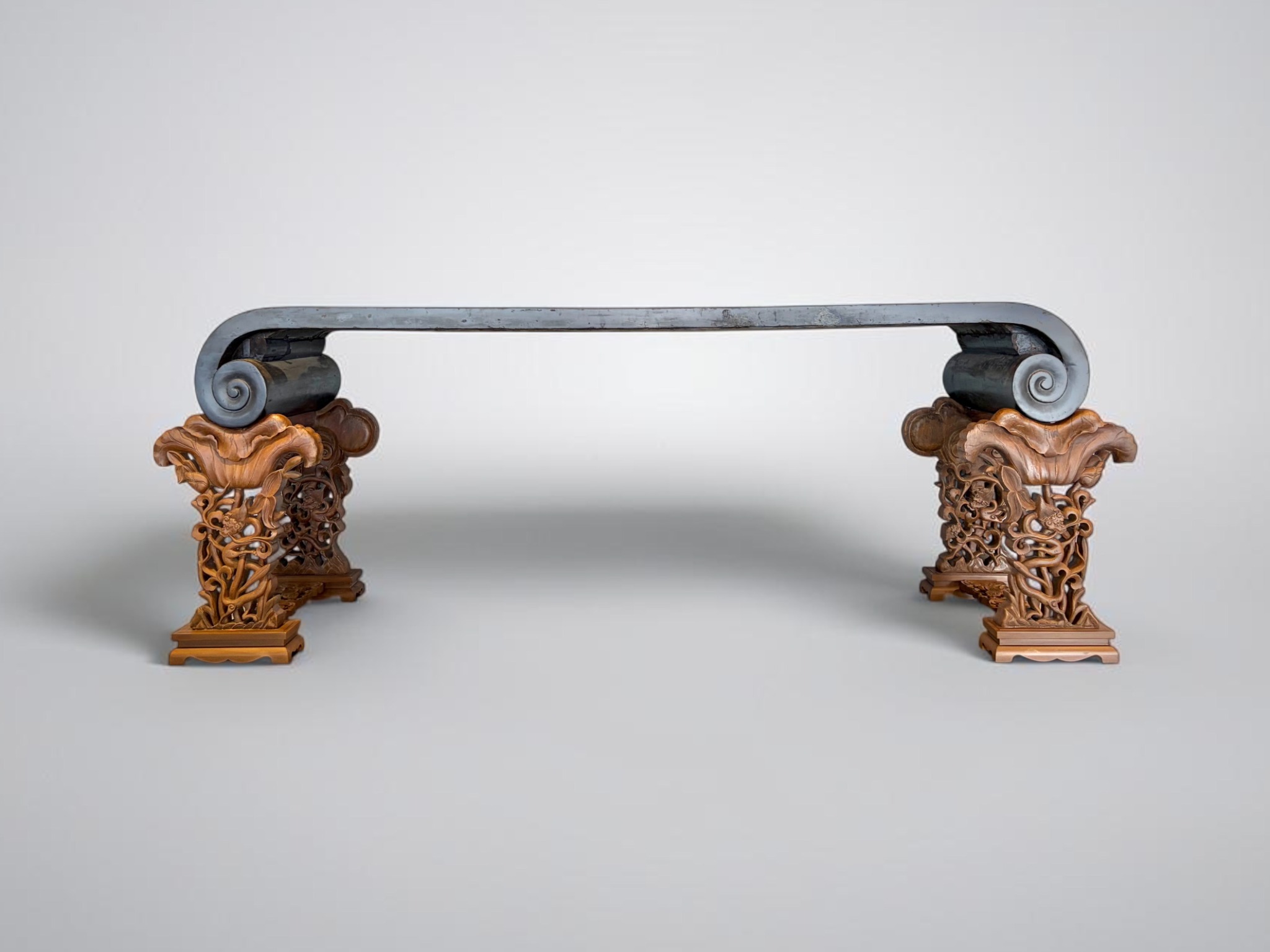
The top is dominated visually by black lacquer throughout. In the post-restoration photographs, the lacquer is not the mirror-bright finish of a new piece but an aged mix of gray-black, silvery gray, and dark brown, with abrasion, cracks, and traces of the wood core visible at edges and turns. This surface condition matters for understanding the object’s sense of age: it sets the large black expanse above against the warm brown carving below in material, tone, and solid-versus-void contrast, rather than simply pursuing splendor.
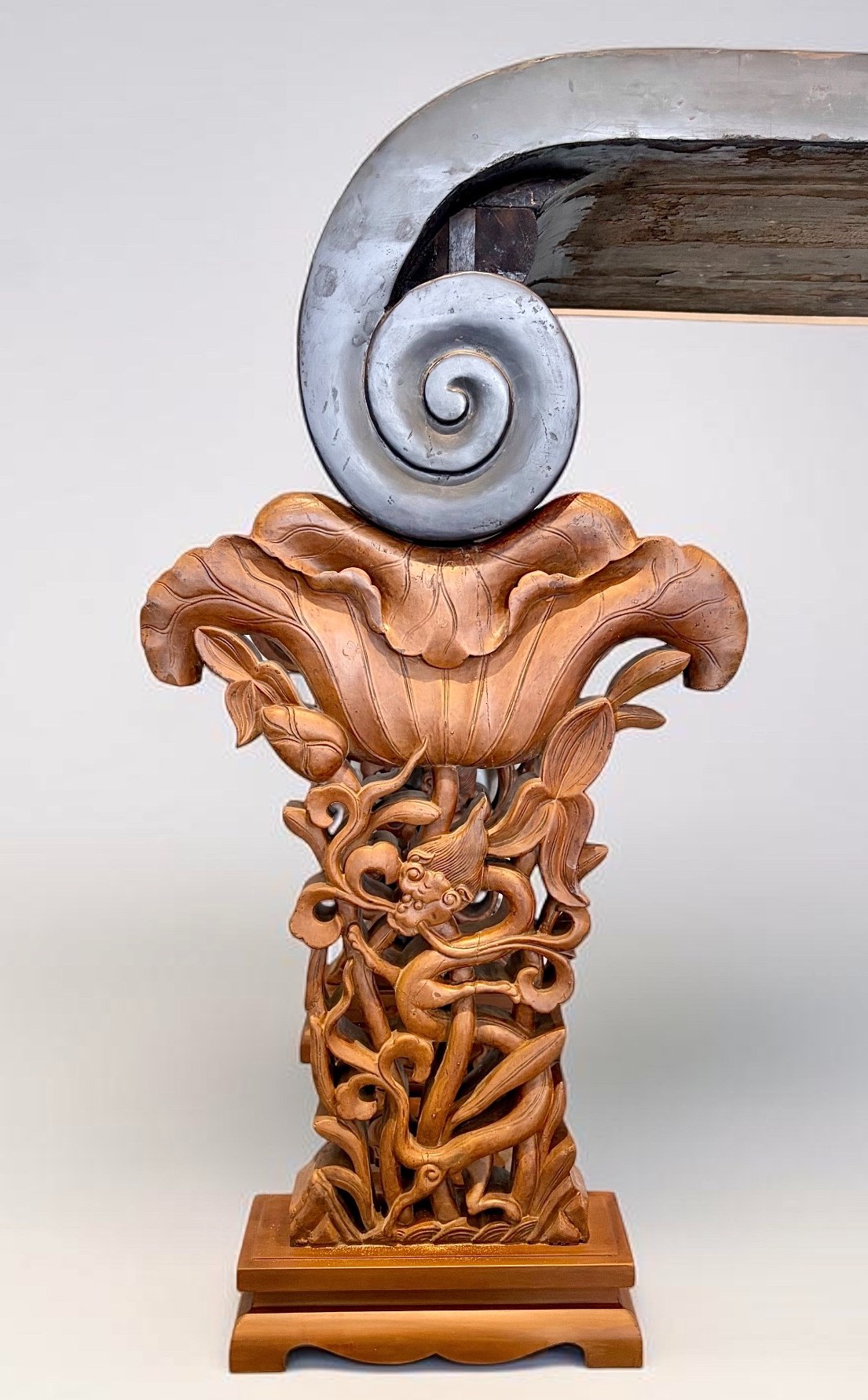
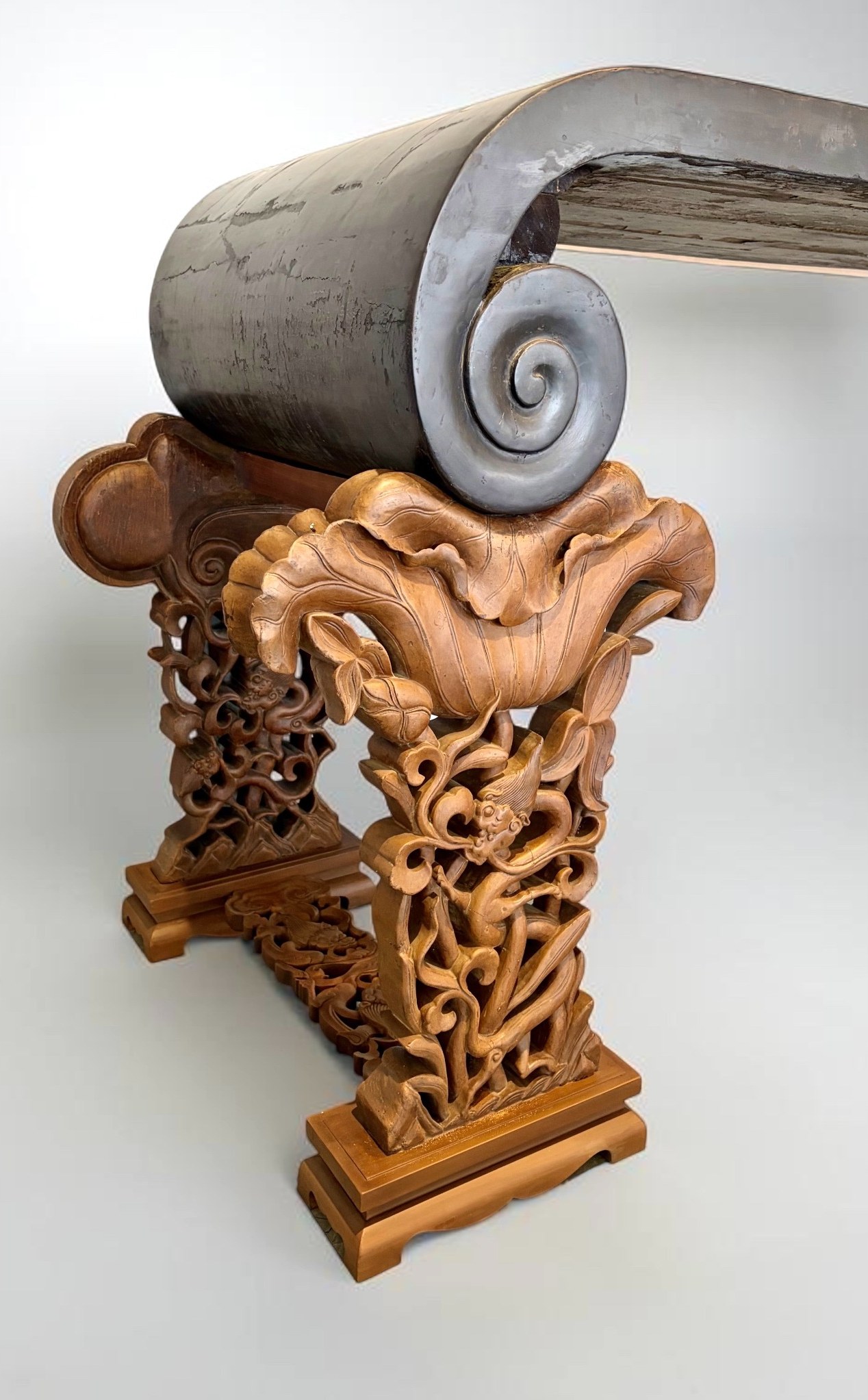
The scroll ends do not press directly on the upright legs; instead, they pass through large leaf-shaped brackets as a transition: a spreading lotus leaf on the front and a lingzhi-shaped element on the back. This hierarchy—geometric scroll head above, plant-form support in the middle, auspicious beasts and scrolling foliage below—softens the weight of the massive top visually and makes the structural joint itself part of the imagery.
III. Two Iconographic Programs, Front and Back: Lotus Leaf with Sea of Longevity, Lingzhi with Mountain of Fortune
(1) Front: Lotus Leaf, Chi Dragon, and Sea of Longevity
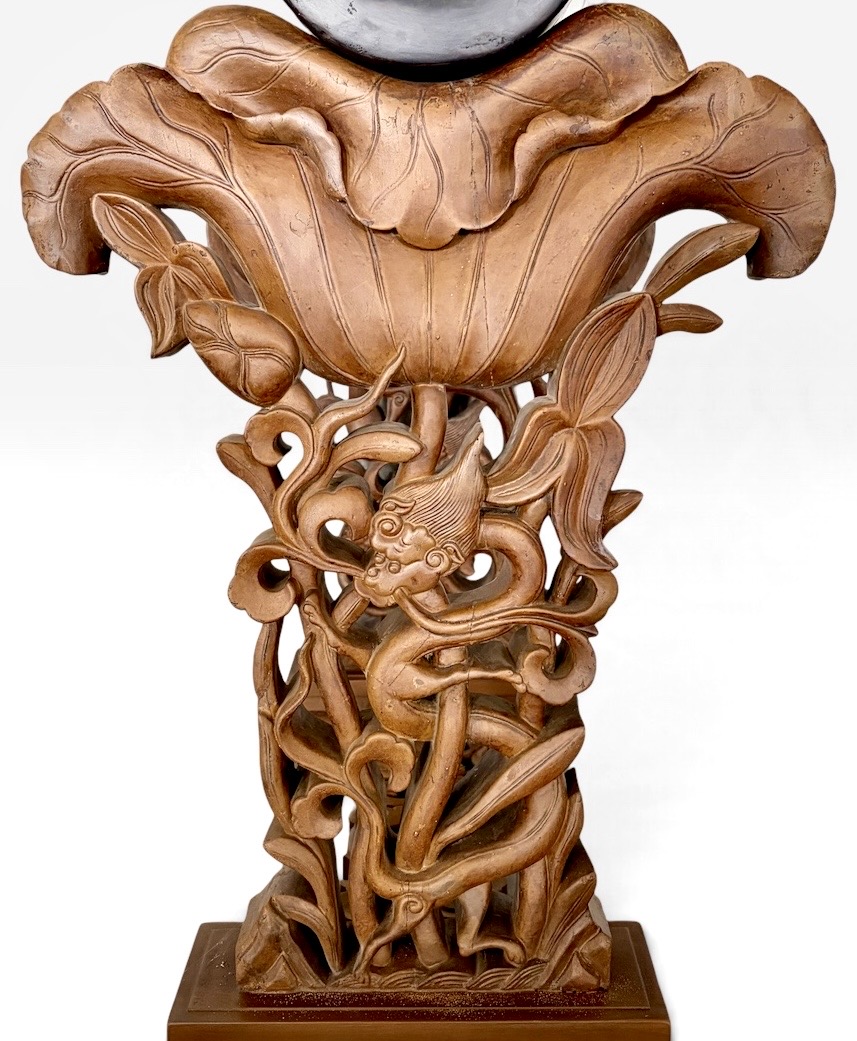
The most striking supporting ornament on the front is the lotus leaf. Its broad blade has rolled-back edges, and its central veins and layered undulations make it look both like a bearing dish and like a plant in the act of unfurling. Beneath the leaf, the body of a chi dragon threads among scrolling foliage and flowers; its slender, curving trunk intertwines with plant tendrils, so that at first glance the viewer can hardly tell where “beast” ends and “plant” begins, producing a highly continuous sense of motion.
In the Chinese decorative tradition, the lotus flower and leaf often carry meanings of elegance, purity, and good fortune. The Metropolitan Museum of Art likewise notes that after the lotus entered Chinese art as a symbol of purity, it gradually became an extremely common decorative motif.[1] On this offering table, the lotus leaf is not merely an independent symbol; it directly supports the scroll head, and so serves both a pictorial and a structural function.
According to the composition as identified by the museum, the area beneath the front chi dragon is formed of water-wave and sea-surge imagery that makes up the “Sea of Longevity.” Read this way, the lotus leaf, chi dragon, and Sea of Longevity constitute a single front program from top to bottom: an elegant plant, a lively auspicious beast, and boundless water together point to good fortune and long life.
(2) Back: Lingzhi, Chi Dragon, and Mountain of Fortune
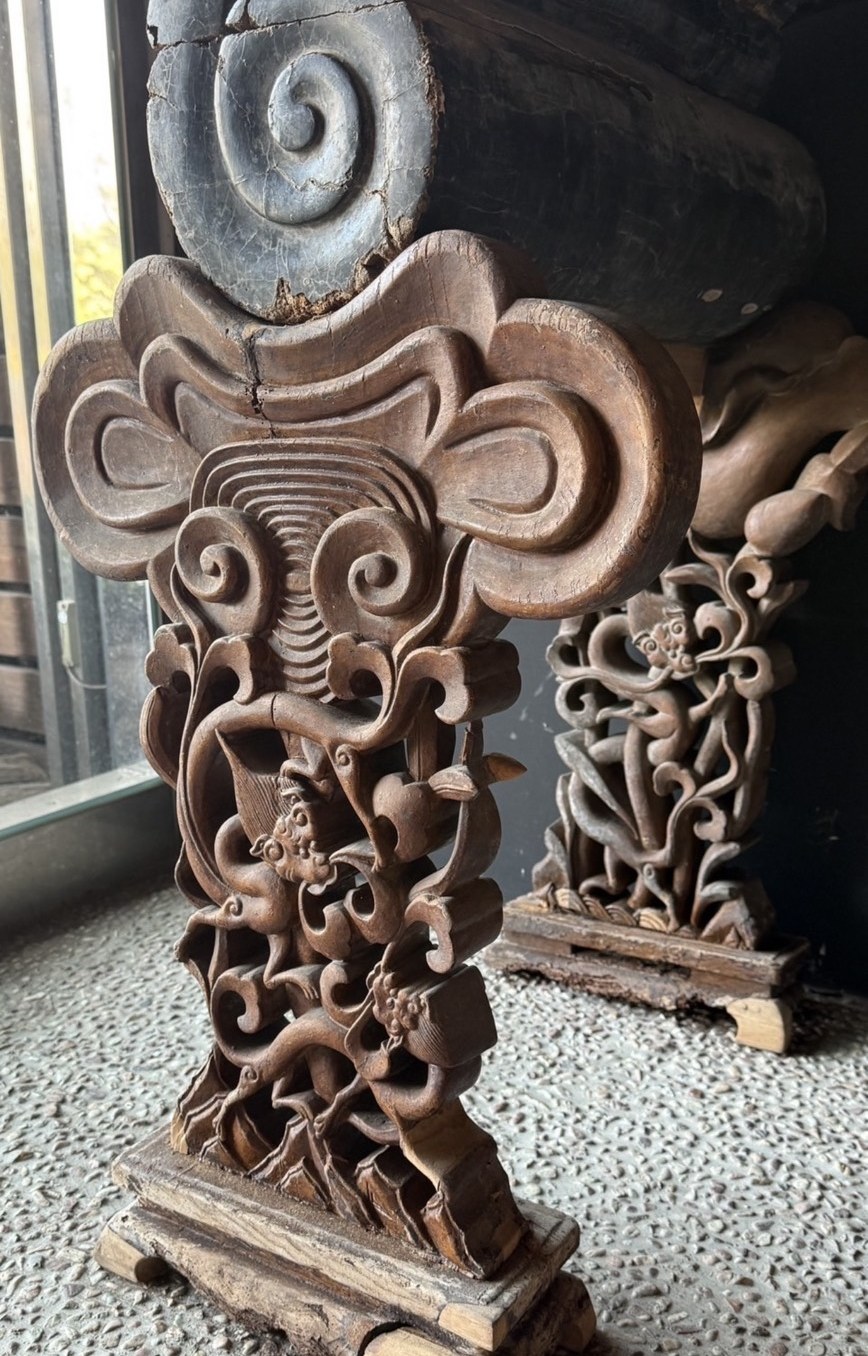
The back does not reuse the lotus leaf of the front but replaces it with a lingzhi-shaped bracket. The close-up photograph from before restoration is especially clear: the outline of the lingzhi opens in many lobes like ruyi cloud-heads, with layered lines in the center, echoing the curled head of the scroll. In Chinese auspicious imagery, lingzhi is closely tied to longevity; both the British Museum and the Metropolitan Museum of Art interpret the lingzhi motif as a “longevity fungus” or longevity symbol, and the imagery already has many examples in Ming art.[2][3]
Beneath the back chi dragon, according to the museum’s identification, is the “Mountain of Fortune.” Rocks pile in layers and rise upward, deliberately paired against the water waves of the front as mountain and sea. The front and back of the object are thus not mirror copies of one set of patterns but two different, complementary auspicious combinations: on the front, “lotus leaf—chi dragon—Sea of Longevity”; on the back, “lingzhi—chi dragon—Mountain of Fortune.”
| Front | Lotus leaf + Chi dragon + Sea of Longevity |
|---|---|
| Back | Lingzhi + Chi dragon + Mountain of Fortune |
IV. “Mountain of Fortune and Sea of Longevity”: Meaning Completed by the Front–Back Relationship
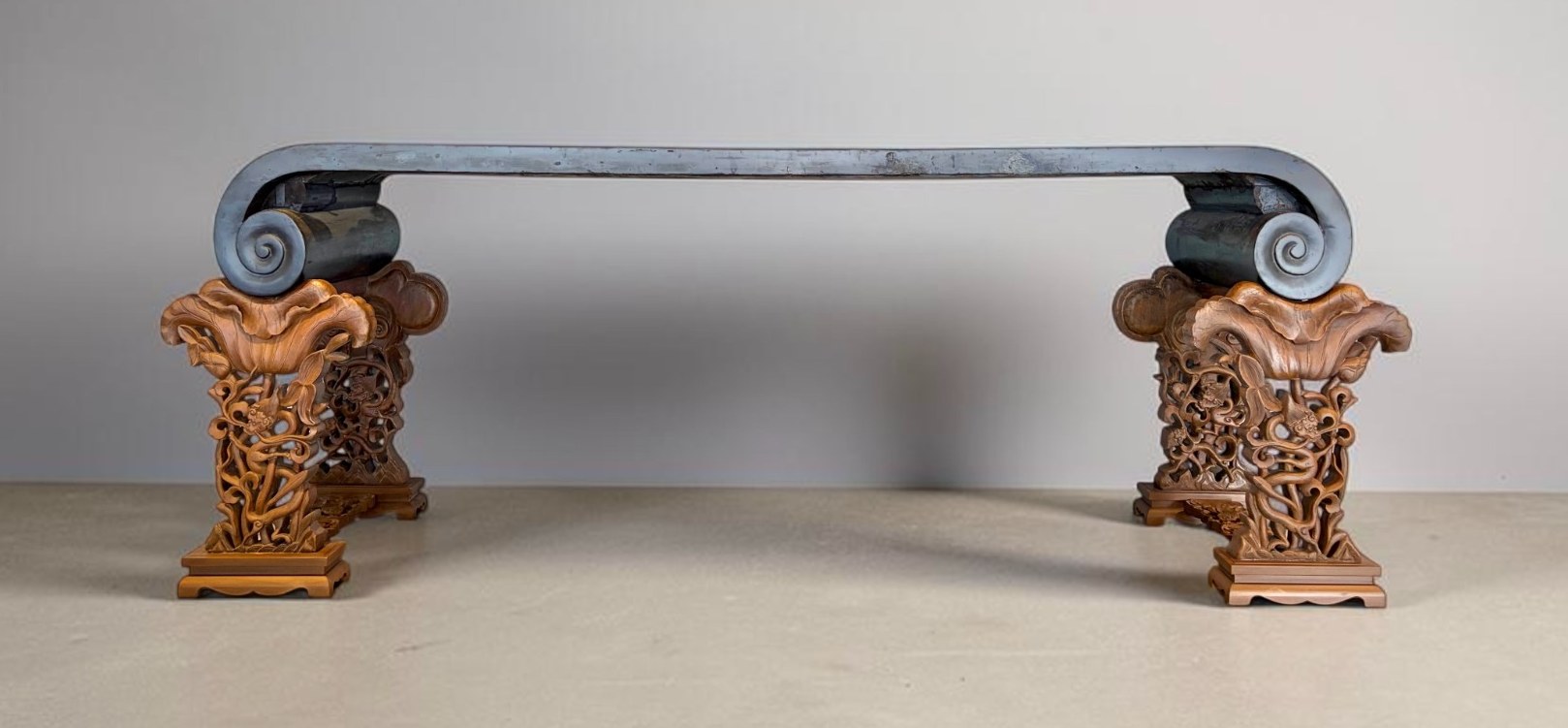
The brilliance of “Mountain of Fortune and Sea of Longevity” lies in the fact that it is not carved as a single seal-like motif that can be read all at once from one side, but is divided between the front and back of the object: the “Sea of Longevity” appears on the front and the “Mountain of Fortune” on the back. Viewers must walk around the entire piece to recombine mountain and sea into one complete blessing. This way of reading gives the offering table a certain spatial narrative: the auspicious meaning is not applied flatly to the surface of the object but emerges gradually as the viewer moves.
Going further, the lotus leaf and lingzhi form a second layer of correspondence. The lotus leans toward elegance, purity, and growth; lingzhi is directly tied to prolonged life and longevity. When they are placed respectively above the Sea of Longevity and the Mountain of Fortune, the grand natural imagery of “mountain and sea” and the plant imagery of “lotus and lingzhi” nest within one another. The chi dragon and scrolling foliage act like a lifeline running through both sides: beast and tendril interweave, giving the whole ornamental scheme a sense of unbroken, ever-renewing movement.
The Metropolitan Museum of Art’s study of longevity imagery in Chinese art points out that longevity motifs are often combined with other auspicious images such as fortune, emolument, and wealth to form a broader context of good omens.[4] Seen in this light, the combination of Mountain of Fortune, Sea of Longevity, lingzhi, and lotus leaf on this object is not merely a single “longevity” theme but places fortune, longevity, elegance, and cultural lineage together on one large piece of display furniture.
V. Openwork Carving and the Sculptural Effect of “Solid Above, Open Below”
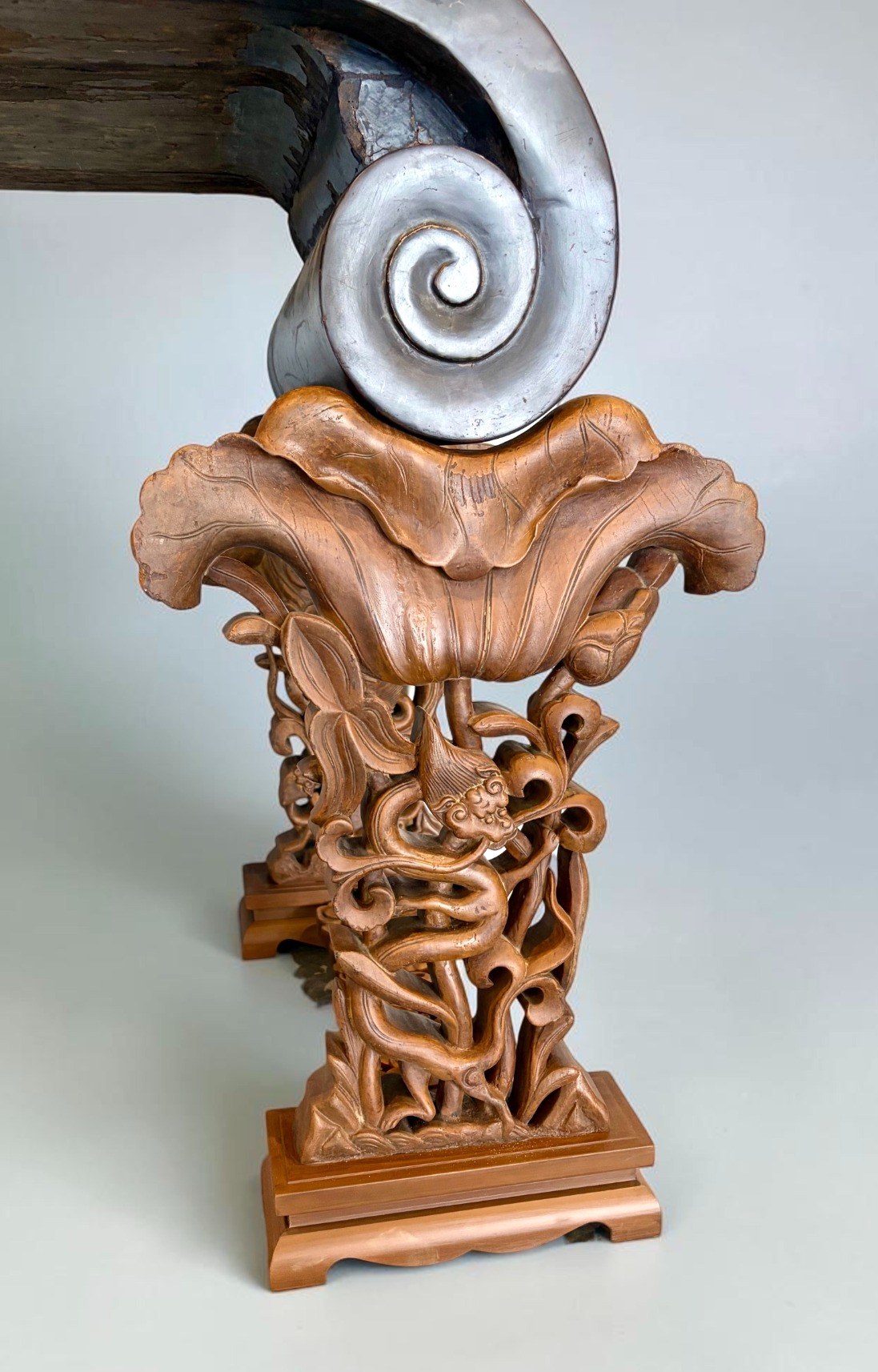
In contrast to the unified, weighty black-lacquer top, the four legs below shape their forms almost entirely through “void.” The carver made extensive use of openwork and deep carving, creating gaps among branches, dragon body, and leaves that the eye can pass through, while using different thicknesses and front-to-back positions to build layers. The legs thus have both the order of a flat pattern and a three-dimensionality close to carving in the round.
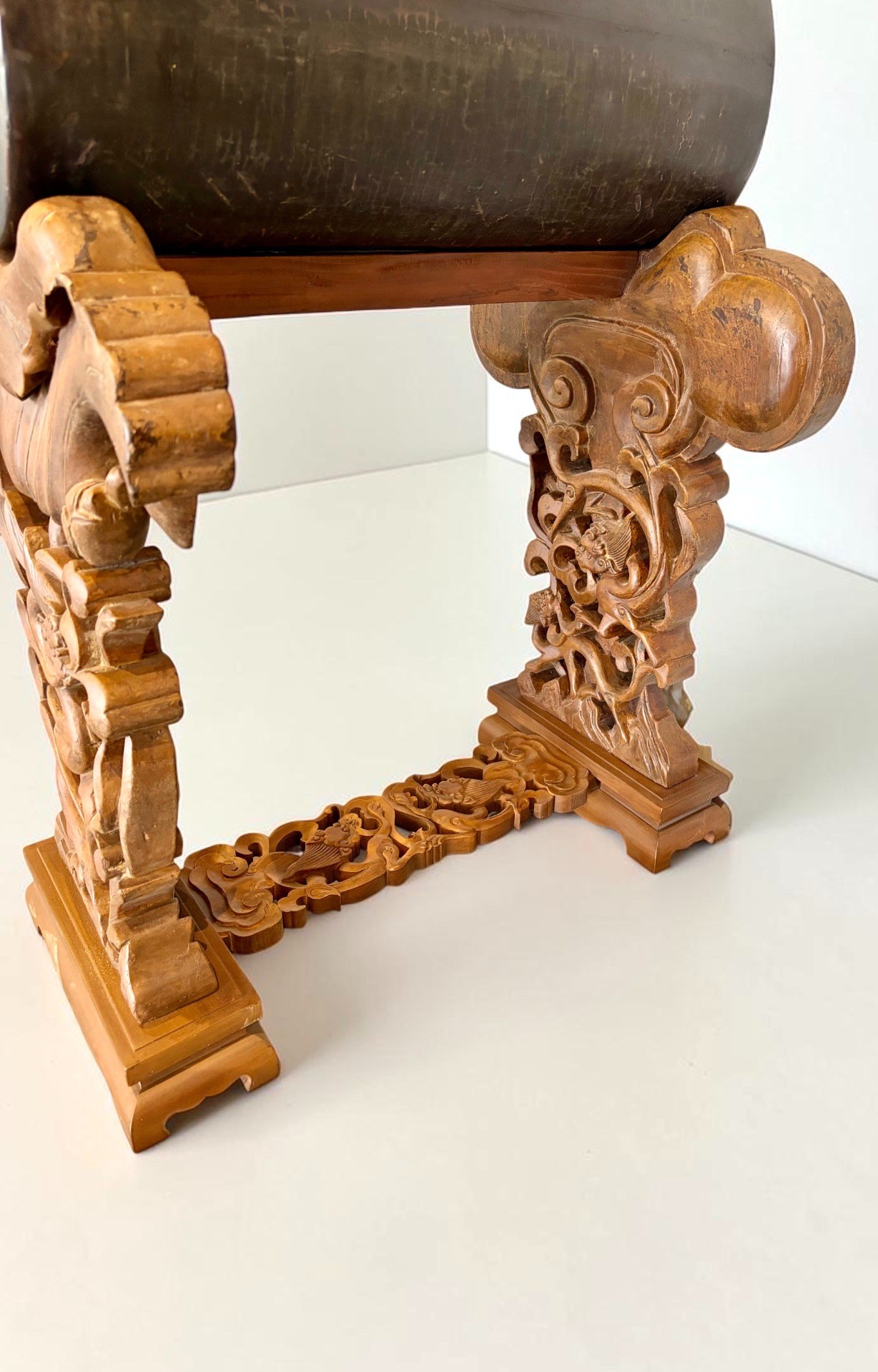
As the photographs show, the carving on the legs is not a single thin board pierced through but has considerable front-to-back depth: outer branches and leaves extend forward, a chi dragon weaves through the middle layer, and inner layers retain further flowers, leaves, and supports. Between the legs, pierced stretchers are also visible, making the four legs correspond to each other structurally. Because the piece has not been examined in person, this paper makes no specific determination about the joinery, wood species, or the locations of replacements; judging from the images alone, however, such dense openwork on large furniture must balance visual transparency with load-bearing stability, showing that composition and structure had to be considered together at the time of making.
VI. Before Restoration: Aging, Damage, and Reduced Legibility of the Ornament
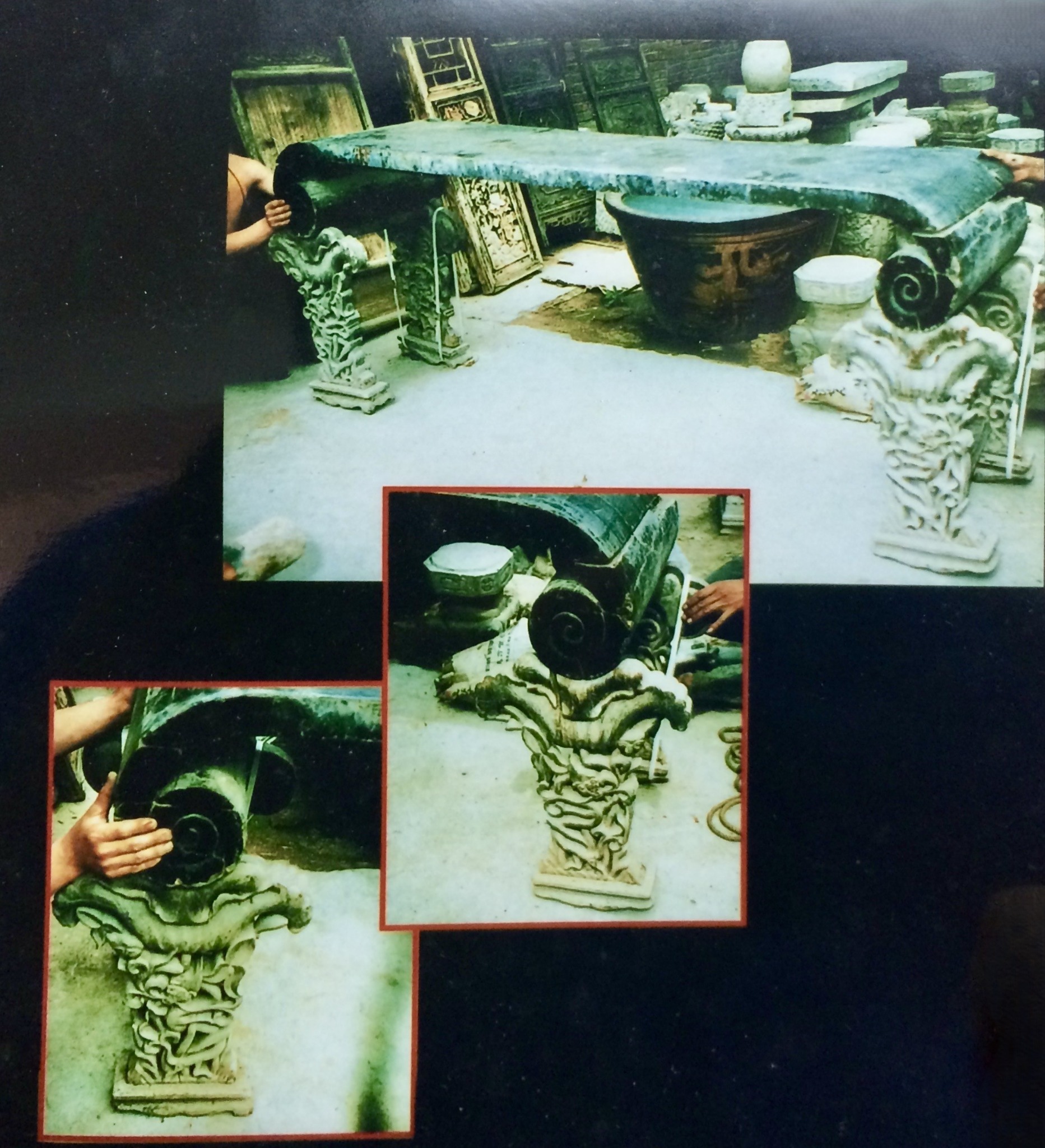
Although the earlier photographs are affected by the color cast of early photography and the on-site lighting, several aspects of the object’s condition can still be identified. First, the color of the black-lacquer top and scroll ends is extremely deep, with a grayish-green or hazy appearance in places; second, the end faces of the scroll show obvious splitting, transverse cracks, and edge losses, indicating that both wood core and lacquer layers had undergone long-term humidity cycling and mechanical stress.
In the old photographs the lower wood carving shows a dark brown, grayish brown, even dusty surface, making fine details such as the chi dragon’s face, the turns of the scrolling foliage, and the mountain-and-sea texture hard to read; the base and leg ends also show abrasion, accumulated dust, color differences, and local irregularities in the components. These conditions do not necessarily amount to “serious damage,” but they directly reduce the layering of the carving and the legibility of the imagery. On such an intricate openwork piece in particular, any dust, loosening, or cracking amplifies the visual muddiness.
VII. After Restoration: Structural Realignment and the Preservation of Historical Traces
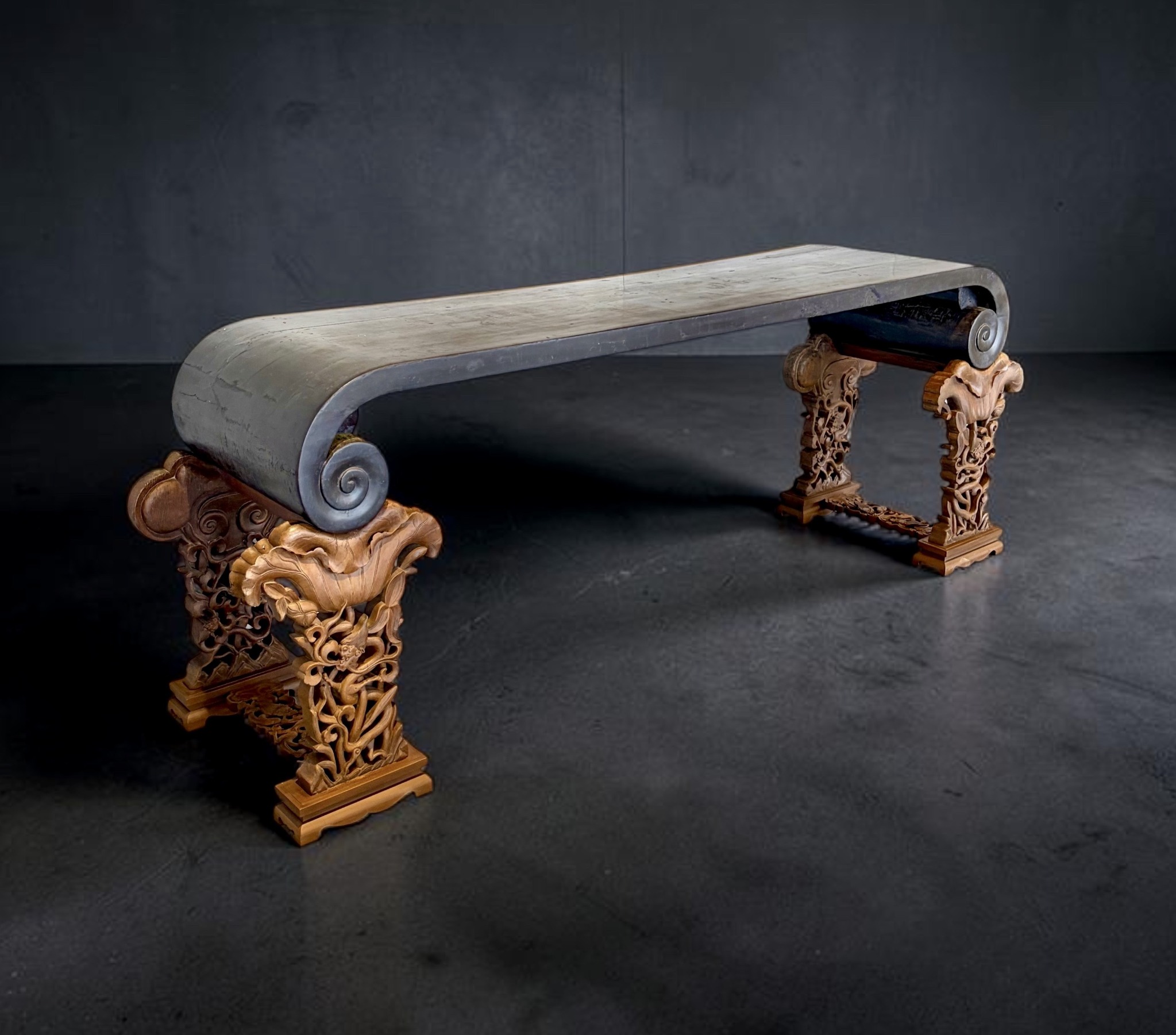
The most direct change in the post-restoration images is that the overall outline and details are clear again. The vertical relationship of the four legs is more upright, and the junctions between base and supporting elements are easier to make out; the surface of the carving has gone from dull to a warmer brown, and the lotus-leaf veins, lingzhi outline, chi dragon face, and turns of scrolling foliage are all markedly more legible.
It is worth noting that restoration did not visually turn the object into a like-new state. The black-lacquer top still shows uneven old color, scuffs, and local cracks; the end face of the scroll head likewise retains surface variation caused by time. In other words, at least judging from the photographs, the result of the restoration is closer to “making form, structure, and carving legible again” than to erasing every trace of age. For antique furniture, such old marks are themselves part of the historical information.
VIII. Before-and-After Comparison: From Object Condition Back to Artistic Form
The difference between the photographs before and after restoration should not be simplified as “old becoming new” or “dark becoming bright.” More important is that the object’s original design logic has become easier to see: the relationship between the scroll top and scroll heads, the front-and-back difference between lotus leaf and lingzhi, the chi dragon’s passage through the scrolling foliage, and the pairing of Mountain of Fortune and Sea of Longevity front to back have all re-entered the viewer’s field of vision thanks to improved surface clarity and structural stability.
On the other hand, the old photographs retain irreplaceable historical value. They preserve the surface color, damage, dust, and component condition before restoration, and they remind later researchers that the object seen today has undergone a round of conservation and repair, so any study of its date, craftsmanship, or materials should take its restoration history into account. If restoration work records, a list of replacement parts, and high-resolution detail photographs from before restoration can be obtained in the future, it will be possible to distinguish more accurately between original, earlier repair, and recent repair areas.
IX. Date and Authentication: Formal Study Is Not Proof of Date
This paper follows the “Ming dynasty” designation recorded in the museum’s collection, but a distinction must be drawn between two levels: the “collection designation” and “scholarly dating.” From the standpoint of art history, motifs such as the chi dragon, lotus, lingzhi, and scrolling foliage all have reliable parallels in Ming decorative art: the Metropolitan Museum of Art’s collection and exhibition materials include black-lacquer chi-dragon objects of the fourteenth and fifteenth centuries and a sixteenth-century textile combining lingzhi with the character for “longevity” (shou); the British Museum likewise holds Jiajing-period objects that use lingzhi as a symbol of longevity.[2][3][5] These comparisons show that the imagery used on this object does not conflict with Ming artistic tradition.
However, similarity of ornament alone cannot complete a dating. To confirm the “Ming” date further, one should still examine the wood species and its aging, the joinery and construction, knife and tool marks, the lacquer layer structure, insect holes and oxidation, and the materials of successive repairs, together with provenance records and early photographs. Where necessary, microscopic wood identification, lacquer cross-section analysis, or other appropriate scientific testing may be considered. This article should therefore be regarded as a study of form and iconography based on the existing images, not as a certificate of authentication.
X. Conclusion
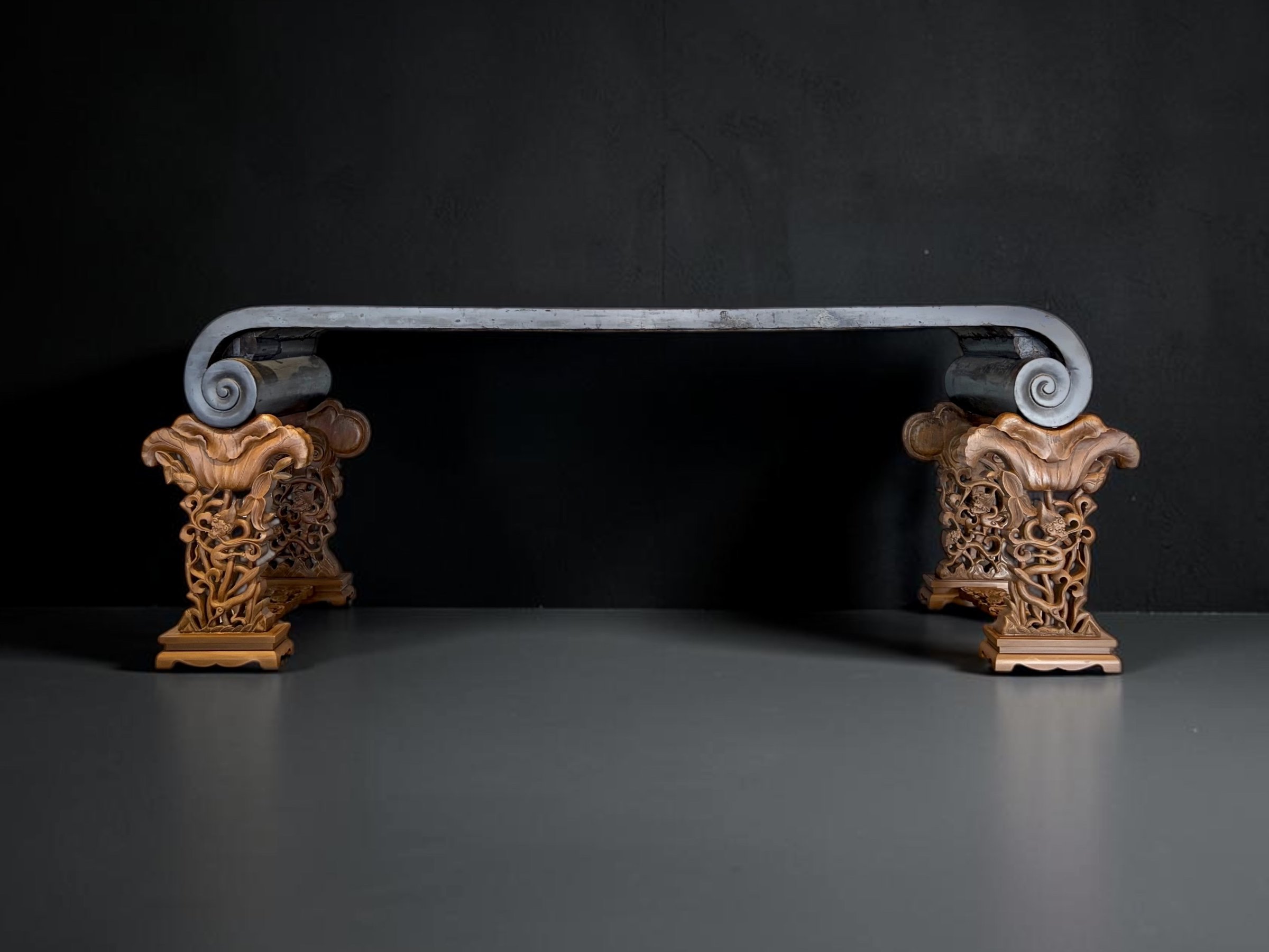
The artistic character of this black-lacquer scroll-form offering table can be summarized on three levels. The first is “form”: a scroll-form top 248 cm long establishes a robust, simple outline with a scholarly air. The second is “craft”: the four legs use extensive deep carving, openwork, and piercing to shape chi dragons, scrolling foliage, flowers and leaves, and mountains and seas, so that the heavy top is borne by a near-sculptural support system, creating the strong contrast of “solid above, open below; simple above, intricate below.” The third is “meaning”: the front’s lotus leaf and Sea of Longevity correspond to the back’s lingzhi and Mountain of Fortune, while chi dragons and scrolling foliage run through both sides, finally integrating cultural lineage, auspiciousness, fortune, and longevity into one piece of furniture that can be viewed in the round.
The photographs before and after restoration further highlight how conservation work affects artistic understanding. Before restoration, cracks, dust, and dullness concealed much of the carved detail; after restoration, the iconographic program is legible again, while the old lacquer, abrasion, and cracks on the top still carry a sense of historical time. If provenance, restoration records, and physical examination can be added in the future, this offering table still holds considerable room for research, especially along three lines of inquiry: large ceremonial furniture, scholar-style forms, and auspicious imagery.
Mountain and sea mirror each other; lotus and lingzhi bear one another.
Within a single scroll, fortune, longevity, and cultural lineage sit side by side.