

Late Ming Carved Bamboo Brush Pot with "Teaching the Son" Scene, Attributed to Zhu Sansong
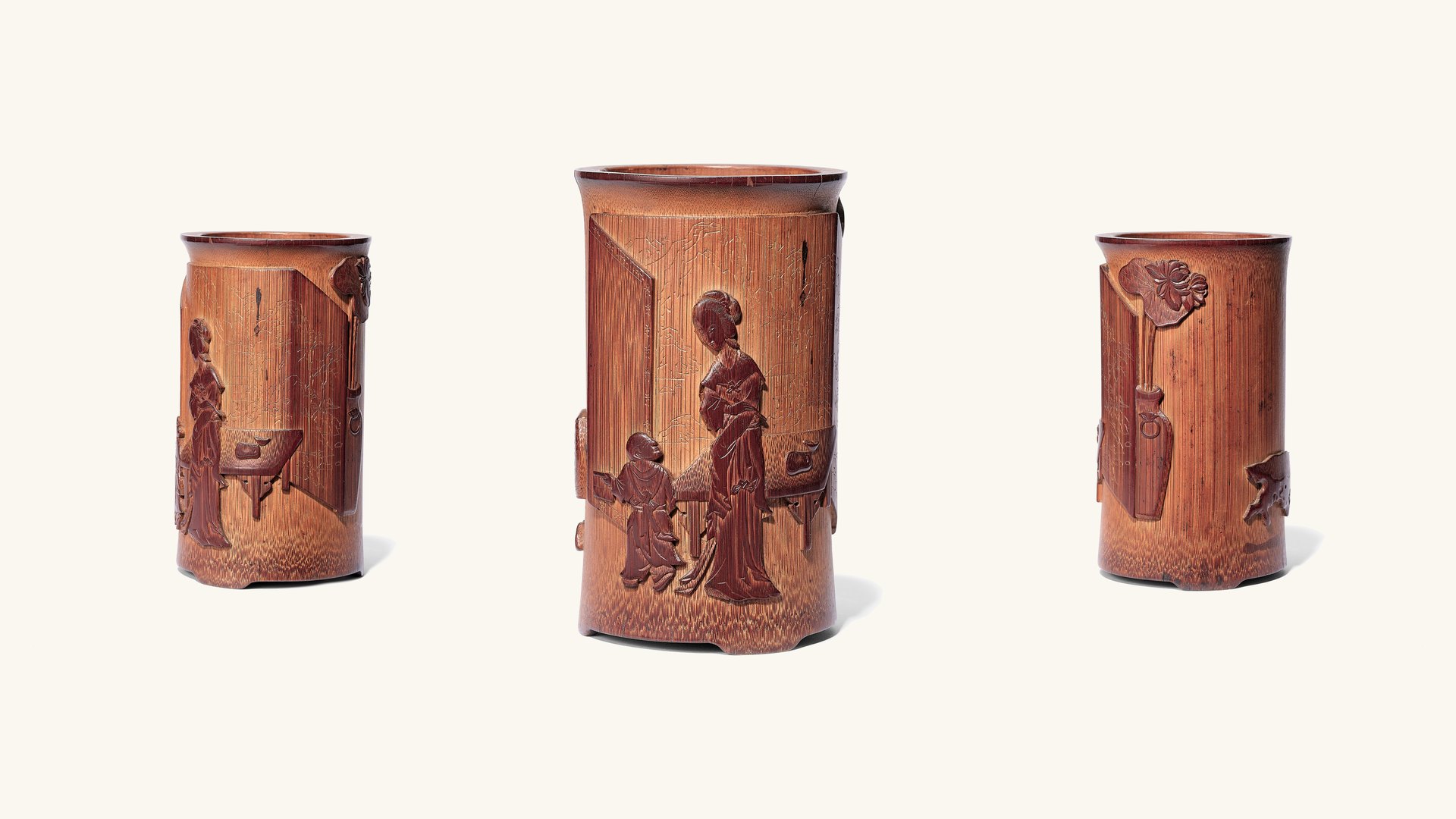
Attributed to Zhu Sansong | Height 15.5 cm
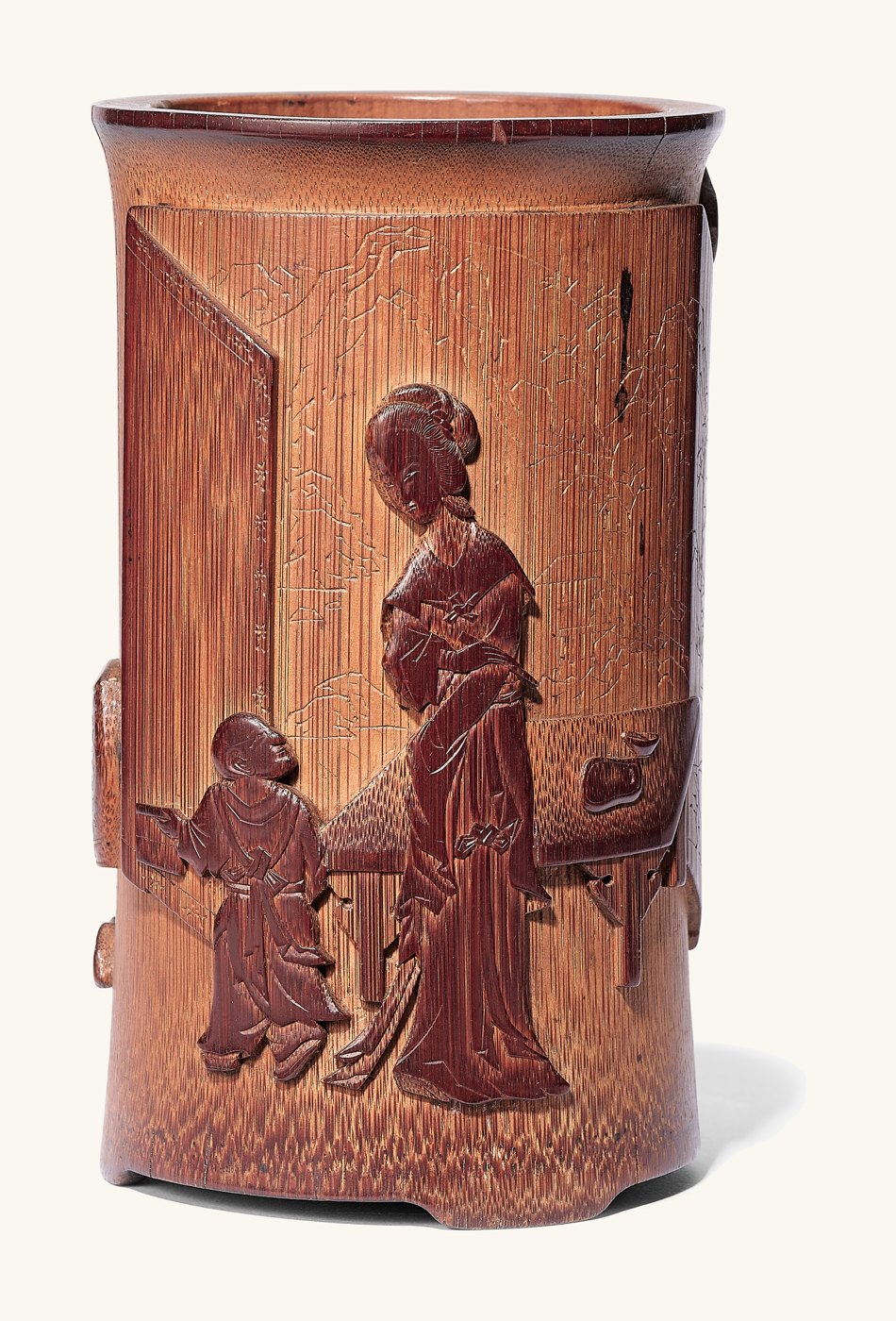
Carved bamboo brush pot with "Teaching the Son" scene, late Ming dynasty (front)
A bamboo tube, a mother, and a child holding a book. Using the deep relief carving for which the Jiading school is famous, this brush pot transfers a scene from the woodblock-print tradition of Teaching the Son (Kezi tu) onto bamboo. Figures, screens, tables and a vase of flowers wrap around the vessel, creating a three-dimensional picture meant to be turned in the hand. This essay describes the object, traces the source of its imagery, examines its carving techniques, and compares it in detail with three bamboo carvings associated with Zhu Sansong in the National Palace Museum, Taipei, to consider its attribution.
I. The Object
| Title | Carved bamboo brush pot with "Teaching the Son" scene |
| Period | Late Ming dynasty |
| Artist | Attributed to Zhu Sansong (Zhu Zhizheng) |
| Dimensions | Height 15.5 cm |
| Material & technique | Bamboo; high relief, low relief, hair-line carving, incised lines |
The brush pot is made from a single section of bamboo stem with a flat rim. Its base is the natural membrane of the bamboo node, with no separate base plate added, preserving the material's original structure. The vertical fibres of the surface are fine and dense. Centuries of handling have deepened the colour from pale yellow to a rich reddish-brown, with the raised areas of relief especially lustrous against the smoothly polished ground.
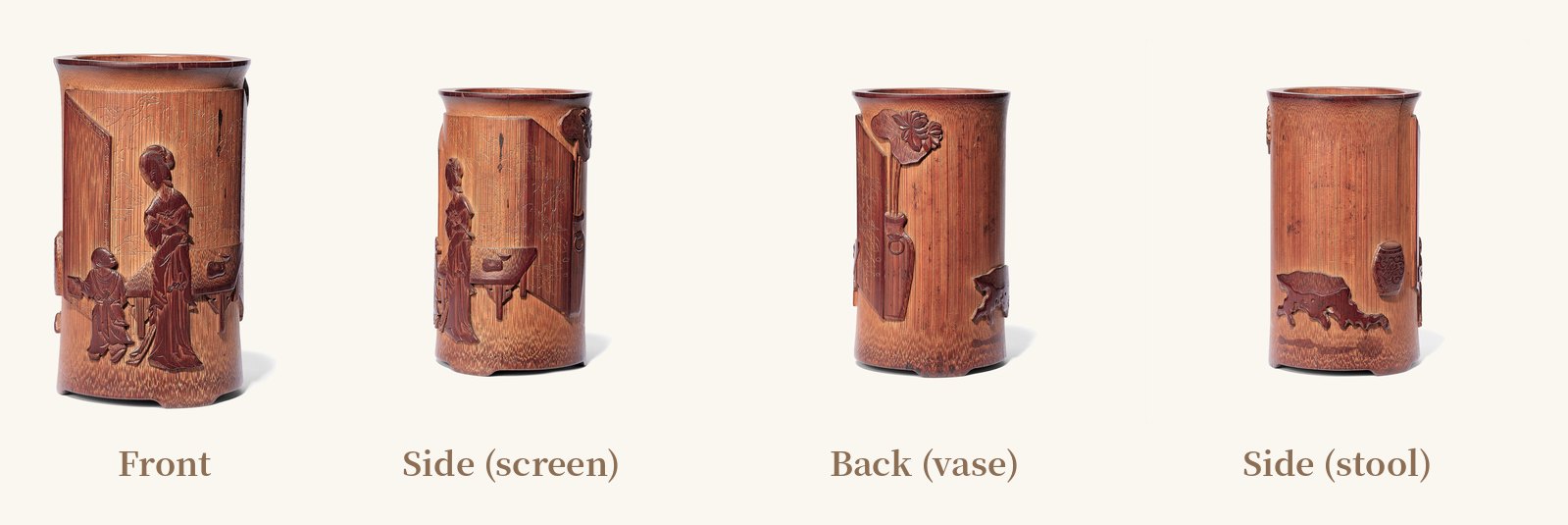
Four views: mother and son at the front, then the screen and table, the vase of flowers at the back, and the table with drum stool. The scenes flow continuously around the vessel.
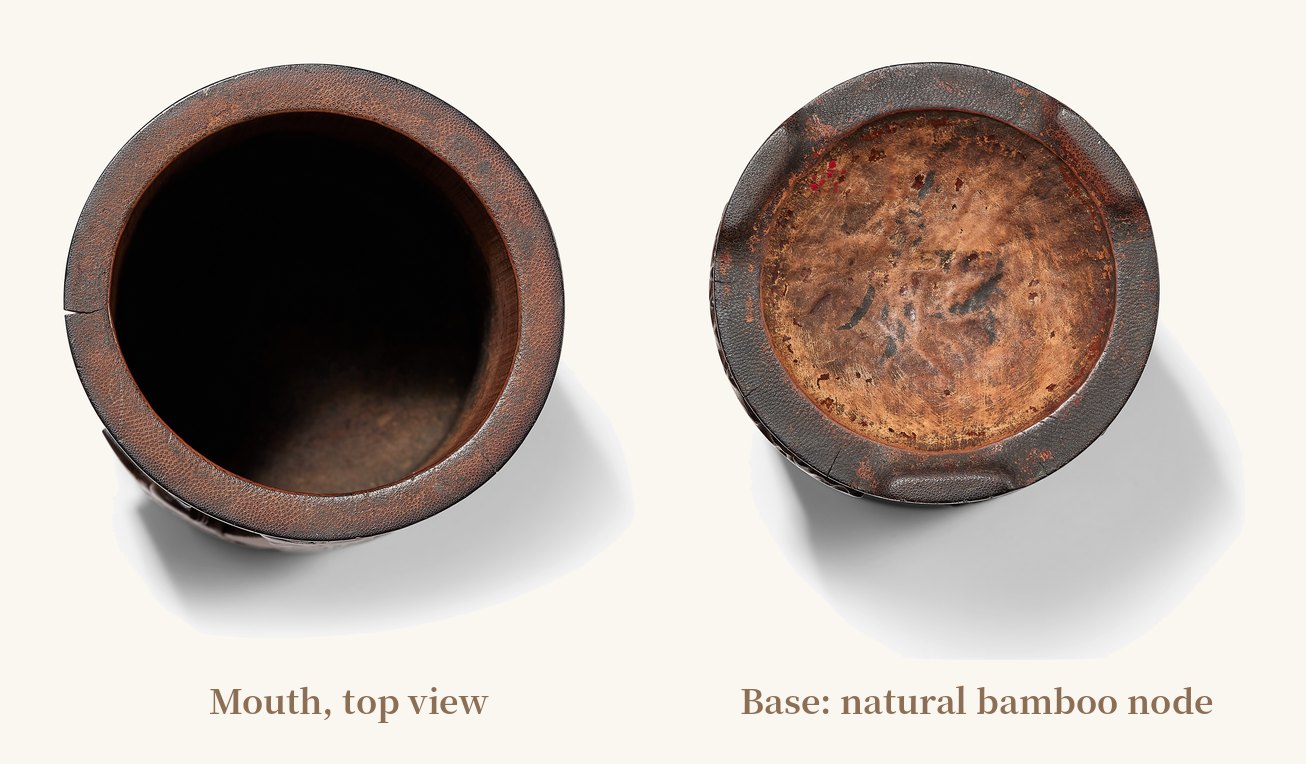
Left: the mouth seen from above. Right: the base, formed by the natural bamboo node.
II. Imagery and Composition: Wrapping a Print Around a Cylinder
The main scene shows a woman standing before a screen, brush in hand, teaching her son. The boy stands in front of her holding a book and looks up to meet her gaze. In this exchange the warmth of a mother's instruction and the attentiveness of the child come vividly to life. A table in front of the screen holds an inkstone, a water pot and other scholar's implements. On the other side of the screen are a vase of flowers, a table and a drum stool, while the face of the screen is incised with a small landscape.
The composition follows the woodblock illustrations of Teaching the Son handed down over the centuries. The figures' dress and bearing are closely similar, and the brushwork of the screen painting and the flowers is likewise adapted from the prints. Yet the carver did not simply copy. The four-panel screen of the prints is reduced to three panels, and extra furniture is added so that it sits behind the screen. Both changes answer the particular demands of a brush pot, whose surface wraps around and joins back on itself. As the viewer turns the pot, the eye passes from the figures to the screen and from the screen to the furnishings without a break. A flat print has been turned into a space that can be viewed in the round.
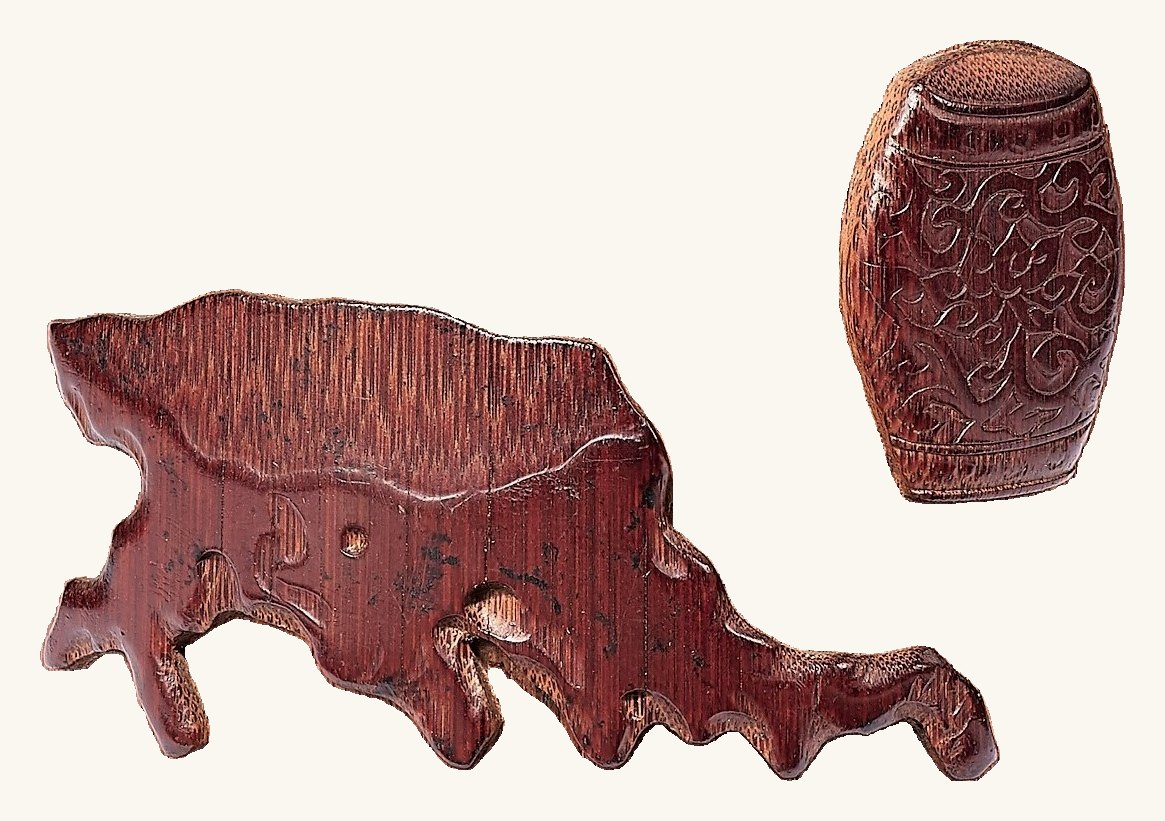
Detail of the table and drum stool behind the screen. The stool is decorated with scrolling foliage in low relief.
III. Carving Techniques: Many Methods in One Vessel
The ground was first cut back and polished smooth, and the design was then raised in high relief, creating deep layers and a great variety of cutting. On top of the high-relief figures and screens the carver added several further techniques:
- High relief: the figures, screens and vase stand well proud of the surface and form the main body of the picture.
- Low relief: the drum stool, tables and lesser folds of drapery are shallowly raised to separate foreground from background.
- Hair-line carving: cuts as fine as a hair render strands of hair and flower stamens with great delicacy.
- Incised lines: the landscape on the screen and the outlines of the robes are drawn in incised line, like ink outline drawing.
- Rounded polishing: the raised forms are polished smooth so that their transitions are soft and natural, with no harsh tool marks.
The carver planned the composition carefully to give it the atmosphere of a painting, while also pursuing fine and intricate workmanship. Uniting pictorial quality with technical mastery, the brush pot can be regarded as a supreme example of Jiading-school bamboo carving.
IV. Comparison with the National Palace Museum Collection
To examine the attribution, three bamboo carvings associated with Zhu Sansong in the National Palace Museum, Taipei, were chosen as reference pieces:
- Carved bamboo brush pot with a lady, mark of Zhu Sansong, late Ming to early Qing
- Carved bamboo brush pot with the scene "Peeking at the Letter", mark of Zhu Sansong, late Ming
- Carved bamboo wrist rest with a lady, Ming dynasty
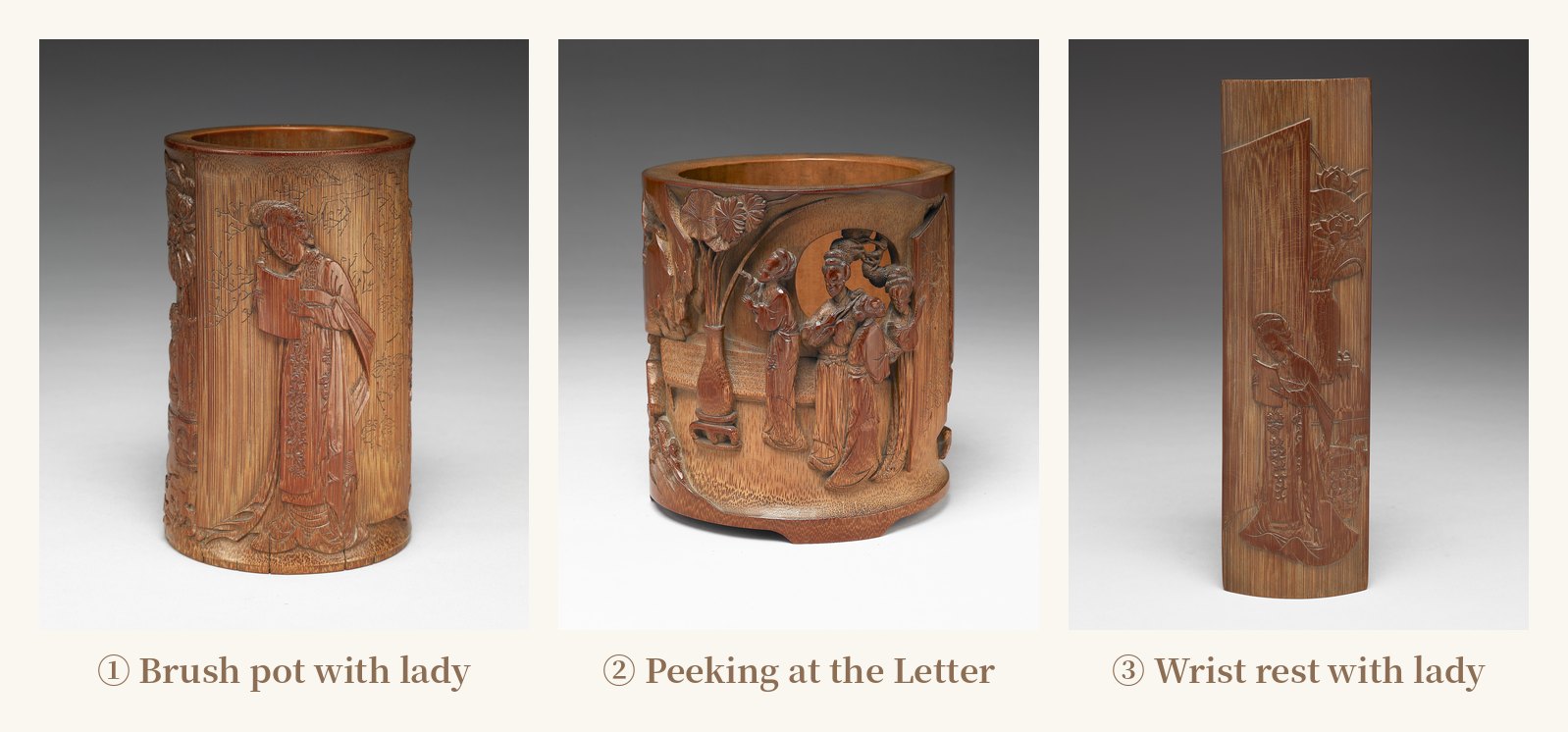
Three reference pieces in the National Palace Museum, Taipei (images: National Palace Museum)
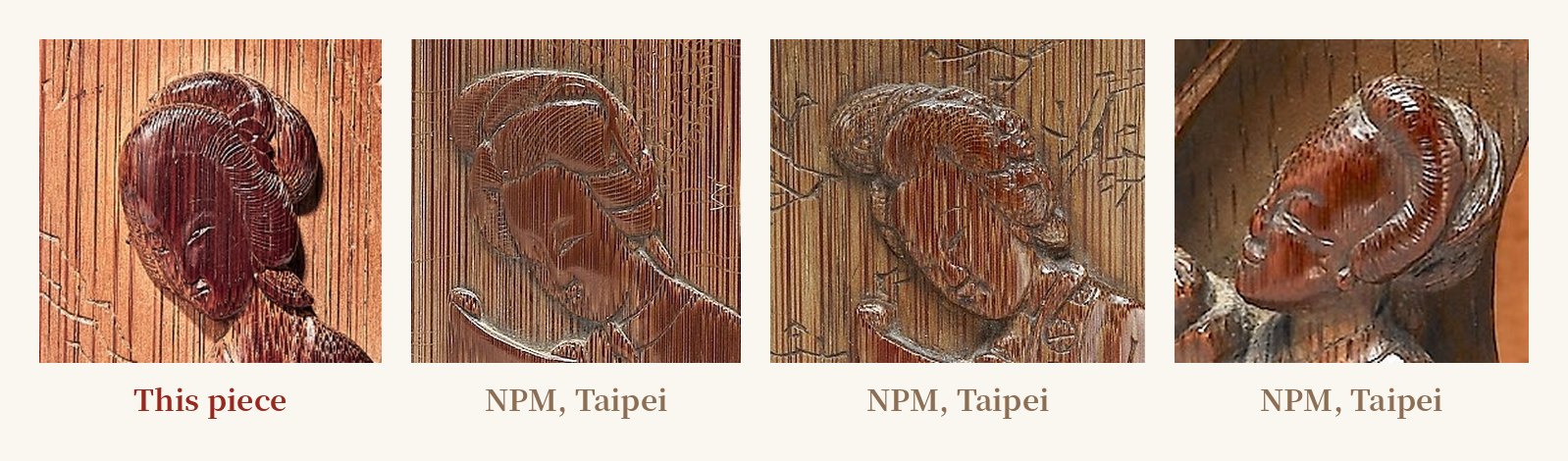
The following comparisons place this piece (labelled in red) beside the museum pieces under five headings: faces, hands, flowers and leaves, drum stools, and screens with their incised lines.
1. Faces
The ladies are shown in profile or three-quarter view, with full foreheads, straight noses and narrow, lowered eyes, giving a calm and reserved expression. Their high chignons are finely carved strand by strand in hair-line technique, dense yet orderly, and the way the coils of hair turn layer upon layer is the same throughout.
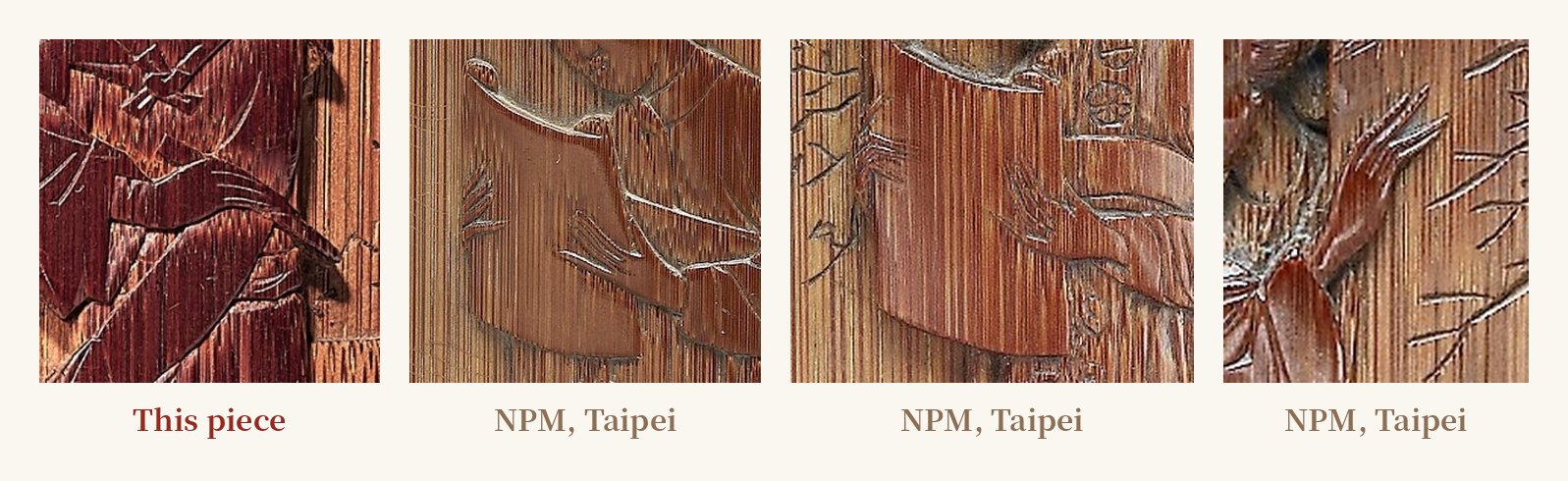
2. Hands
The fingers are long, slender and gently curved, with the joints suggested by the slightest modelling. The folds of the falling wide sleeves follow the form in incised line, and the turned-back cuffs are treated in the same way.
3. Flowers and Leaves
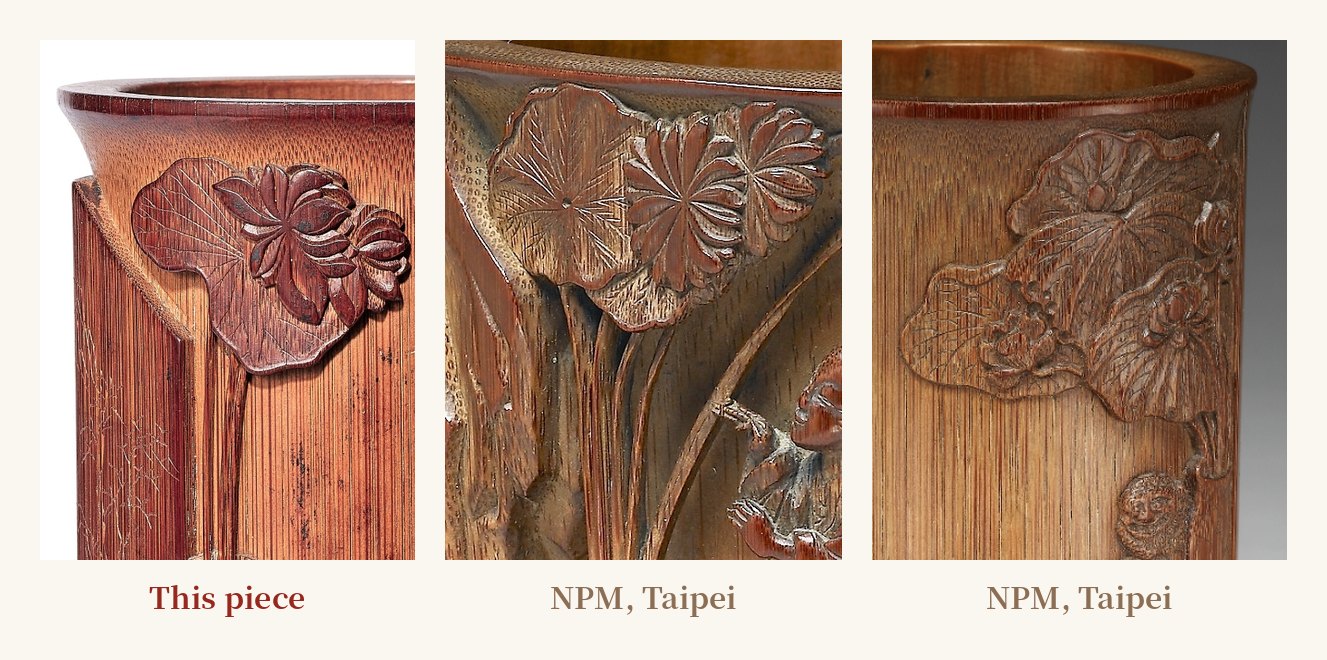
Petals overlap in layers with slightly curling edges, and the leaves have incised veins. In every case the flowers cling to the rim or the edge of a screen and break out beyond the frame, a compositional device often seen in carvings of the Sansong manner.
4. Drum Stools
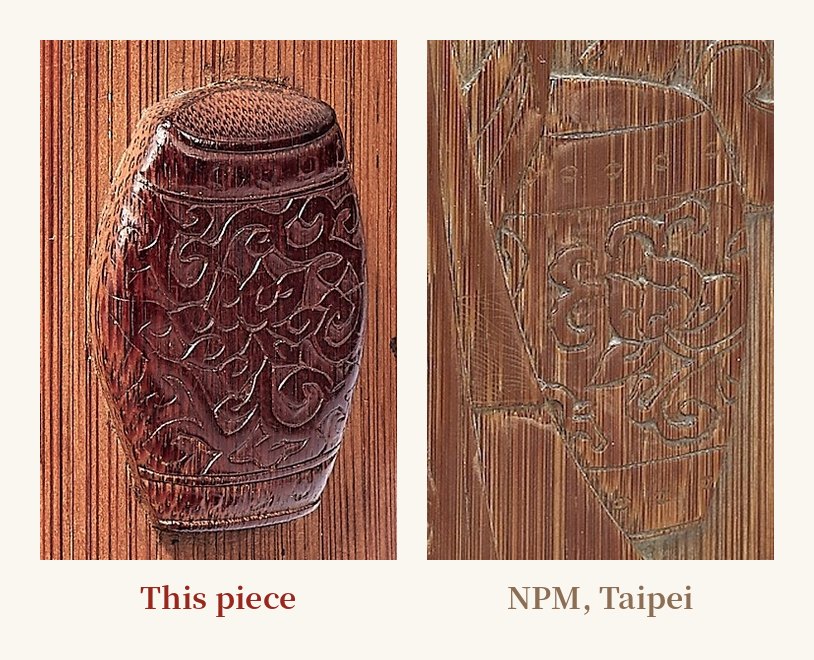
The stools are barrel-shaped, bordered top and bottom with fine bosses or bands, and covered with scrolling foliage. The layout and cutting of the decoration are very close.
5. Screens and Incised Lines
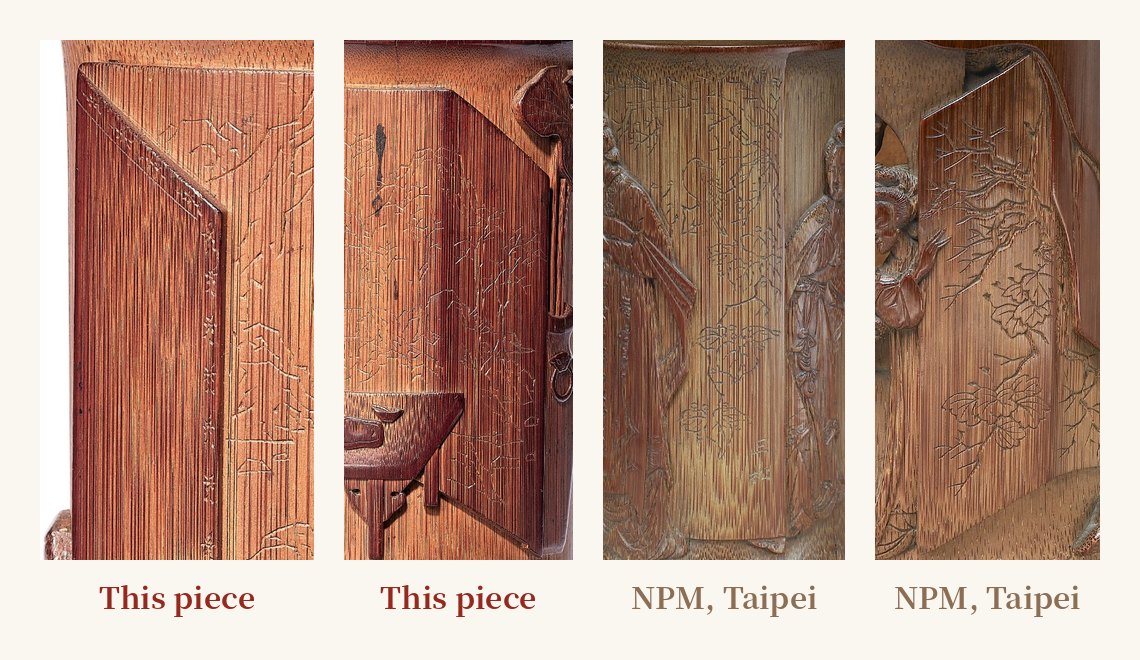
The screens are given thickness in high relief, with crisp, square corners to their frames. Their faces are incised with landscapes, trees and rocks in very fine, flowing lines, which contrast with the solid frames. This treatment is identical in this piece and in the museum pieces.
Summary of the comparison: Across all five points (faces, hands, flowers and leaves, drum stools, and screens with incised lines), the carving techniques of this piece match those of the three museum pieces. It is therefore reasonable to conclude that this late Ming brush pot with the "Teaching the Son" scene is also the work of Zhu Sansong.
V. The Artist: The Three Zhus of Jiading and Zhu Sansong
Zhu Zhizheng, courtesy name Shuzi, art name Sansong, was a native of Jiading in Jiangsu and came from a family of bamboo carvers. With his grandfather Zhu He (art name Songlin) and his father Zhu Ying (art name Xiaosong), he is known as one of the "Three Zhus of Jiading". Across three generations the family established the Jiading style, celebrated for its deep carving and high relief.
Sansong was also a painter of landscapes and was especially admired for his paintings of donkeys. In both miniature landscapes (penjing) and bamboo carving he devised his own designs, arranging them like painted scenes. The way this brush pot turns a print into a composition that wraps around the vessel reflects exactly this painter's eye. By Sansong's time the craft had reached new refinement and fame, and he had many followers, so that bamboo carving became a local speciality of Jiading, a trade that supported households and was practised from family to family.
VI. Conclusion
This brush pot takes its subject from the traditional ideal of a mother's teaching and its design from Teaching the Son woodblock prints, yet it adapts them to the vessel. By reducing the screen panels and adding furnishings, the carver lets the picture flow unbroken around the pot. High relief, low relief, hair-line carving and incised line are combined, joining painterly vision with craftsmanship. Detailed comparison with the National Palace Museum pieces shows a close match with the style and technique of Zhu Sansong, making this a highly representative example of the artistic achievement of late Ming Jiading bamboo carving.
Reference pieces (National Palace Museum, Taipei)
Carved bamboo brush pot with a lady, mark of Zhu Sansong, late Ming to early Qing
Carved bamboo brush pot with the scene "Peeking at the Letter", mark of Zhu Sansong, late Ming
Carved bamboo wrist rest with a lady, Ming dynasty