

Yun'an Art Museum | Divine Craft in Bamboo: A Study of Ming and Qing Bamboo Carving
How did Ming and Qing bamboo carving grow beyond everyday bamboo ware into an art form with recognized masters, a technical vocabulary and standards of connoisseurship? Its history involves the scholar's-studio culture of Jiangnan, the professionalization of craftsmen, the circulation of painting and pictorial imagery, and the collecting and archaizing tastes of the imperial court. Organized around schools, styles and functional applications, this essay draws on museum research and surviving works to examine how bamboo carving turned a natural material into art that could be used, read and appreciated. Works from the Yun'an Art Museum exhibition Divine Craft in Bamboo provide comparative cases across different forms and subjects.
1. The Formation and Development of Ming–Qing Bamboo Carving
Bamboo has a long history of use in China. In discussing the flourishing of Ming–Qing bamboo carving, the history of the material's use should be considered separately from the emergence of a specialized art. As an everyday material, bamboo could be split, pared, woven and chiselled into many kinds of implements. When bamboo carving began to have esteemed makers, recognizable styles, professional lineages and critical writing, the objects acquired a new cultural status. The rise of Jiading and Jinling (Nanjing) as major centres in the late Ming, and the growing attention paid to professional carvers and to scholars who took up carving, are key signs of this transformation.[1]
This process of becoming art involved both supply and demand. Carvers accumulated specialized knowledge of selecting material, handling the knife and composing designs, while collectors and users judged works by their literary and artistic cultivation, the meaning of the subject and their taste in daily living. Research at the National Palace Museum links the development of carving crafts after the mid-Ming to the status of artisans, patronage at court and among the gentry, and literati gatherings.[2] The history of bamboo carving is therefore both a history of technique and a history of how people assigned value to objects. Material cost, labour time, the maker's reputation and inscribed content could all contribute to a work's value.
The changes from the late Ming to the Qing can be understood as an expansion of creative focus. The Jiading tradition represented by the late-Ming 'Three Zhus' brought figures, narrative and the management of shallow and deep layers to maturity. Early Qing carving further developed refined low relief, three-dimensional figures and liuqing (retained-skin) work. By the mid-Qing, intaglio landscapes, poetry and calligraphy, court archaism and composite-material objects each extended the possibilities of bamboo carving. These directions ran in parallel over long periods, and later works also emulated earlier masters, so the relation between period and technique should be understood as a historical association rather than a one-to-one correspondence.
| Historical period | Research focus | Representative phenomena |
|---|---|---|
| Mid to late Ming | Emergence of specialist makers and connoisseurship | The family lineage of the Three Zhus of Jiading; Pu Zhongqian of Jinling's choice of material and carving that follows the material; painted and literary narratives enter bamboo objects. |
| Late Ming–early Qing to Kangxi | Differentiation and deepening of carving language | High relief, openwork, carving in the round and low relief (bodi yangwen) each excel; figural narrative, studio use and connoisseurs' objects merge. |
| Yongzheng to Qianlong | Painterly turn and expansion of court taste | Zhou Hao's intaglio landscapes are prized; bamboo objects entering the imperial collection, inscribed poems and archaistic production reflect varied cultural demands. |
| Jiaqing and after | Transmission, documentation and continuation of masters' styles | Texts such as Records of Bamboo Carvers (Zhuren lu) compile carvers' biographies; earlier styles continue to be studied, compared and collected. |
The periodization above is a framework for observation. Dating a specific object still requires signatures, provenance, form and reliable comparanda. From an art-historical perspective, the most important questions about Ming–Qing bamboo carving are how a single material could accommodate such different aesthetic demands, and how those demands circulated among makers, users and collectors.
2. Schools and Traditions: Positioning Jiading, Jinling and Liuqing
The Jiading tradition — family lineage and the kinship of carving and painting
The Three Zhus of Jiading are Zhu He, Zhu Ying and Zhu Zhizheng, known respectively as Songlin, Xiaosong and Sansong. Transmission from grandfather to grandson gave bamboo carving a relatively clear technical continuity, and successors each developed figures, landscape, calligraphy or sculpture in the round. The Jiading tradition is often associated with multi-layered relief, openwork and intricate composition; its artistic focus lies in turning a limited bamboo wall into a scene with depth. The overlapping of figures, trees, rocks, screens and buildings became a means of controlling distance from front to back.[1][3]
The idea that 'carving and painting are kindred' is best understood through composition rather than a single cutting technique. A painter arranges figures and scenery on paper, while a carver must deal with height, thickness and turning surfaces at the same time. On a brush pot, the frontal scene must connect with the sides and back; in a bamboo-root figure, the pose must suit the volume of the material. The achievement of Jiading carving thus includes the ability to translate pictorial experience into the structure of an object. The later explorations of Wu Zhifan, Zhou Hao and others show that different technical choices continued to coexist within Jiading itself.
The Jinling tradition — Pu Zhongqian and carving that follows the material
In the history of bamboo carving, Pu Zhongqian of Jinling is usually associated with choosing natural forms and restrained use of the knife. The Palace Museum, in presenting his work, emphasizes his skill in exploiting the twists of the material and the interest of roots and nodes. Yet the museum's Bamboo Brush Pot with Bamboo Branches also shows finely carved branches and leaves, indicating that an artist's surviving profile must still be tested against specific works.[4] 'Carving that follows the material' involves recognizing natural contours, deciding which parts to preserve, and then carving only as much as needed for the image to emerge.
Carving that follows the material proposes a different relationship between the man-made and the natural. Existing hollows, bumps, nodes and curves can be absorbed into images of rocks, branches or animals; the carver's judgement shows in where to work and where to stop. This art equally depends on skilled technique, because even slight cutting can destroy the existing contour. The sense of naturalness in such works is often the joint result of material selection and finishing.
The scholarly debate over the 'Jinling School'
The classification in Jin Yuanyu's Qing-dynasty Records of Bamboo Carvers shaped the later habit of pairing Jiading and Jinling. Wang Shixiang's essay 'On the Schools of Bamboo Carving' argues that a school should have a traceable lineage and successors, and questions treating the work around Pu Zhongqian as a complete Jinling School.[5] Thus 'Jinling School' can serve as a conventional label in general introductions, but in research one must specify whether it refers to a region, a creative tendency or a concrete master–pupil lineage. A shared place of production does not necessarily produce a uniform style, and similar forms may result from later emulation.
The liuqing tradition — a material technique that crosses regions
Liuqing is often associated with masters such as Zhang Xihuang, but it is first of all a way of treating the material. It builds images from differences in colour, texture and thickness between the bamboo skin (zhuqing) and the underlying fibre (zhuji). This is not quite the same level of classification as the regional and lineage categories of Jiading and Jinling. Research can record a work's regional connections, maker's lineage and technique together, without assigning every liuqing piece to a single regional school. The National Palace Museum's Bamboo Paperweight with Landscape renders a landscape in liuqing combined with a hardwood body, showing how the technique entered different kinds of objects.[6]
| Name | Primary reference | Stylistic observations | Distinctions in research |
|---|---|---|---|
| Jiading carving | A region with a relatively traceable lineage | Figural scenes, multi-layered carving, painterly quality, with rich internal variation | Within Jiading, high relief, low relief or intaglio may be adopted separately. |
| Jinling carving / Jinling School | A region and a historical discourse centred on Pu Zhongqian | Material selection, shaping that follows natural form, regard for natural shapes | Whether the school had a continuous lineage remains a matter of scholarly debate. |
| Liuqing carving | Material layers and surface-treatment technique | Light and shade, patterns and painterly effects through colour difference and minute height differences | Technique, region and attribution should be recorded separately. |
| Bamboo-root carving in the round | Material selection and three-dimensional modelling | Volume of figures, animals and rocks; viewing from multiple sides | Material, structure and maker must be examined; school cannot be judged from carving in the round alone. |
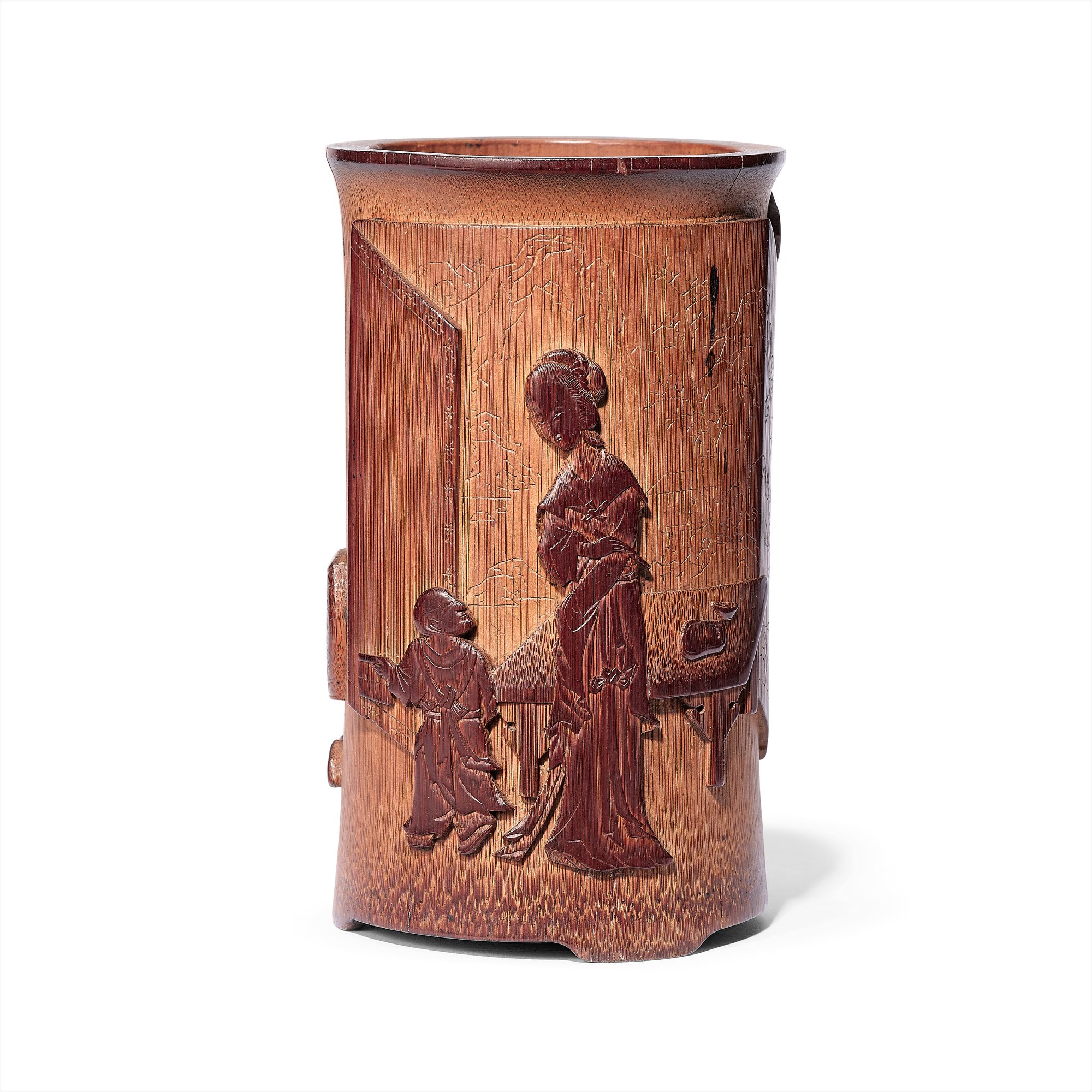
Yun'an's Bamboo Brush Pot with a Scene of Teaching a Child, in the Style of Zhu Sansong can serve as a case study in questions of lineage. The scale of the figures and the interior furnishings in the scene invite comparison with Jiading figural carving, while 'in the style of Zhu Sansong' places the discussion on formal relationships. Pursuing authorship further would require inscriptions and evidence of transmission. This distinction lets the exhibit take part in stylistic study while keeping its attribution open to verification.
3. How Technique Shapes Style: From Ground Reduction and Liuqing to Intaglio and Tiehuang
The style of a bamboo carving arises from the combination of material selection, knife work, composition, surface treatment and viewing conditions. Whether a piece is carved deeply or shallowly alone cannot capture these levels. High relief relies on large differences in height; low relief (bodi yangwen) seeks detail within minute height differences; liuqing exploits the colour differences of the material; intaglio organizes images with incised lines; and tiehuang (bamboo veneer) reconstructs the surface of the object. The choice of technique also determines how a work receives light, how it is touched by the hand and how it reveals itself at different distances.
| Technique | Basic principle | Main expressive qualities | Common applications and what to observe |
|---|---|---|---|
| Intaglio (yinke) | Characters or patterns cut into the surface | Line, calligraphic brush flavour, outlining and texturing of rocks | Brush pots and wrist rests with poems; observe where incisions start and end, their width and turns. |
| Low relief / bodi yangwen | Ground lowered, main design left slightly raised | Subtle volume, clear contours, delicate expression | Bamboo objects with figures, flowers and birds; observe the boundary between design and ground. |
| High relief | Deeper ground reduction so the subject stands out boldly | Layering, shadow, dramatic space | Brush pots and hanging screens; observe front-to-back layers and supporting parts. |
| Openwork / pierced carving | Material pierced through in places to create voids | Transparency, overlapping, participation of the background | Incense holders, brush pots and display pieces; observe the openings and connecting structures. |
| Carving in the round | Complete volume modelled from all sides | Figure posture, centre of gravity and viewing in the round | Bamboo-root figures, animals and mountain carvings; observe the sides, back and base. |
| Liuqing | Bamboo skin retained and adjusted to contrast with the fibre beneath | Thin layering, tonal light and shade, painterly effect | Wrist rests, brush pots and inlays; observe the retained skin and cut-away ground. |
| Tiehuang / wenzhu | Processed inner bamboo veneer applied to a core, then decorated | Smooth surfaces, composite forms, uniform colour | Boxes, vases, stationery and furniture; observe veneer, joins and core. |
Low relief and high relief — two ways of controlling space
Wu Zhifan's low relief (bodi yangwen) displays clear technical features on the Palace Museum's Bamboo Brush Pot with Herding Horses. The outlines of the subject rise above a flat ground, and the surfaces of figures and animals are given further subtle undulation, so that hair and drapery can appear within a very shallow depth.[7] The precision of low relief comes from distributing height within a limited depth. If the outlines are unclear, the forms merge into the background; if the surface undulation is too even, expression and volume become flat.
High relief, by contrast, converts the thickness of the material into a more pronounced distance from front to back. It allows figures, trees and pavilions to unfold layer by layer, and creates shadow in the deeper recesses. The carver must plan in advance the angles at which tools enter and leave and the supports between forms; once openwork and deep carving interlock, composition and structure become closely bound. Dense works should therefore be judged by whether their layers are clear and their main contours legible; the amount of detail alone tells only part of the story.
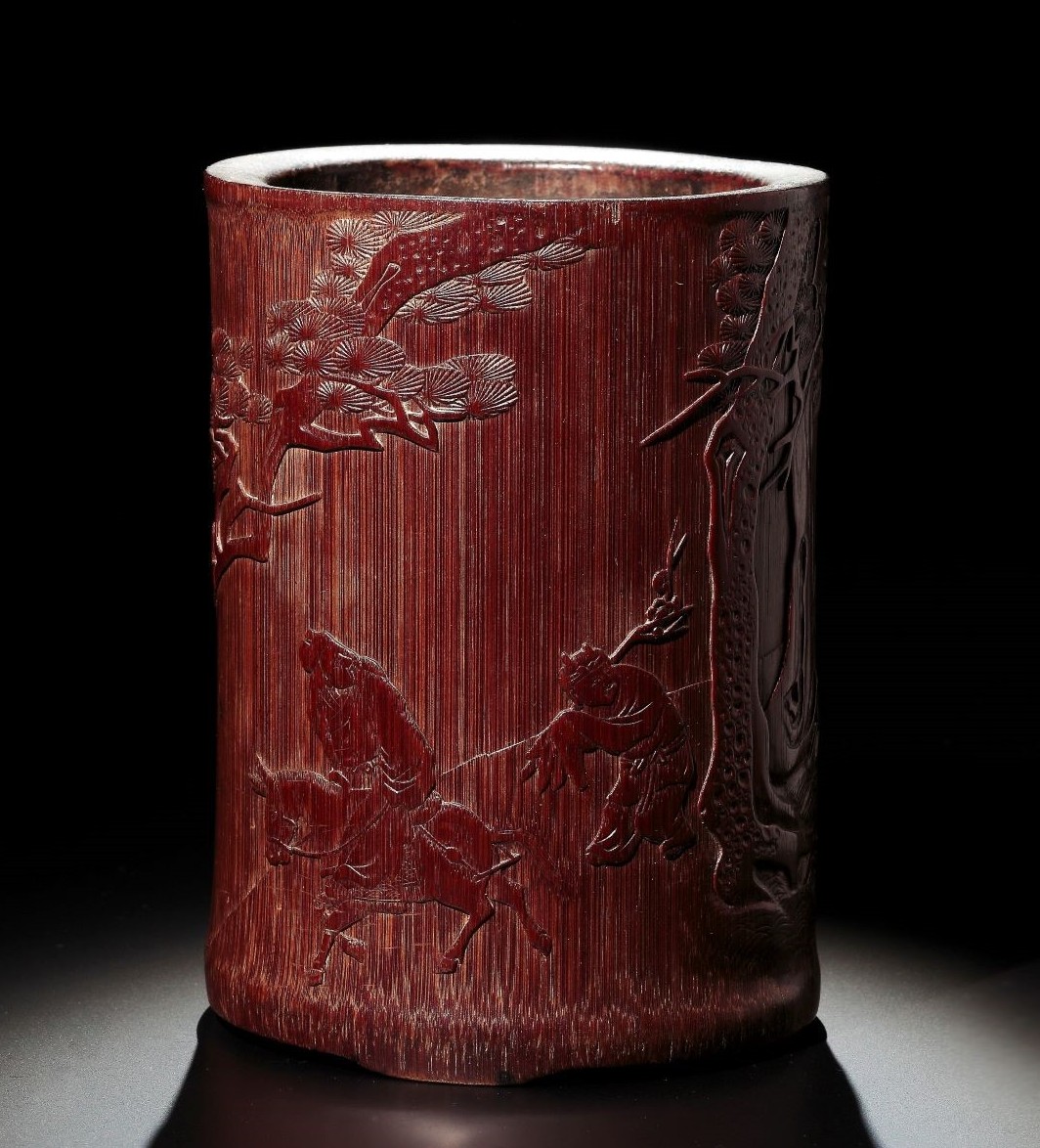
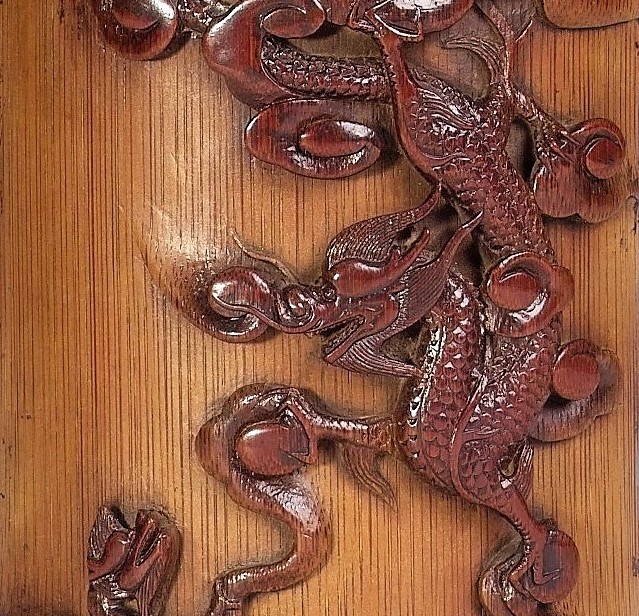
Yun'an's Brush Pot with Searching for Plum Blossoms in the Snow and Hanging Screen with Auspicious Dragon allow a comparison of the visual effects of different degrees of relief. The former lets a travel theme unfold around the wall of the pot, while the latter strengthens frontal movement through the raised dragon and the turning clouds. Each responds to its own form and subject, showing that stylistic judgement must address technique and composition together.
Liuqing — light and shade from the layers of the material
The basic condition of liuqing is the difference between the bamboo skin and the fibre beneath. By choosing to retain, thin or remove the skin, the carver forms pattern and ground. The National Palace Museum's description of the Bamboo Paperweight with Landscape relates these layers to the different colouring of skin and fibre.[6] The Palace Museum's Liuqing Brush Pot with Figures and Pavilions further shows that the edges of the material can be subtly varied along with the grain to evoke clouds and ink-wash-like visual effects.[8]
From the standpoint of medium, liuqing turns the material's inherent differences into pictorial resources. The carver must arrange contours within an extremely thin layer and anticipate the contrast between subject and background. This gives liuqing a different working rhythm from deep carving and suits it to flatter objects meant for close viewing, such as wrist rests or inlays. Its painterly quality arises from the relation between layer and surface, so identification requires examining the material rather than relying on light and dark tones in photographs.
Intaglio — the independent value of calligraphic line and knife marks
Zhou Hao, styled Zhiyan (also written 芝岩), was a major figure in Qing landscape carving on bamboo. Scholars emphasize how he brought his cultivation in painting and calligraphy into intaglio, developing a knife technique rich in brush flavour for landscapes and bamboo-and-rock subjects.[9] Intaglio places the image within incised lines, so the width, depth, breaks and turns of the line become central to expression. Once landscape outlining and texture strokes enter the bamboo surface, they must adapt to the resistance of the material and the curvature of the object, and the knife marks thus acquire a texture of their own.
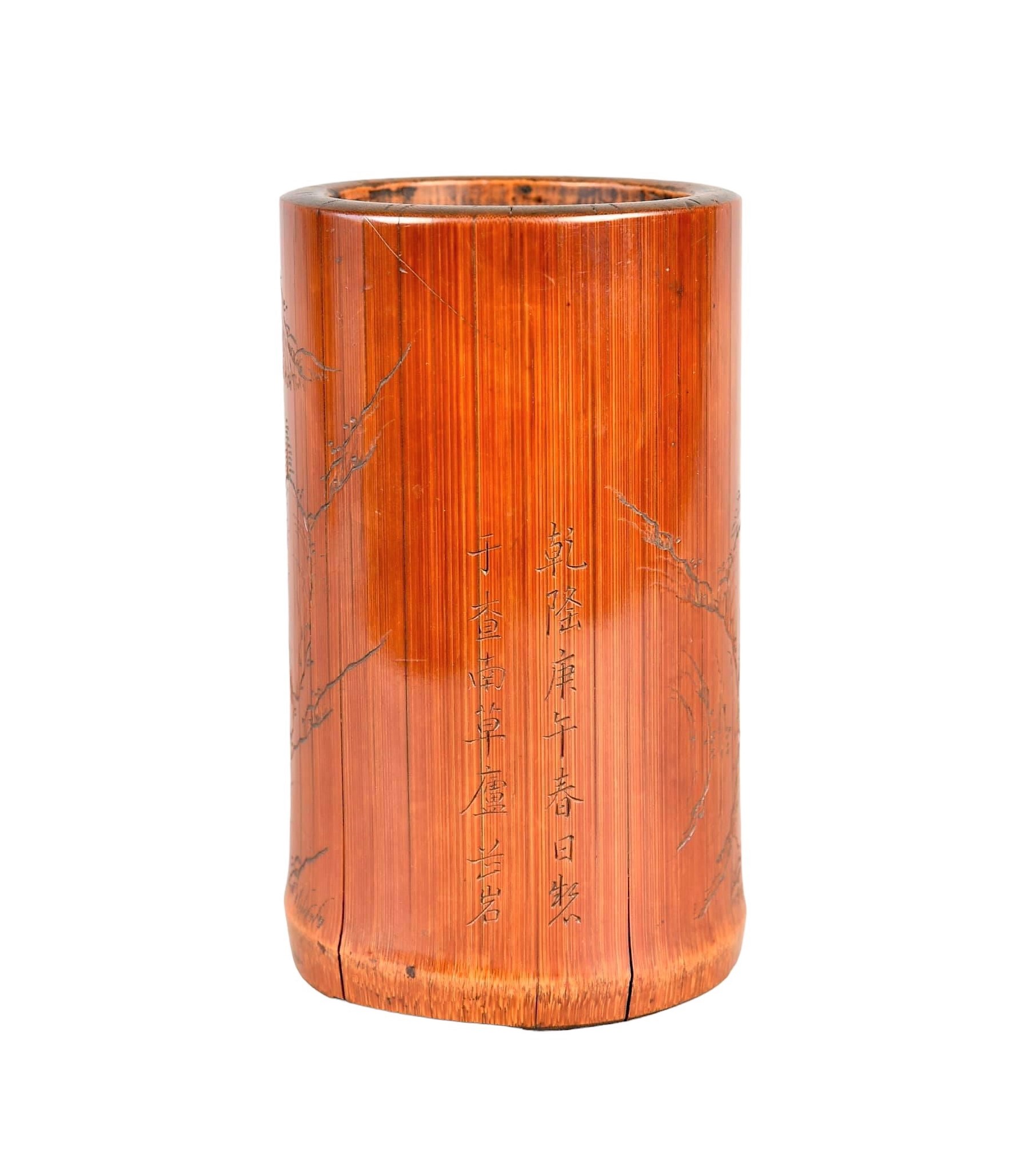
Yun'an's Landscape Brush Pot inscribed 'Zhiyan' can be viewed within this painterly and calligraphic context. Its more open surface lets incised lines, characters and the sheen of the bamboo compose the picture together. Analysis must distinguish the signature from attribution, and should also ask how the lines build the structure of rocks on the bamboo surface. Only then does 'using the knife as a brush' become an observable formal question.
Tiehuang — surface craft that expands the range of forms
Tiehuang, also called wenzhu or tiehuang (貼黃), essentially involves applying processed thin sheets of the inner layer of bamboo onto a core and then carving or otherwise decorating them.[10] This technique allows bamboo to cover forms that could not be made directly from a single bamboo section. The structure is supported by the core, while the surface displays the colour and fine texture of the bamboo veneer, extending bamboo craft to a wider range of boxes, vases and furniture.
Tiehuang and liuqing use different parts of the bamboo and involve different production processes. The study of tiehuang should attend to the relation between core, joins and decoration, while the study of liuqing focuses on retaining the skin and cutting away the ground. This distinction matters for understanding Ming–Qing crafts, because works may look similar while the material structure and labour behind them differ.
4. Literati, Craftsmen and Taste: The Social and Cultural Basis of Bamboo Carving
Calling bamboo carving a literati art concerns its subjects, contexts of use and modes of appreciation, as well as its actual making. Literati could supply poems, inscriptions, pictorial ideas and aesthetic standards, while professional carvers commanded material and process; some makers were accomplished in both painting/calligraphy and carving, and some works may have been completed through the collaboration of different roles. Research should identify these relationships from works and texts, avoiding attributing all the cultivation embodied in an object to the person named in the inscription, while not overlooking the carver's active choices in composition and technique.
The late-Ming culture of connoisseurship reflected in Wen Zhenheng's Treatise on Superfluous Things (Zhangwu zhi) placed implements, furnishings and way of life within a single aesthetic order. The National Palace Museum exhibition 'Everyday Life in a Small Era' further interprets this culture through the relationship between objects and identity.[11] In this context, brush pots and wrist rests mean more than holding brushes or supporting the arm; they resonate with paintings, calligraphy, desks and interiors, becoming a means by which users organized their lives and expressed their cultivation.
These sources suggest a further interpretation. Part of the cultural value of bamboo carving comes from combining an ordinary material with highly specialized labour. Bamboo retains its natural texture in appearance, yet its making could require great effort in selection and carving. The refined simplicity admired by collectors coexisted with the technical investment behind it. Seeing bamboo only as plain or cheap makes it hard to understand why finely worked bamboo became a treasured curio; looking only at dense carving misses the role of the material's natural character in appreciation.
'Refined' and 'vulgar' should also be understood within historical criticism. For some users, sparseness, antique simplicity and natural form were valued; other works won fame for minute figures, complex landscapes and intricate carving. These demands could coexist and could shift with function, collecting context and personal taste. The diversity of bamboo-carving styles reflects precisely the fact that aesthetic judgement was never uniform.
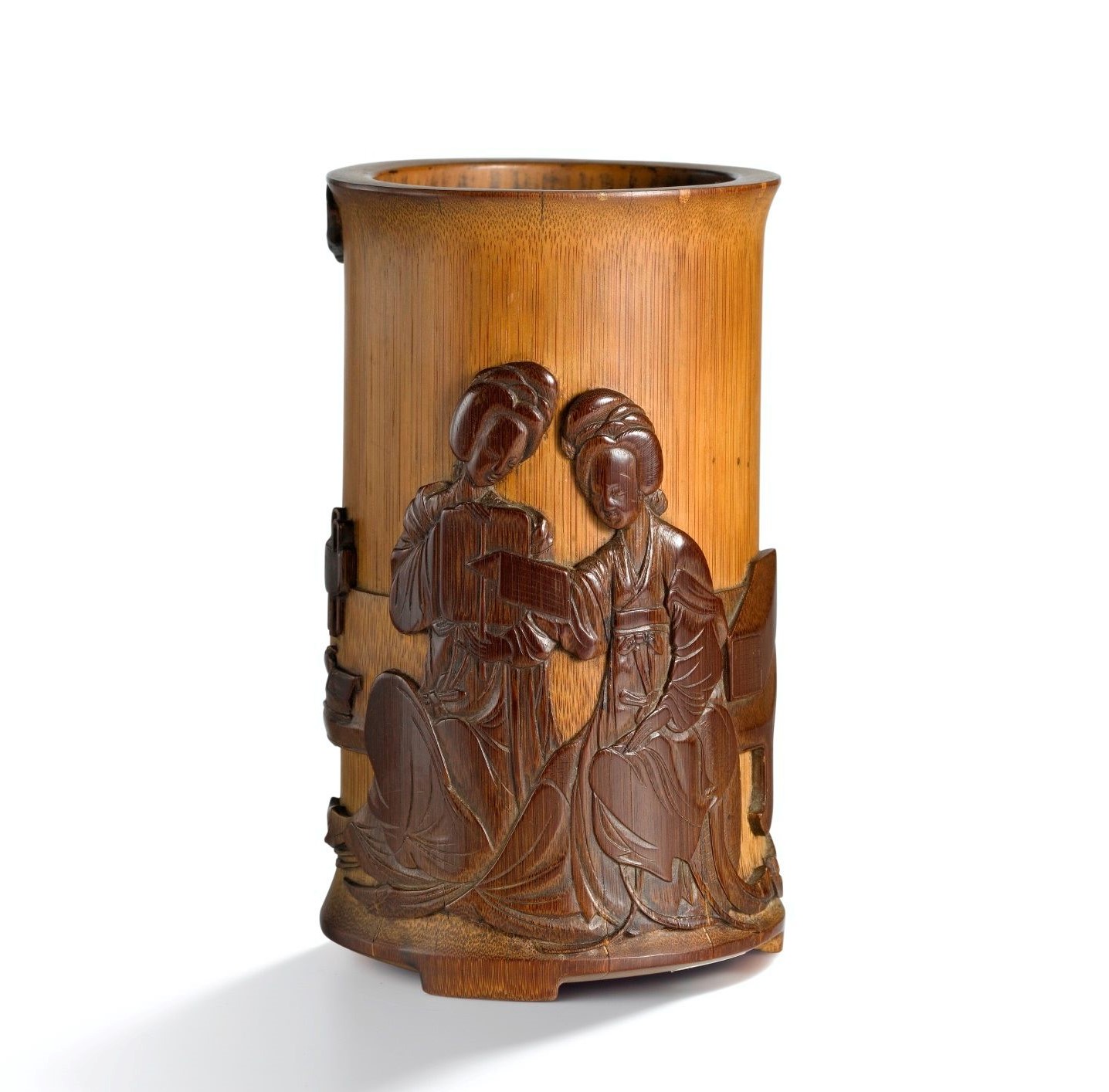
The Brush Pot with the Two Qiao Sisters Reading brings a reading scene into the study, while the Brush Pot with Teaching a Child places an educational theme where brushes are picked up every day. Both show that there are connections between subject and function that users could understand. Figural stories provide something to look at, and also bring the owner, in daily activity, into contact with values related to learning, upbringing and literary memory.
Carvers' signatures, collectors' inscriptions and textual records also allowed works to gain renown beyond the objects themselves. A maker's name could spread through collecting and imitation, and an original style could be selectively continued by later generations. Studying signatures from this angle addresses both the history of production and the history of reception, revealing how certain forms became models to be emulated. This is why the study of bamboo carving needs to combine technical analysis with social and cultural analysis.
5. Pictorial Sources and Media Translation: How Poetry, Calligraphy and Painting Entered Bamboo Carving
Ming–Qing bamboo carving frequently depicts literary stories, elegant gatherings, recluse scholars, landscapes, flowers and birds, and auspicious subjects, whose imagery is interconnected with painting, woodblock prints and poetry. 'Pictorial source' can be divided into source of theme and source of specific design. The Goddess of the Luo River has a literary background, and the Orchid Pavilion theme involves the spring purification gathering and calligraphic culture; whether a given work is based on a particular painting model, however, requires item-by-item comparison of figure placement, dress, scenery and inscriptions. A shared subject only sets a direction for research; formal correspondence is what helps identify actual borrowing.
The National Palace Museum's Brush Pot with a Scene of Secretly Reading a Letter by Zhu Sansong offers a concrete case for comparison. The museum links the figures to Chen Hongshou's woodblock illustrations for Romance of the Western Chamber and notes that the screen and furnishings were adjusted in being transferred to the brush-pot composition.[3] Such changes show that when a design enters a three-dimensional object, its space must be reconfigured. Distances that on paper can be conveyed by perspective or overlapping become, on the bamboo wall, a continuous relationship of height differences, deep channels and turning surfaces.
Text also serves multiple functions in bamboo carving. An inscribed poem can establish the setting, a title can help identify the story, and calligraphy itself can become the main decoration. The National Palace Museum's Bamboo Brush Pot with Inscription bears a text by Su Shi and displays calligraphic interest through Wang Yongfang's carving style.[12] In such works, the text is both readable content and a visual structure made of line spacing, character movement and knife marks.
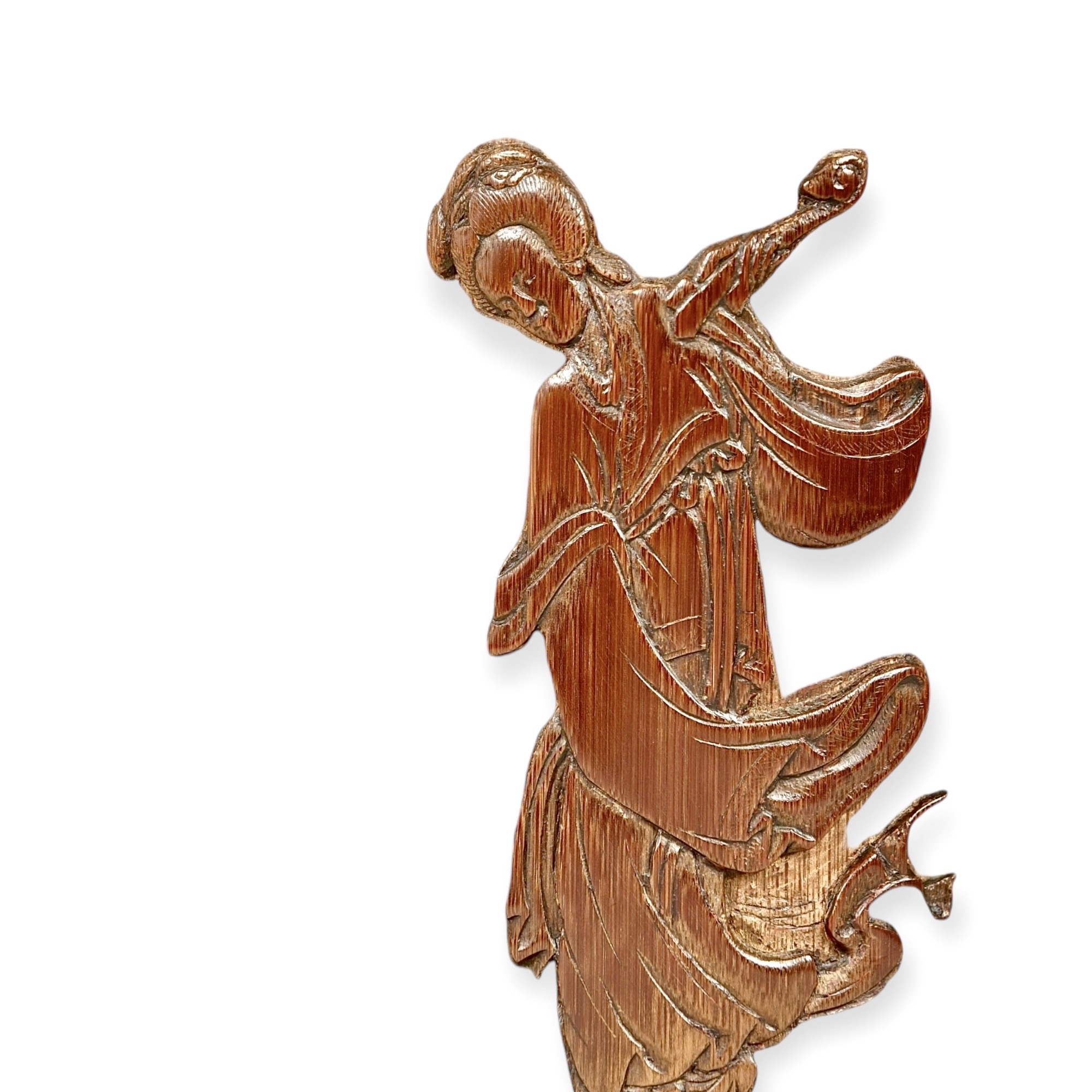
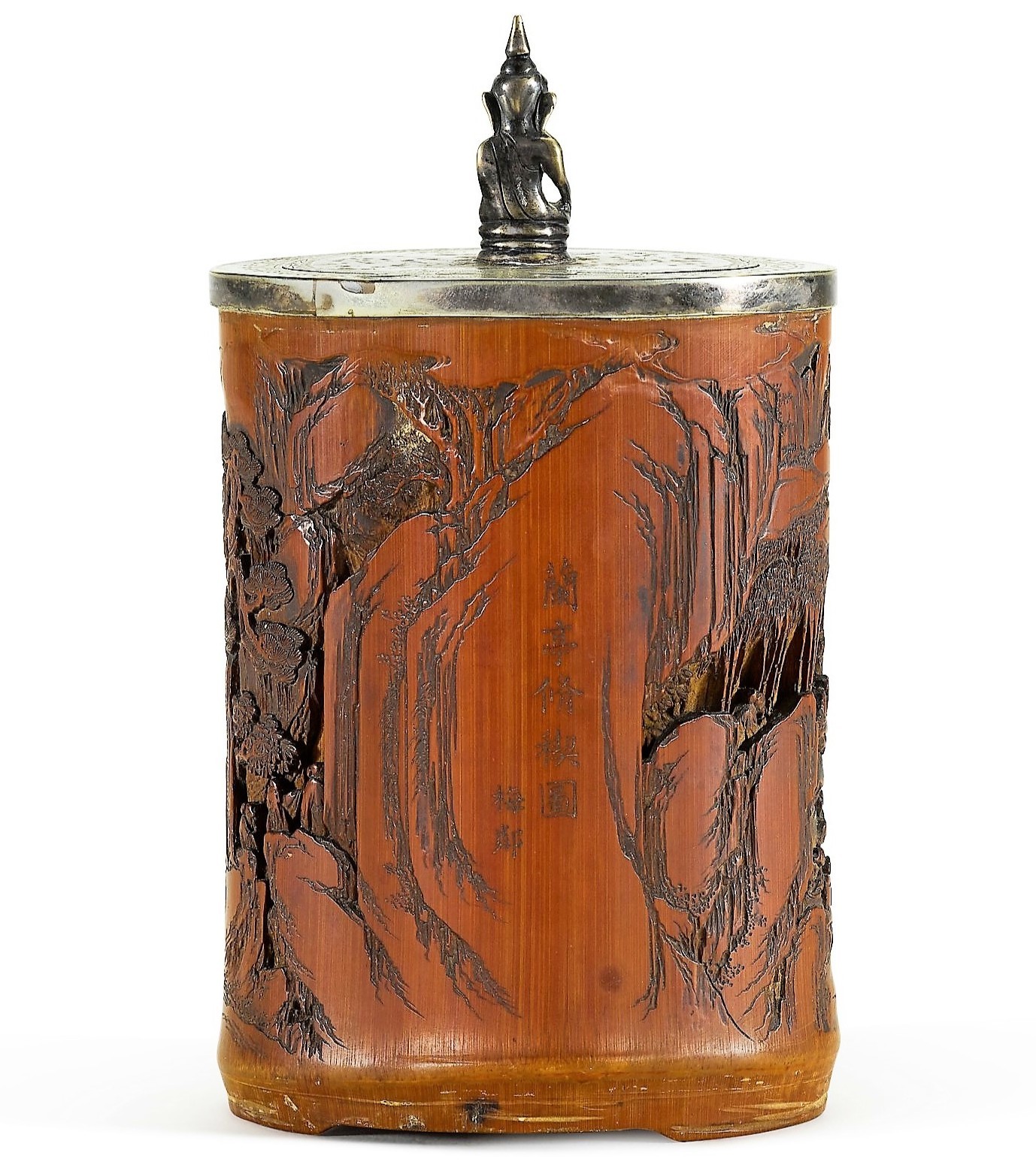
Yun'an's Brush Pot with the Goddess of the Luo River and Poem connects the figure's pose with the literary theme, the curves of the sash extending the figure's movement across the surface. The Brush Pot with the Orchid Pavilion Gathering, by contrast, uses more figures and landscape groupings so that the collective activity unfolds in sections around the wall. Together they show that bamboo carving chooses different narrative densities according to vessel form and the nature of the story.
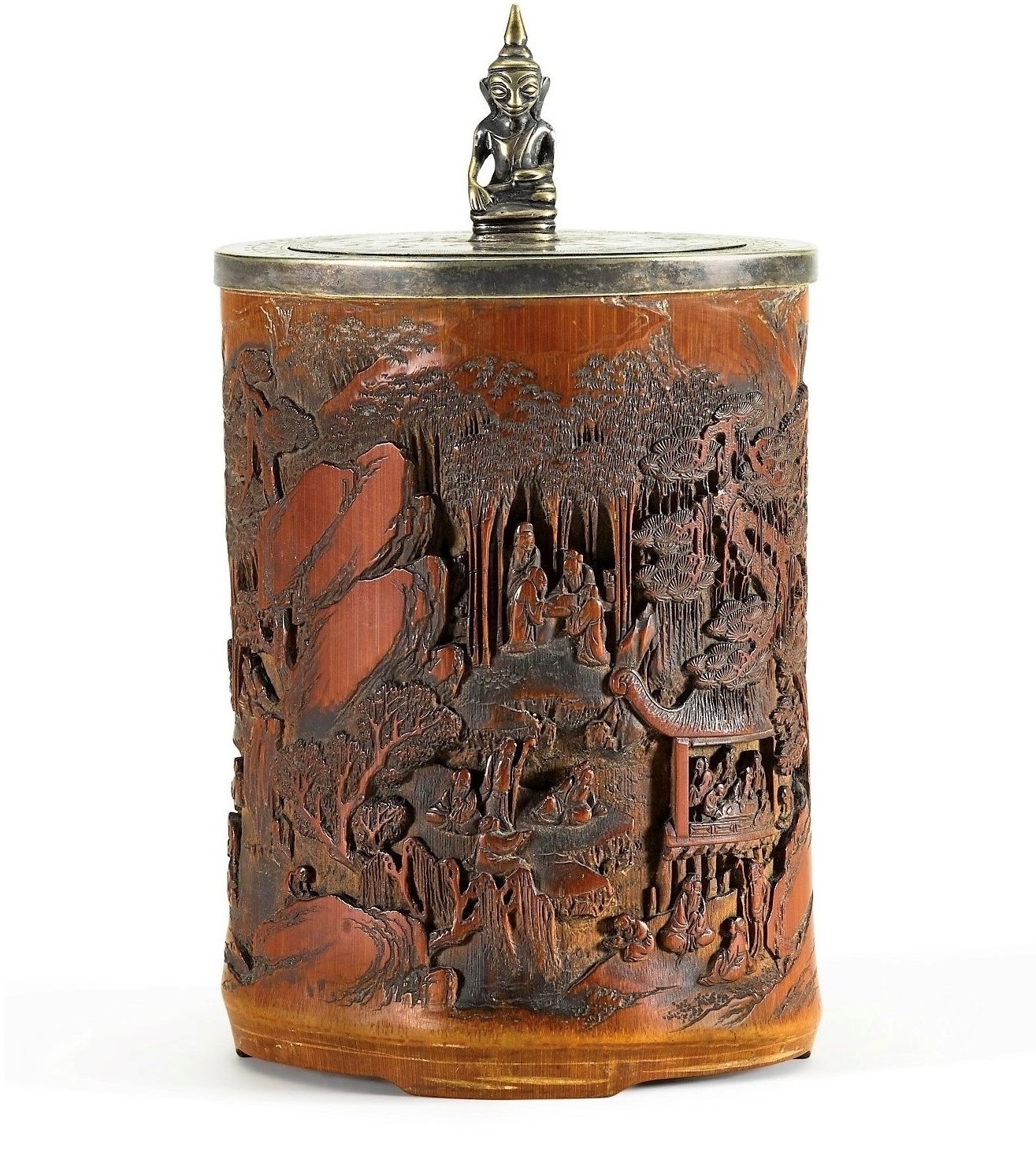
From the perspective of media translation, bamboo carving's transformation of imagery can be summarized in three operations. First, selection: distilling recognizable actions from long narratives. Second, rearrangement: adapting compositions on paper to curved surfaces, sides and backs. Third, materialization: through texture, relief and light, making the subject into an object that can be turned and touched. These three operations give carvers creative latitude and show that bamboo carving has medium-specific qualities that merit independent discussion in art history.
6. Functional Applications: The Studio, Incense, Drinking and Interior Display
Function is fundamental to understanding bamboo carving. When the same subject appears on a brush pot, an incense holder or a hanging screen, its size, viewing distance and decorative arrangement all change. Studio implements must suit the act of writing; incense ware involves internal capacity and ventilation; cups must handle both interior cavity and outer wall; display pieces emphasize silhouette and orientation. Function thus takes part in choices of composition and technique, and provides a common measure for comparing different works.
| Object type | Basic use | Relation between form and decoration |
|---|---|---|
| Brush pot | Holding brushes and desk display | The body offers a picture wrapping around the wall; rim, base and centre of gravity together sustain use. |
| Wrist rest | Supporting the forearm while writing | The long curved surface must balance support and feel; suited to poems, shallow carving and liuqing. |
| Paperweight | Holding down paper or paintings | Weight and a stable base affect function; often paired or bar-shaped, and may be combined with hardwood. |
| Brush rest | Temporarily holding a brush | Peaks and supports work together; rock and figural subjects make the implement also an object of delight. |
| Incense holder | Containing incense and display | The body, openings and internal structure together determine use and the effect of transparency. |
| Cups, ewers, water droppers and water pots | Vessels for drinking or for studio water | Interior cavity, spout and grip shape the form; specific function must be judged from construction. |
| Mountain carvings and figural ornaments | Desk or interior display | Multi-sided viewing, centre of gravity and stand shape the form; scenery and figures establish a miniature scale. |
| Hanging screens, archaistic zun vessels and shrines | Hanging, display or religious use | Frontal orientation, mode of placement and subject determine the organization of decoration. |
| Fly whisks and handheld objects | Handheld use, connoisseurship or specific cultural activities | Handle, grip, joints and fittings need to be studied together. |
In many bamboo carvings, use and appreciation reinforce each other. A brush pot may be turned each time a brush is taken; a wrist rest lies close to the arm; a paperweight is moved as a scroll is unrolled. Such actions keep the surface, weight and feel of the object continually present in daily life. Judging a work only from a fixed frontal photograph easily overlooks its original relationship with the body and the desk. The experience of viewing bamboo carving is often made up of approaching, turning and repeated close examination.
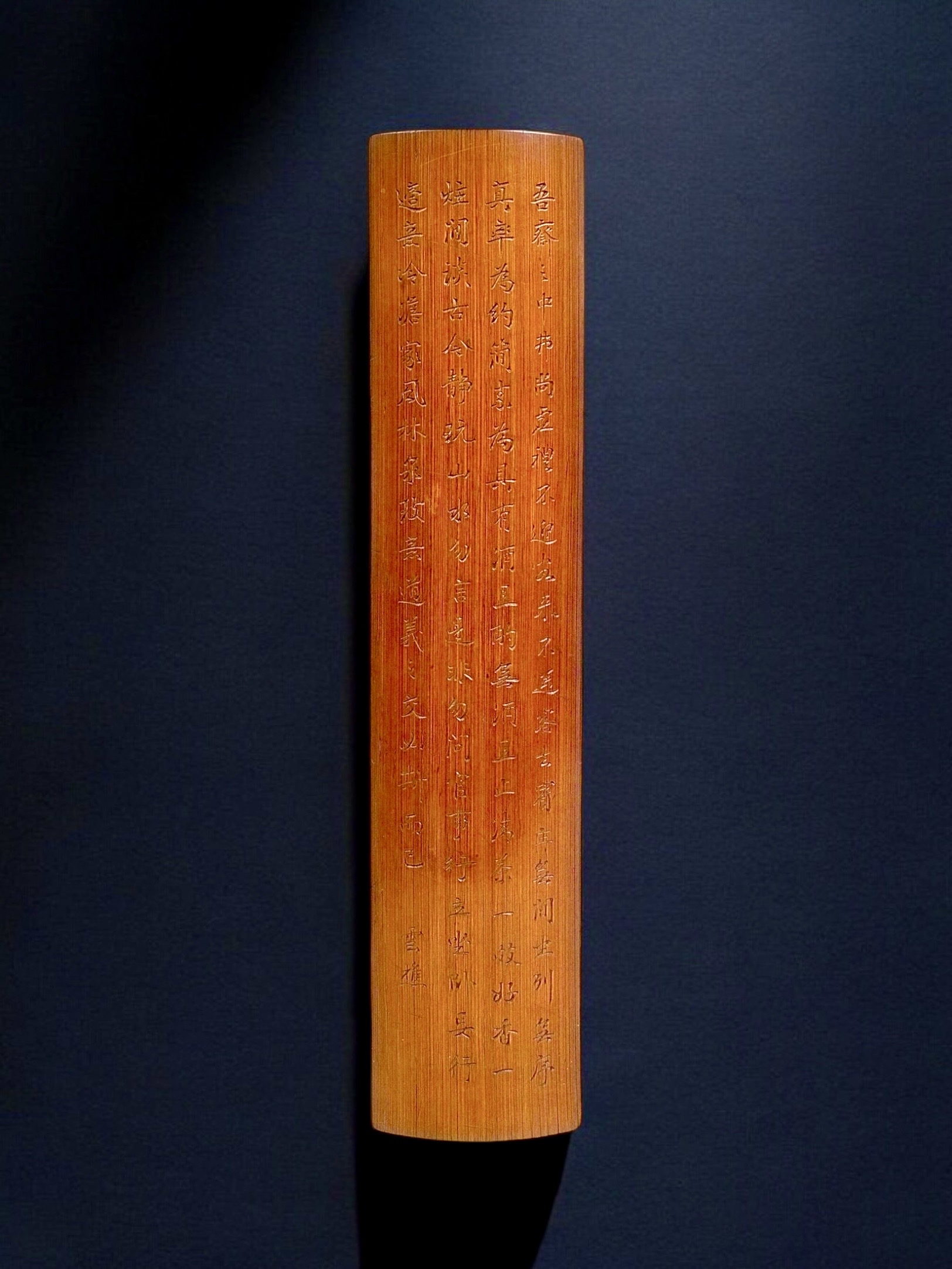
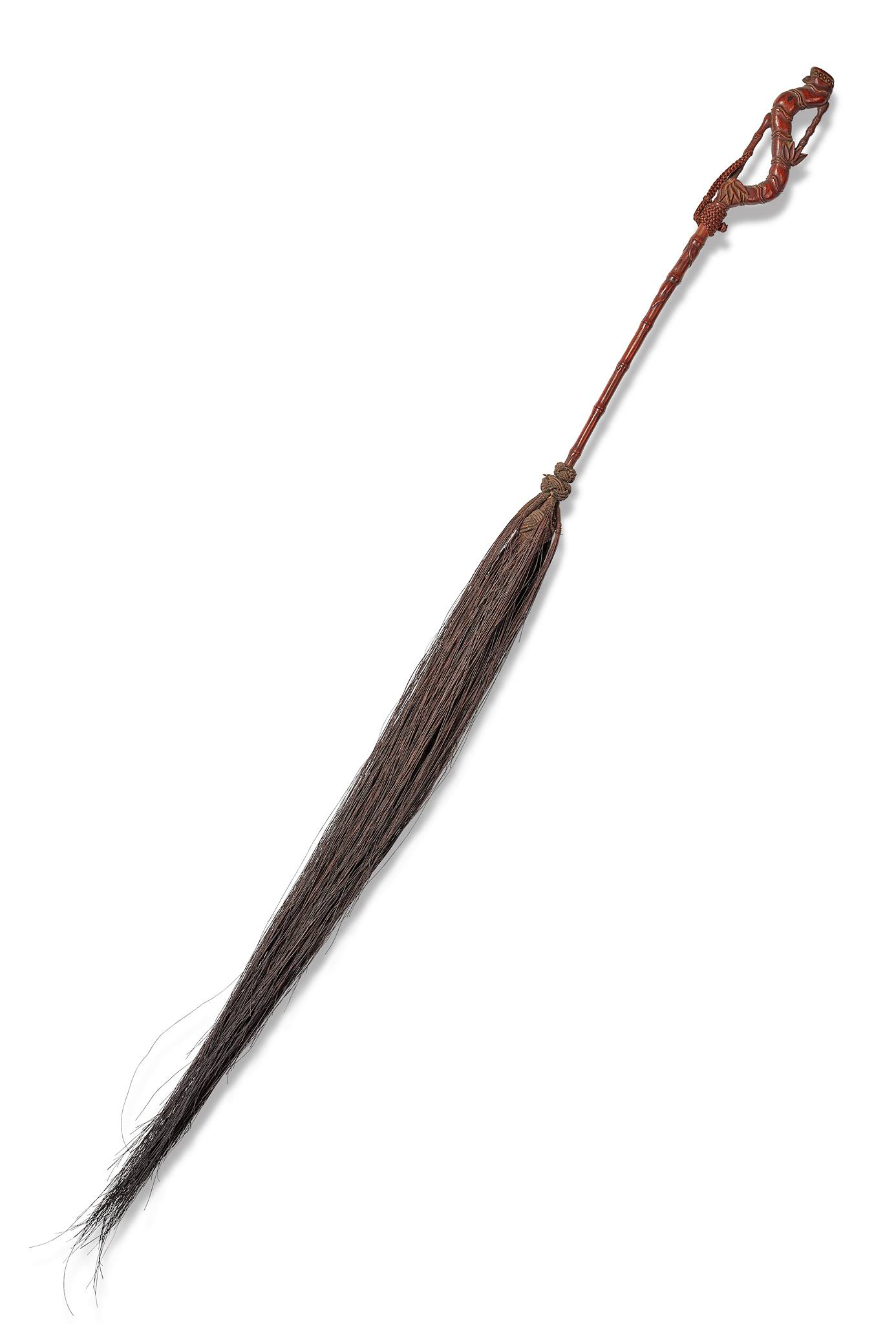
The Wrist Rest with Poem inscribed 'Yunqiao' shows text fitted to a long surface, while the Bamboo Fly Whisk joins a slender handle to a soft whisk. Both show that the placement of decoration is shaped by how the object is held and touched. The former arranges the poem along the surface; the latter concentrates sculptural form at the end of the handle. The relation between use and material therefore explains their forms better than classification by subject alone.
An object's name may suggest its use, but actual use requires examining the interior, wear, repairs and fittings. A cylindrical object with openings, for example, should be studied together with its internal structure before discussing how incense was used; a bamboo object with a cup cavity may be both a curio and a vessel. Such research turns function into a historical question that can be investigated, and helps identify later re-mounting, added lids or conversion into display pieces.
7. Space and Viewing: From Landscapes on the Vessel Wall to Miniature Worlds on the Desk
The spatial expression of Ming–Qing bamboo carving can broadly be examined through three relationships: the vessel wall, openwork and three-dimensional volume. Wall landscapes follow the curved surface, establishing distance through density, line and height differences; openwork brings the real background into the work, so that overlapping changes with light and angle; mountain carvings form miniature landscapes from a complete volume that the viewer can walk around. Each mode has its material conditions and produces a different rhythm of reading.
Narrative on a curved surface cannot be taken in at a single glance. As a brush pot is turned, the figure seen first gradually recedes to the side and new scenery comes into view, so time enters into viewing. Rocks, tree trunks and inscription areas can serve as turning points, giving pauses to a continuous scene. The two photographs of the Yun'an Orchid Pavilion brush pot from different angles are useful for understanding this kind of reading around the wall.
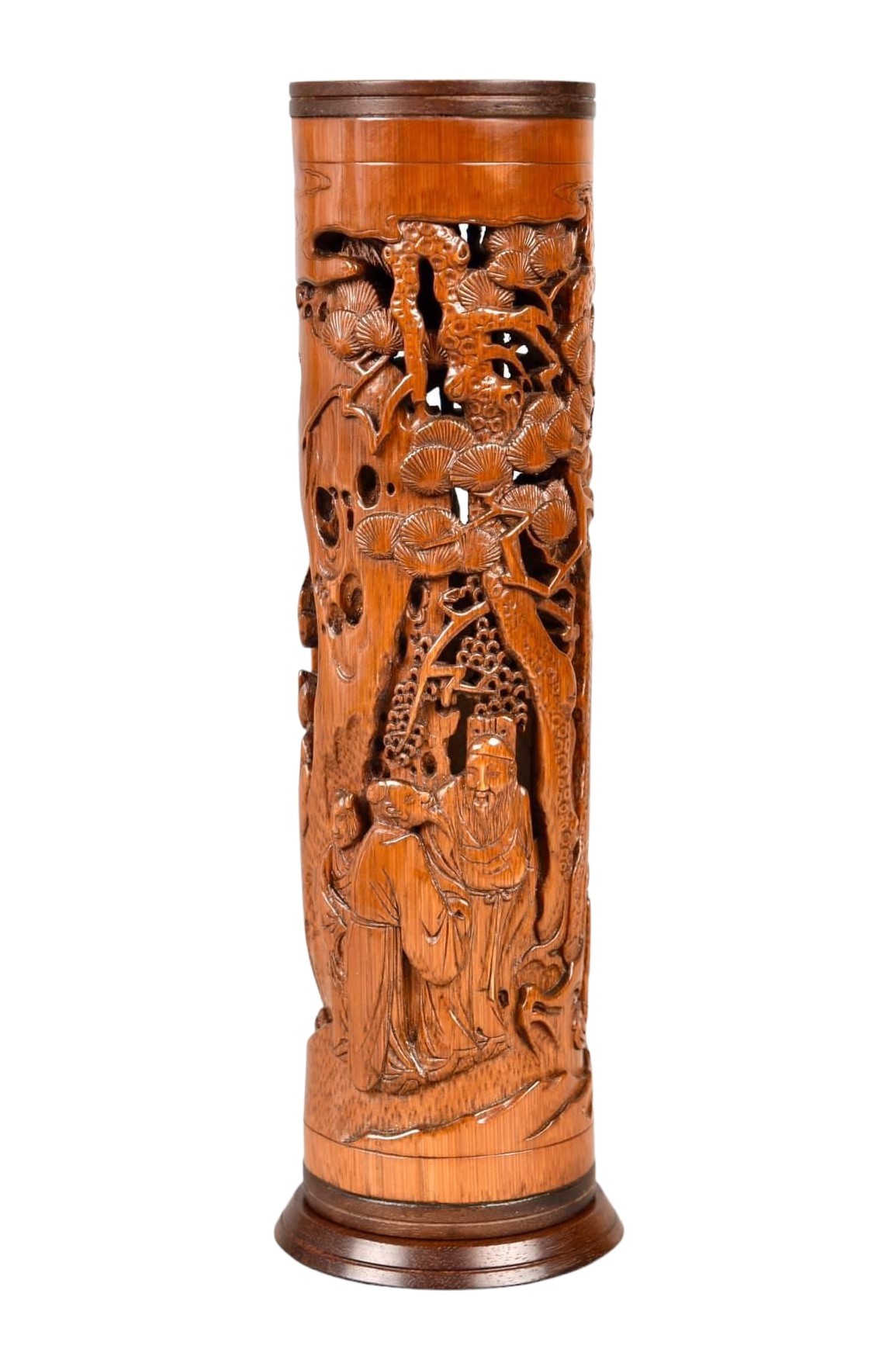
The Openwork Incense Holder with the Seven Sages of the Bamboo Grove makes voids part of the composition. The connections between figures, branches and rocks support the wall, while the front openings let the viewer see the rear layer. The proportion of solid to void affects both structure and appearance. The achievement of openwork can therefore be assessed by whether the subject is clear, whether the voids have rhythm, and how forms relate from different angles.
A miniature landscape depends on recognizable cues of scale. Roofs, pines, bridges, paths and figures lead the viewer to imagine mountains and forests far larger than the object itself. Carvers usually emphasize these cues while simplifying overly fine parts according to the strength of the material. Such choices organize natural landscape into scenery suited to close viewing, and the limited space of the desk can thus hold an imagined journey.
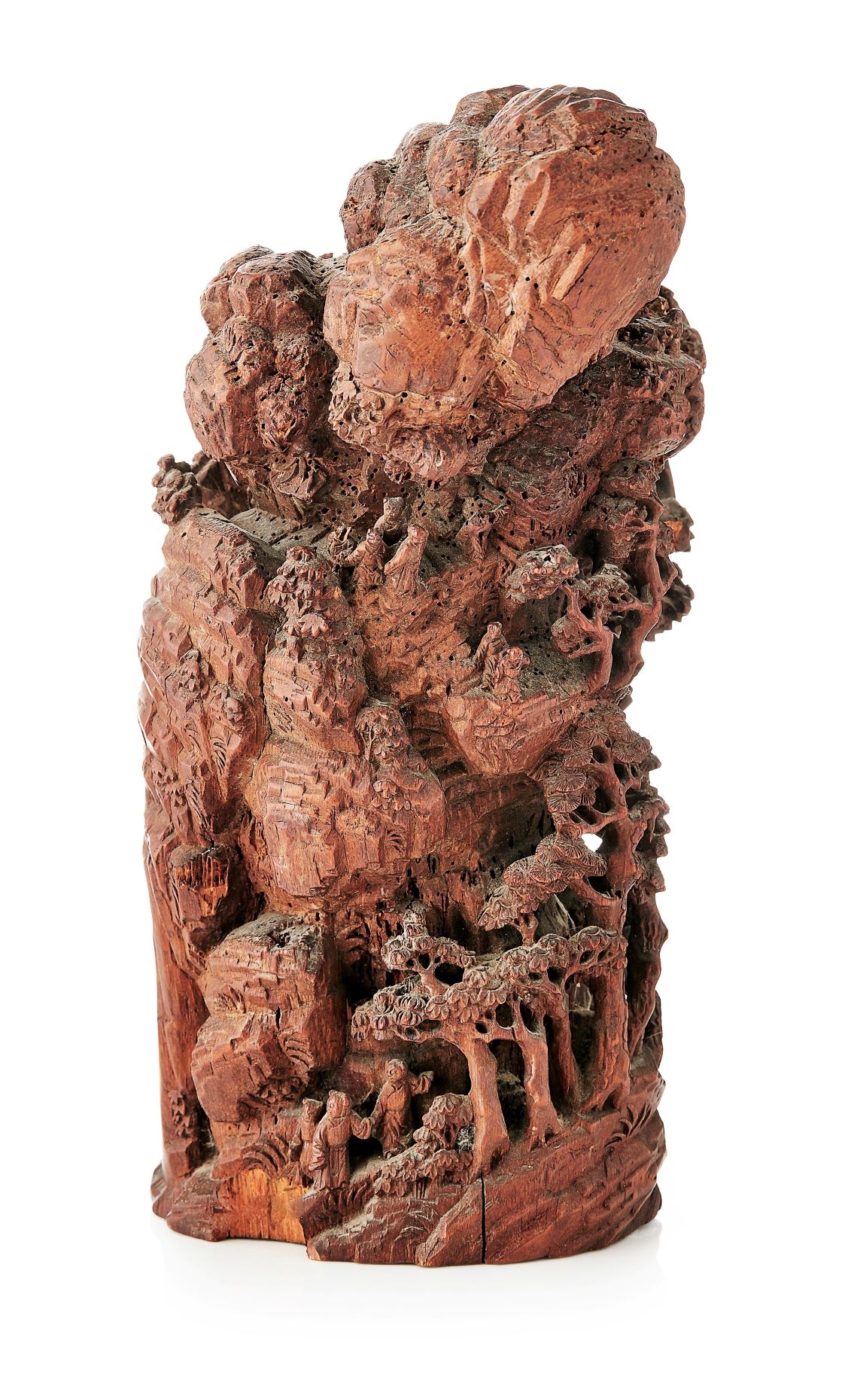
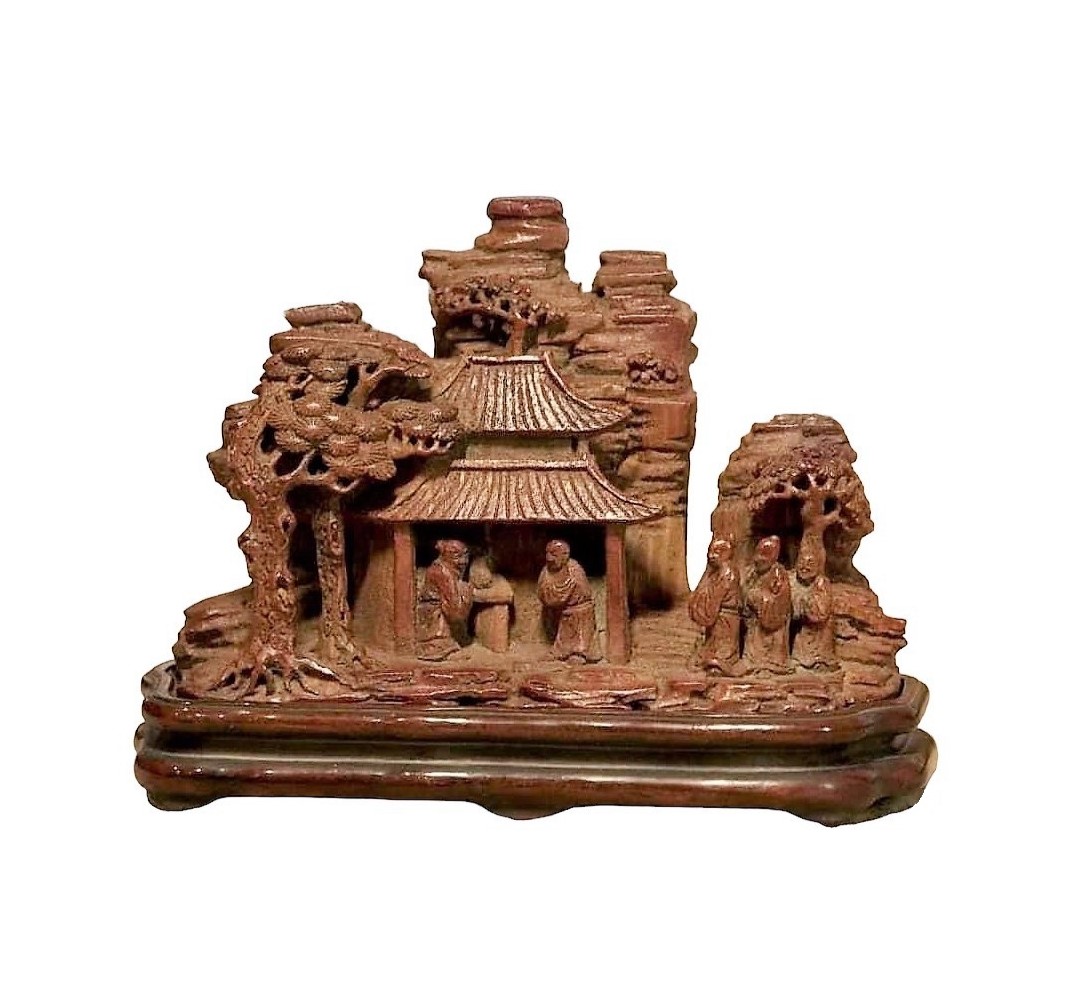
The towering Mountain Carving with Landscape and Figures and the horizontally extended Brush Rest with Figures under Pines offer two kinds of miniature construction. The former guides the eye upward through stacked rock masses; the latter unfolds horizontal relationships through pavilion, trees and rocks. They show that landscape composition in bamboo carving responds at once to the contour of the material, the direction of display and functional needs.
8. Style and Subject: Where the Literary, the Auspicious and the Religious Meet
Style and subject are related, but they still need to be studied on separate levels. Subjects such as the Orchid Pavilion, searching for plum blossoms and the Seven Sages offer literary memory and the ideal of the recluse; peaches, pines, deer and immortals carry associations of blessing and good fortune; bodhisattvas and arhats involve religious imagery. The same subject may be rendered in sparse intaglio or dense relief, and similar techniques may serve different cultural purposes. Only by combining identification of subject with formal analysis can the specific expression of a work be explained.
The so-called literati style may appear in the interplay of poetry, calligraphy and painting, in empty space, in antique flavour and in the imagining of life among mountains and forests. But these features should be demonstrated by a work's form and text, not inferred merely from the label 'studio object'. Auspicious subjects can likewise be made with sparse elegance, and literary stories can be carved densely. Style is thus the result of making choices, while subject provides the cultural background for understanding those choices.
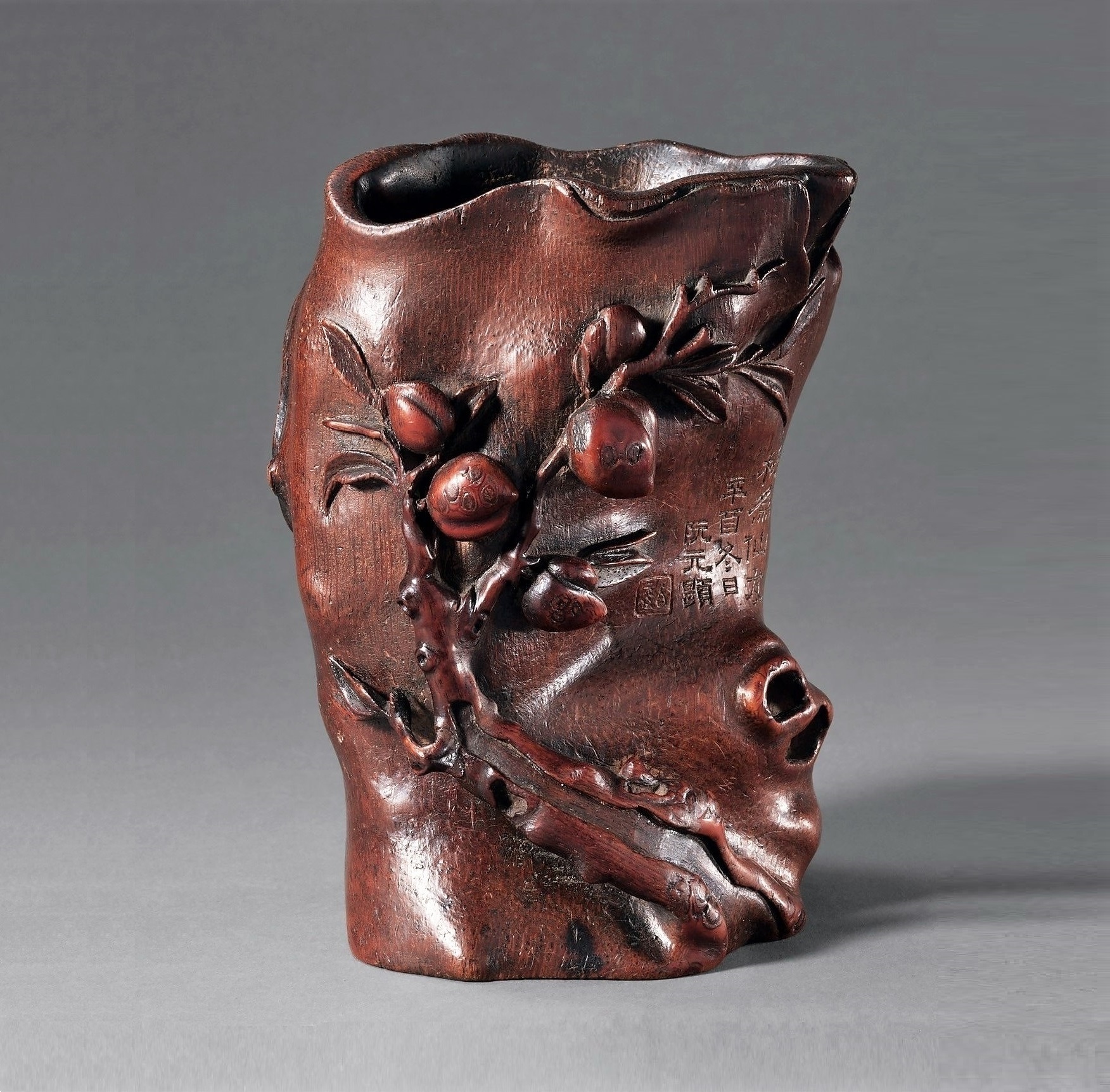
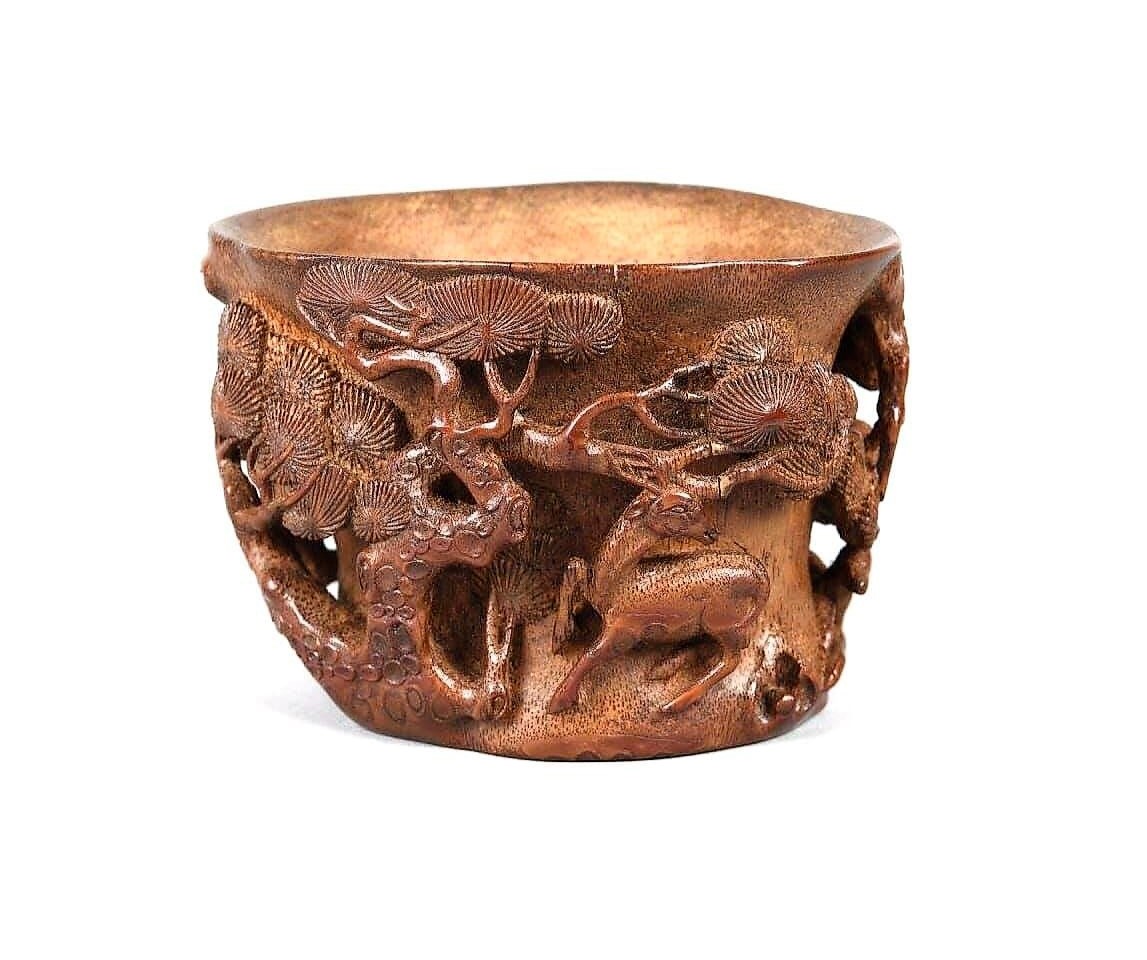
The Free-form Brush Pot with Nine Peaches absorbs peaches and foliage into its outer contour, while the Cup with Pine and Deer interweaves pine branches, animals and the space of the vessel. Both combine natural imagery, auspicious associations and functional structure, showing that imagery can go further and reshape form. When decoration becomes the rim, the cup wall or a supporting part, the subject participates in generating the overall form.
The entry of religious figures and auspicious immortals into small bamboo carvings also involves the circulation of images across different settings. Some works may relate to devotional use, while others were appreciated as curios or display pieces. Specific use must be supported by evidence such as original placement, attributes, stands and provenance. Research can first analyse iconographic clues, posture and drapery, then discuss how the object was used, avoiding equating subject directly with a single function.
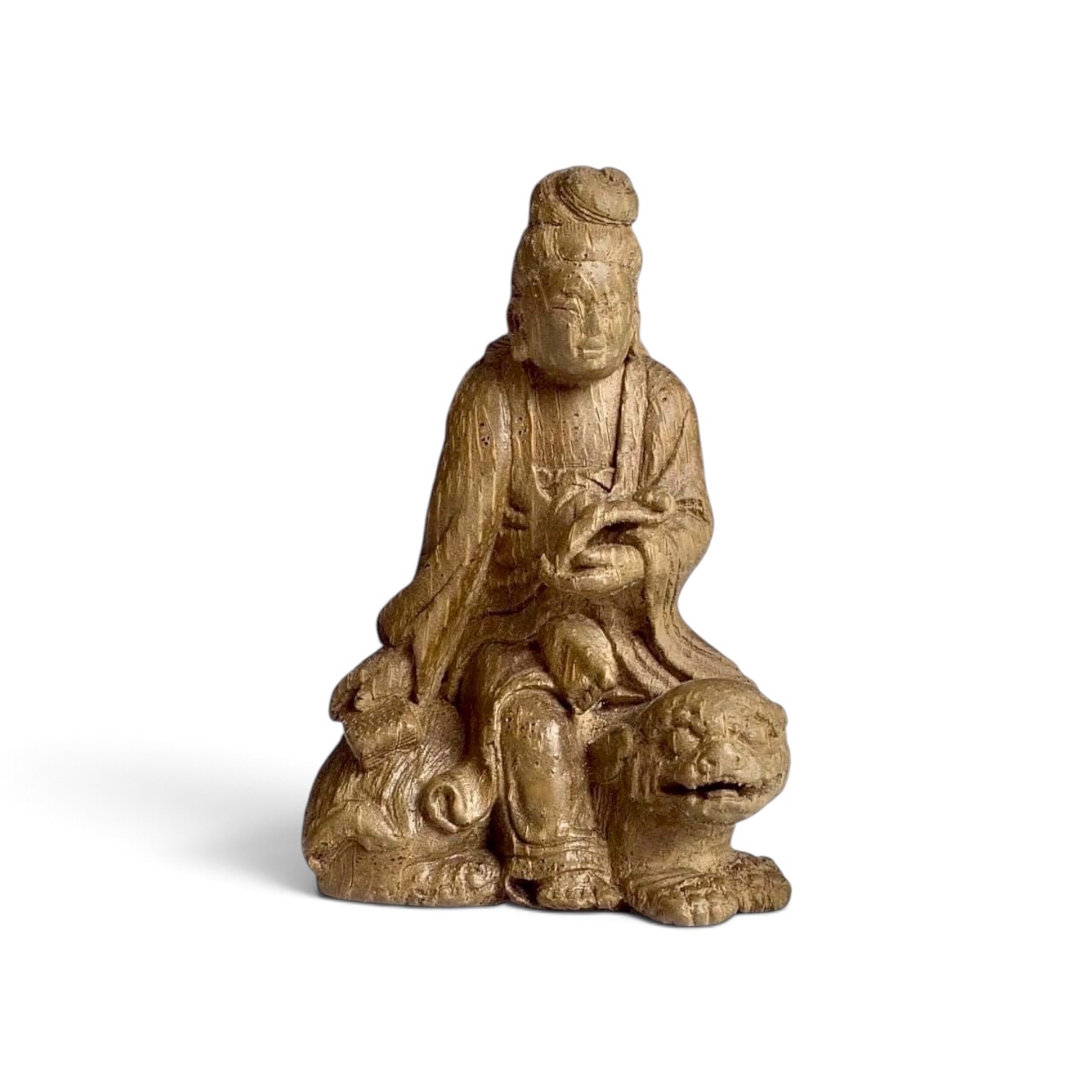
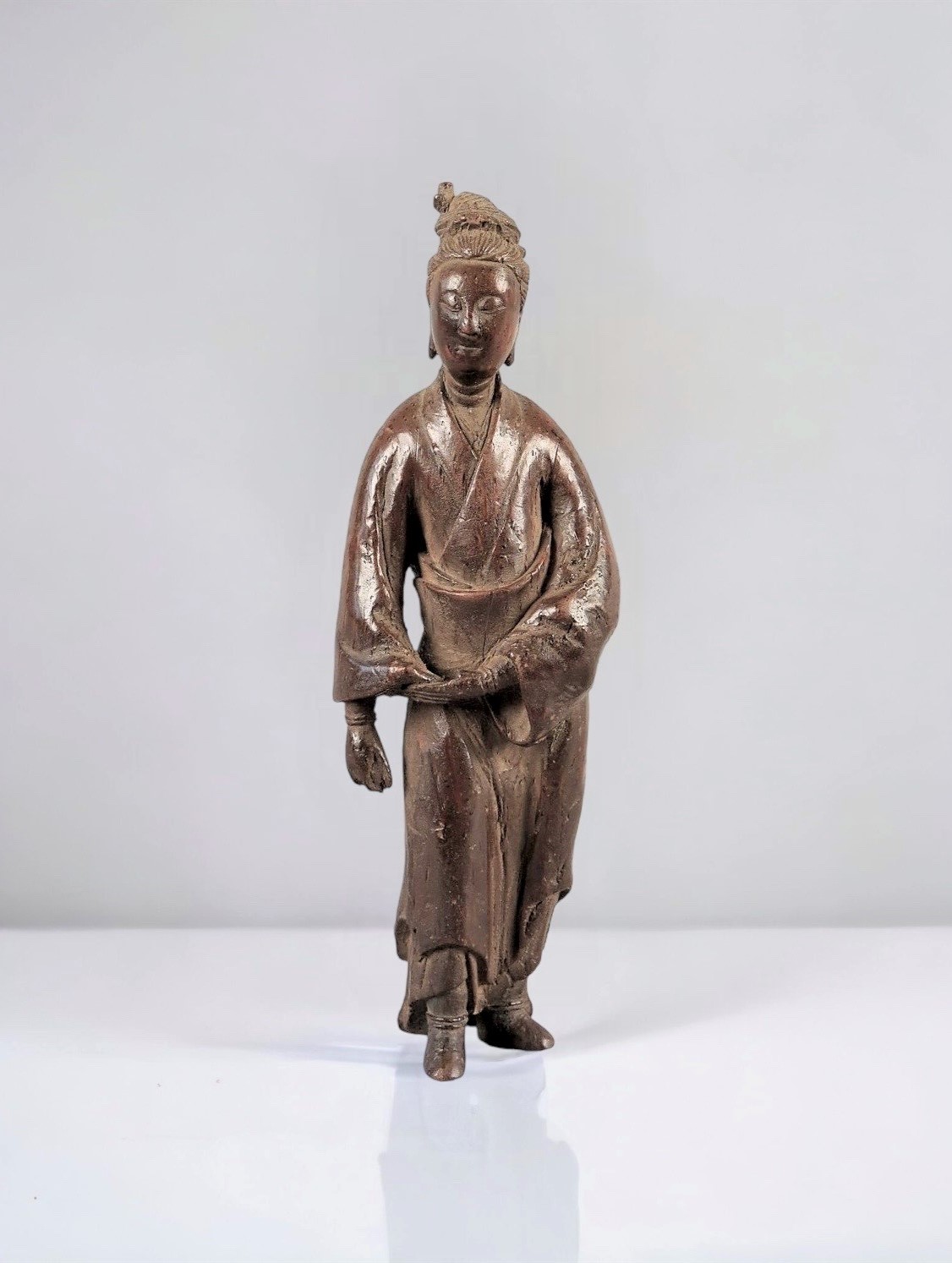
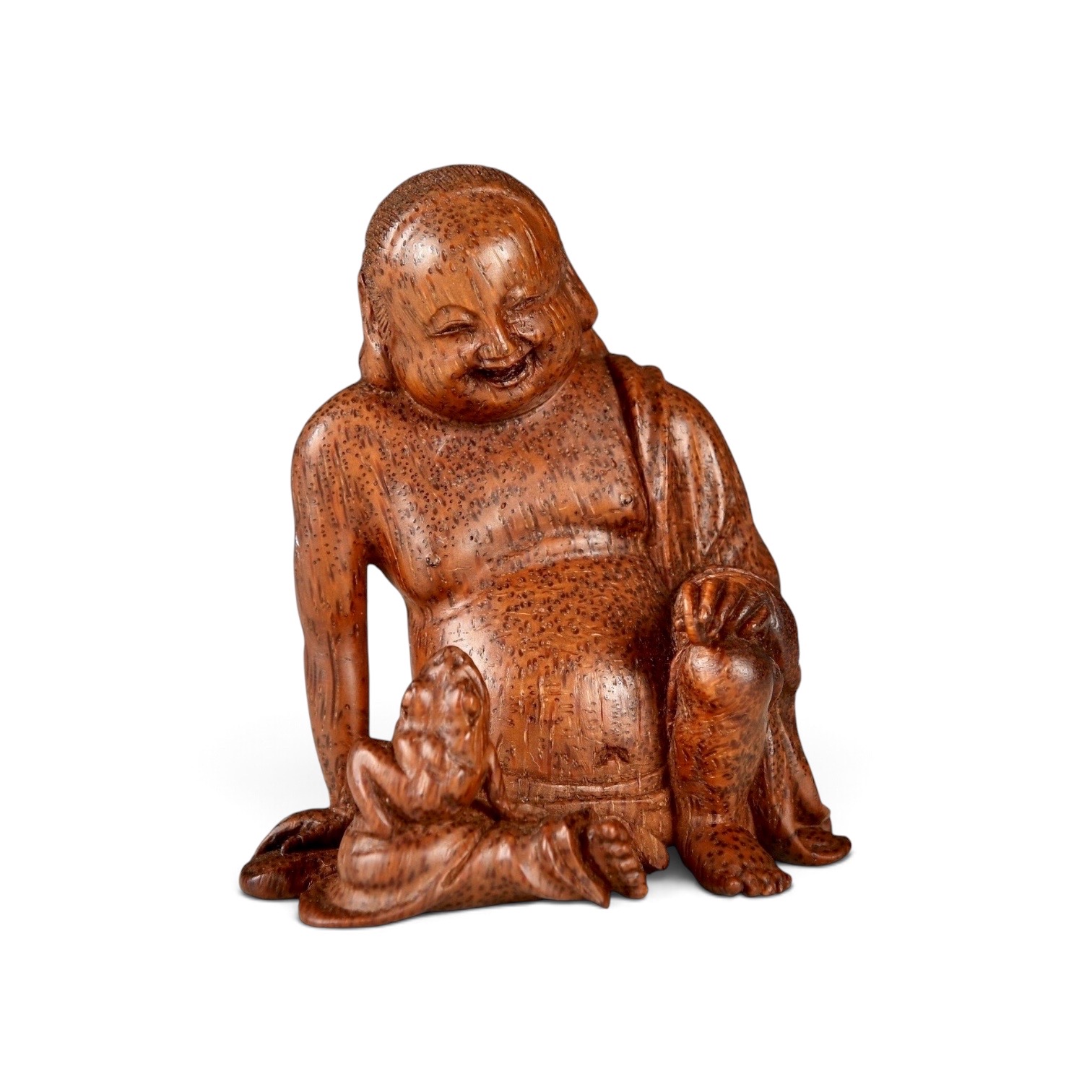
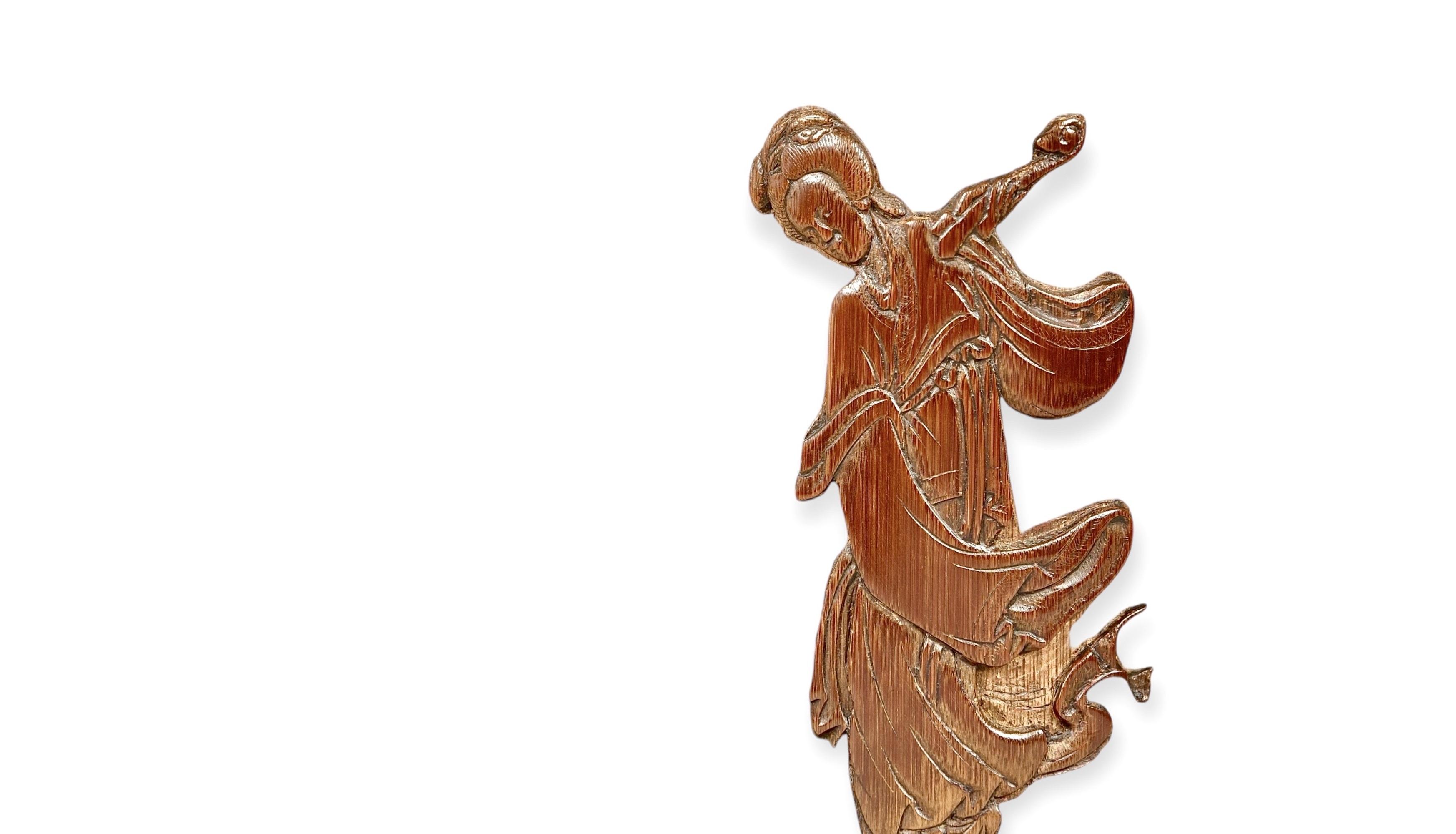
The Bodhisattva, the Lady and Liu Hai Playing with the Golden Toad allow comparison of figural modelling ranging from solemn to leisurely elegant to lively. The angle of head and shoulders, the centre of gravity, the flow of drapery and facial expression together establish character. Carving in the round in particular must resolve the sides and back so that the action holds as the viewer moves around it. These concrete sculptural choices explain the artistic achievement of bamboo figures better than generic praise such as 'lifelike' or 'exquisite'.
9. Court and Commoner: Exchange in Production, Imperial Inscriptions and Archaism
The relationship between court and non-court bamboo carving in the Qing can be traced along three lines: craftsmen, works and images. Works entered the imperial collection or court interiors, craftsmen might be summoned to take part in production, and designs and aesthetic requirements were transmitted between different production settings. Palace Museum research records the case of bamboo carvers of the Feng family of Jiading serving in the Hall of Mental Cultivation, providing documentary evidence linking local craft with court production.[13]
Court collecting could also change how existing works were viewed. Once an object was re-mounted on a new stand, inscribed with a poem, boxed or incorporated into a particular display, its meaning came to include that later stage of collecting. The Qianlong emperor's poem on the Palace Museum's Bamboo Brush Pot with Figures by Zhu Sansong shows that the carving and the imperial inscription can belong to different historical layers.[14] Studying a Qing-court-related object requires examining in sequence its production, entry into the collection, inscription and display in order to understand how each layer of evidence relates.
Archaism is another important topic. Bamboo carvings imitating bronzes involve recombining form, ornament and material. When the registers, taotie masks and handle types of bronzes are transferred to bamboo, carving methods and supports must be arranged according to the nature of the material, and the bamboo's own grain and sheen in turn alter the visual effect. Archaism can thus embody both an understanding of ancient forms and the contemporary maker's command of material.
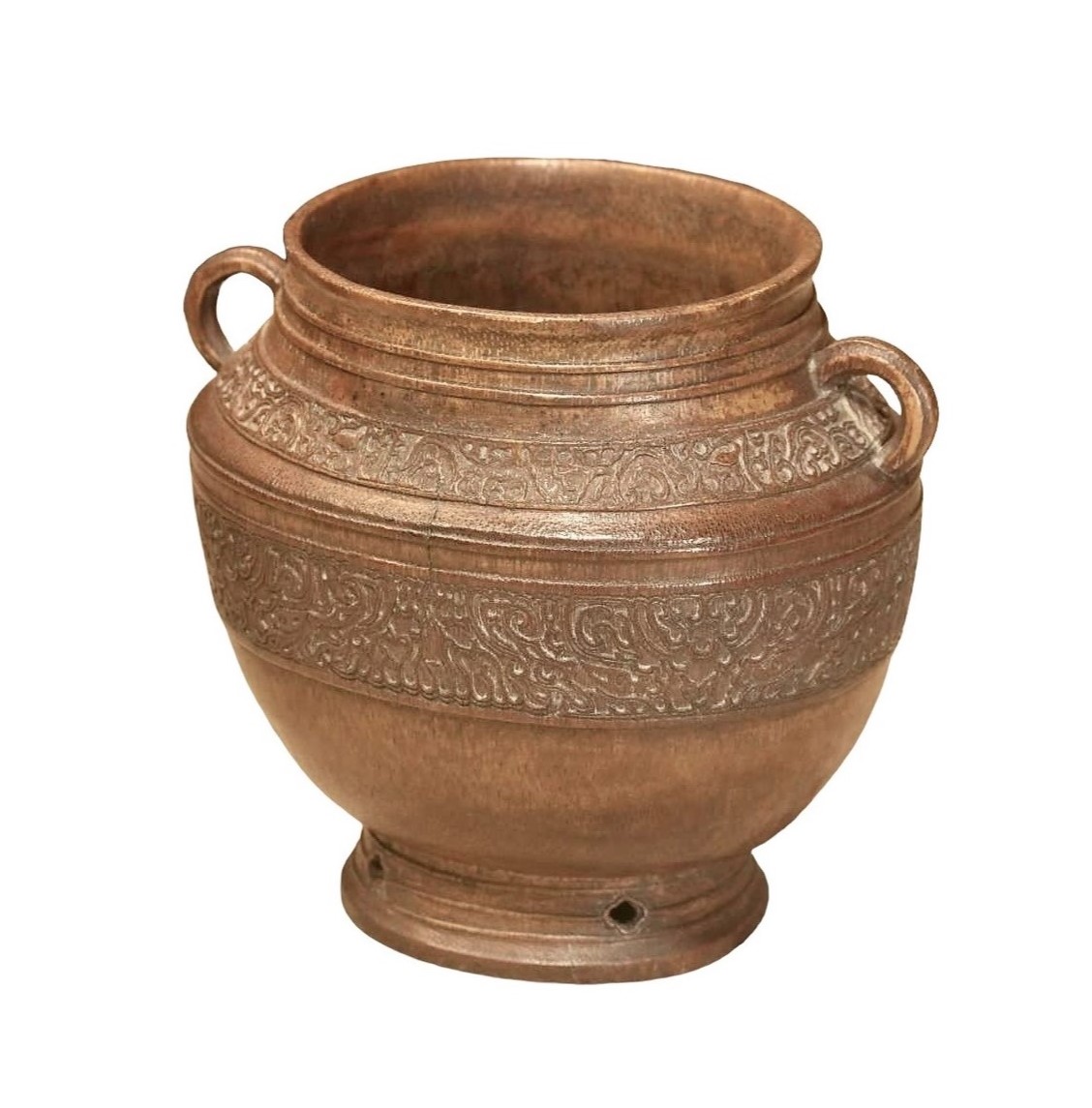
Yun'an's Zun Vessel with Taotie Decoration and Two Handles presents this translation through its symmetrical form and encircling bands. The National Palace Museum's Bamboo Vase with Tubular Handles and Animal-mask Decoration offers a comparable court-collection context, which the museum links to the antiquarian taste of the Qianlong period and to illustrated bronze catalogues.[15] Such comparison helps identify archaistic vocabulary, but whether a given exhibit was made for the court must still be supported by its own provenance and archival evidence.
Court taste was also internally varied. Ingenuity and intricacy could be admired, while antique elegance and weathered depth could equally serve as criteria. Research on the Palace Museum's Wenzhu Vase with Plantain-leaf and Taotie Decoration connects mid-Qing archaistic bronze forms with court taste, social fashion and scholarly culture.[16] Summarizing all works as 'literati restraint versus court opulence' therefore cannot adequately explain the coexistence of archaistic bamboo objects with other finely crafted wares.
From the broader perspective of craft history, bamboo carving stood at the meeting point of local technique, literati connoisseurship and court demand. The same craft could serve different users, and the same image could move between materials and production settings. Such exchange let schools, styles and functions influence one another, and it was through this that the diverse face of Ming–Qing bamboo carving gradually took shape.
10. Signatures, Records and the History of Connoisseurship: How Works Became Masterpieces
Studying the makers of bamboo carvings requires distinguishing between signatures on the object, stylistic judgement and textual records. A signature is writing on the physical object; stylistic judgement rests on formal comparison; records concern when a work was documented and how it was transmitted. When the three support one another, attribution becomes clearer; when they disagree, the discrepancy itself may reveal a history of inscription, emulation or later collecting.
Works such as Records of Bamboo Carvers preserve carvers' names, activities and critiques, while also reflecting the compilers' regional positions and value choices. Wang Shixiang's discussion of schools is an example of re-examining established classifications.[5] Texts therefore both provide information and need to be studied themselves. Reading them against surviving objects makes it possible to check whether written