

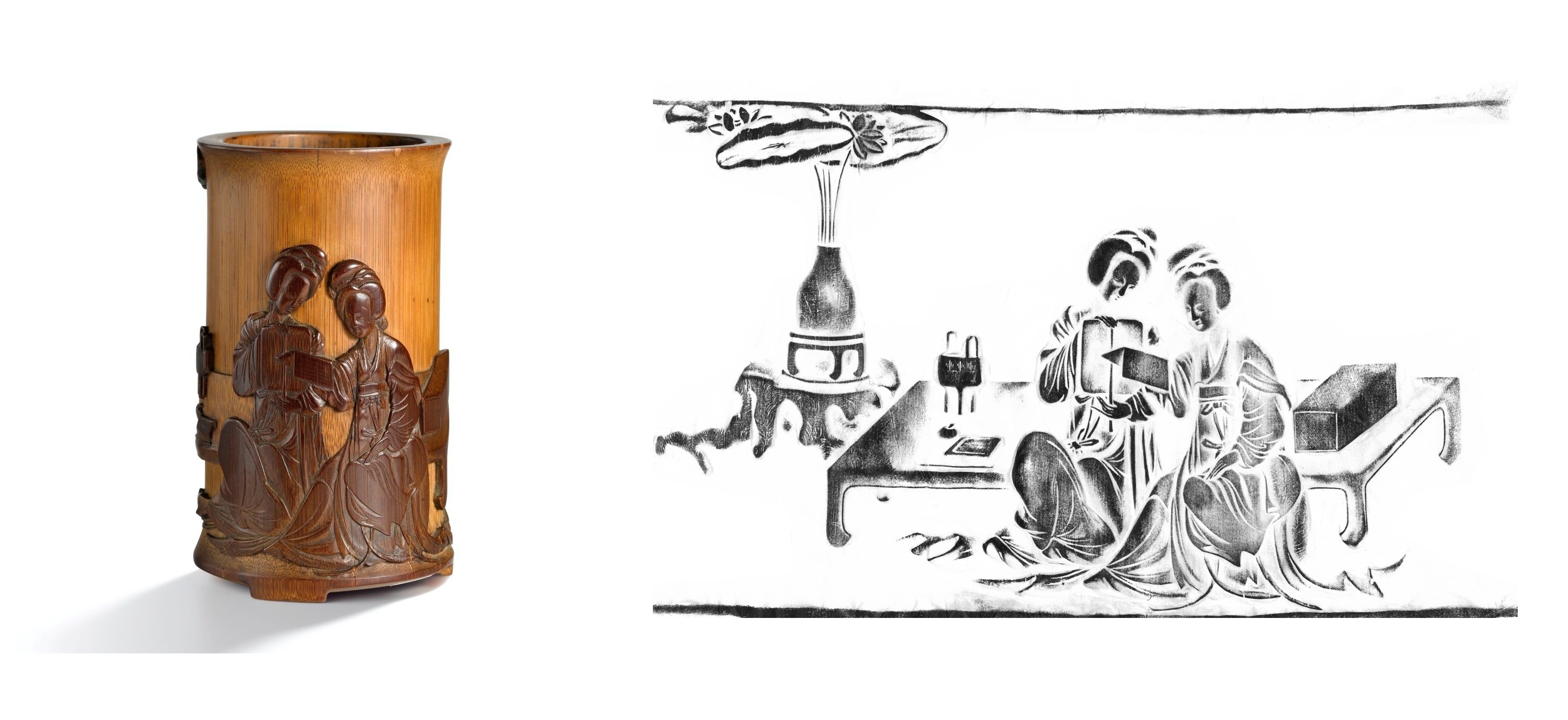
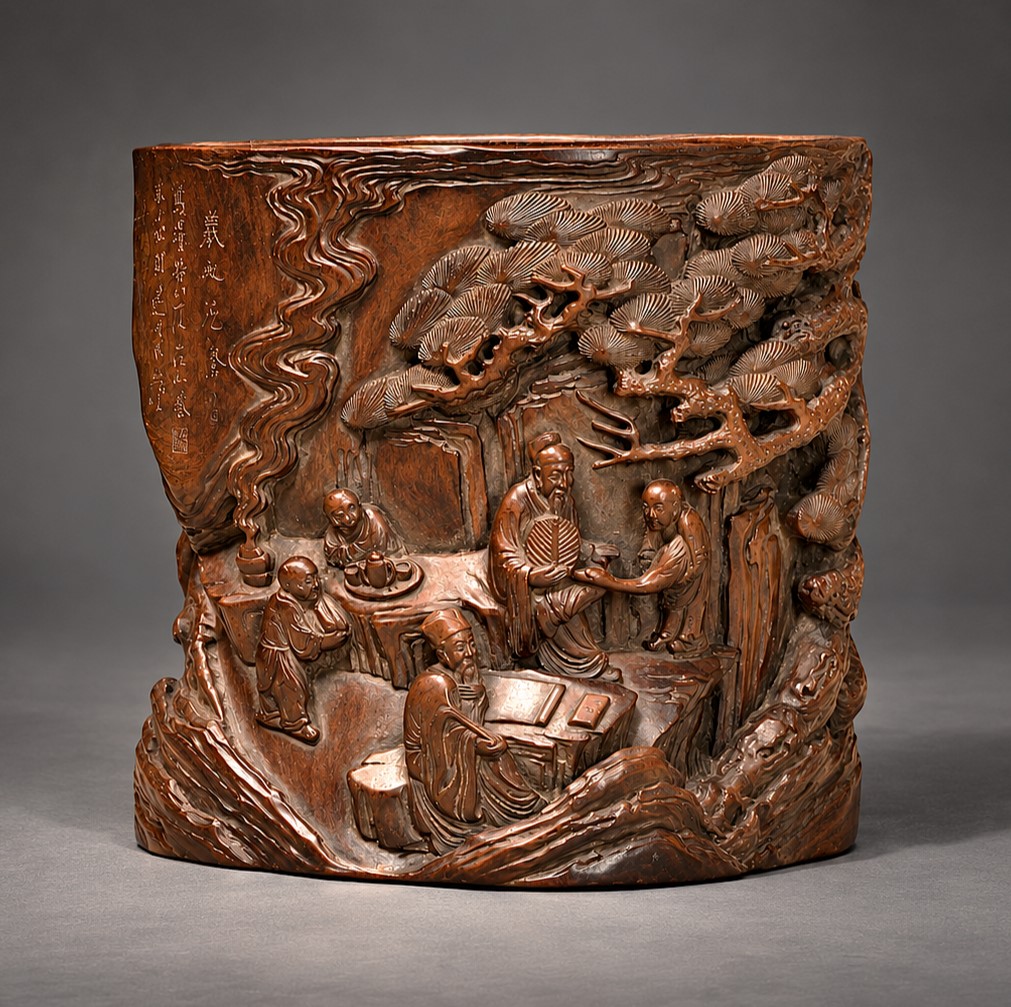
The Qing bamboo Orchid Pavilion and a Ming pot carved with a lesson at home offer two ways into this collection. One invites the viewer to turn the vessel to follow a gathering. The other compresses the exchange between teacher and child into the space before a screen. What room does a maker find inside the narrow compass of a writing implement?
How a bamboo node becomes a base
The late Ming bamboo brush pot with a mother instructing her child measures 15.5 cm high. A cross partition at a bamboo node forms the floor of the vessel. The hollow stem takes the brushes while the outer wall provides a field for carving. The catalogue describes the work as being in the style of Zhu Sansong, a useful distinction between stylistic comparison and documented authorship.
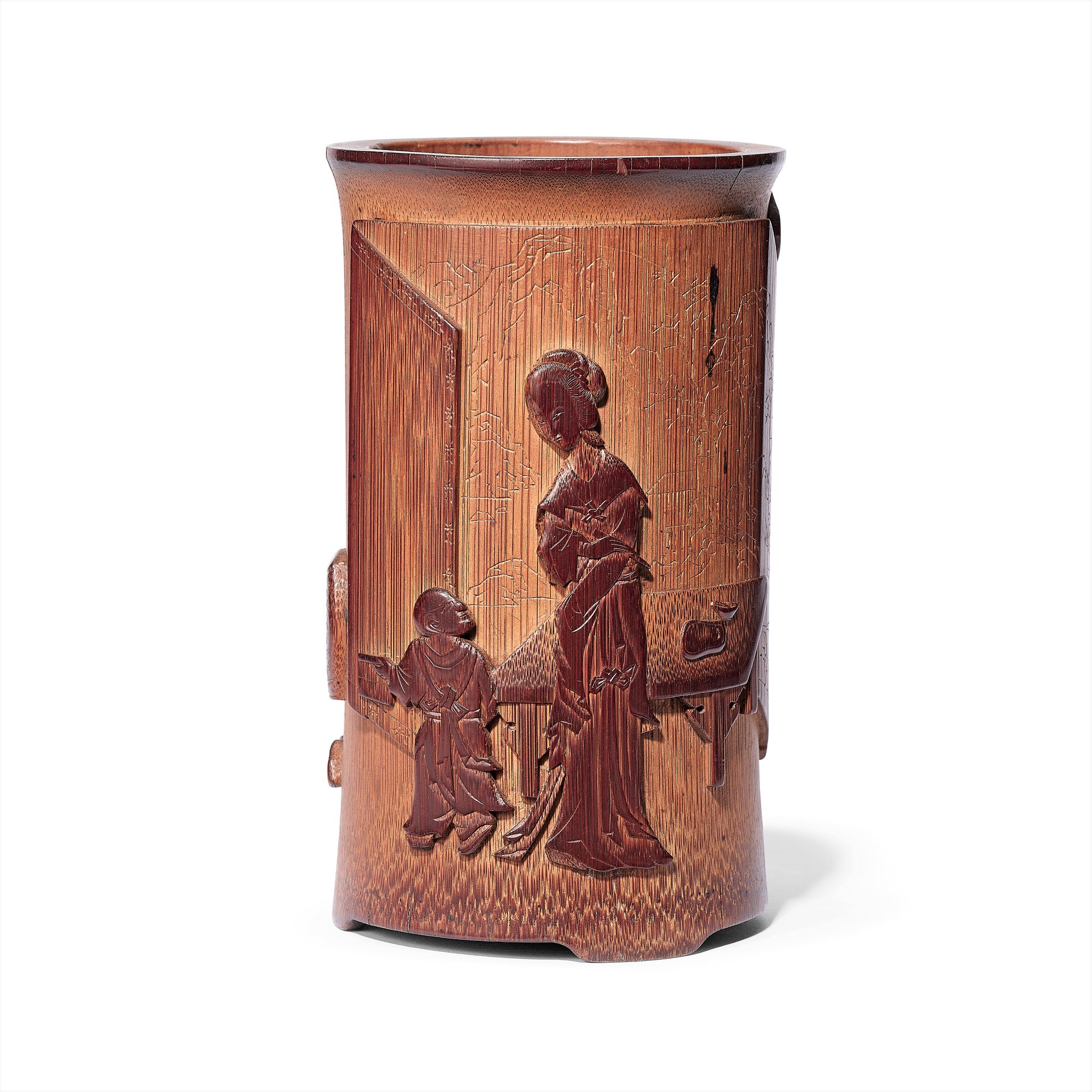
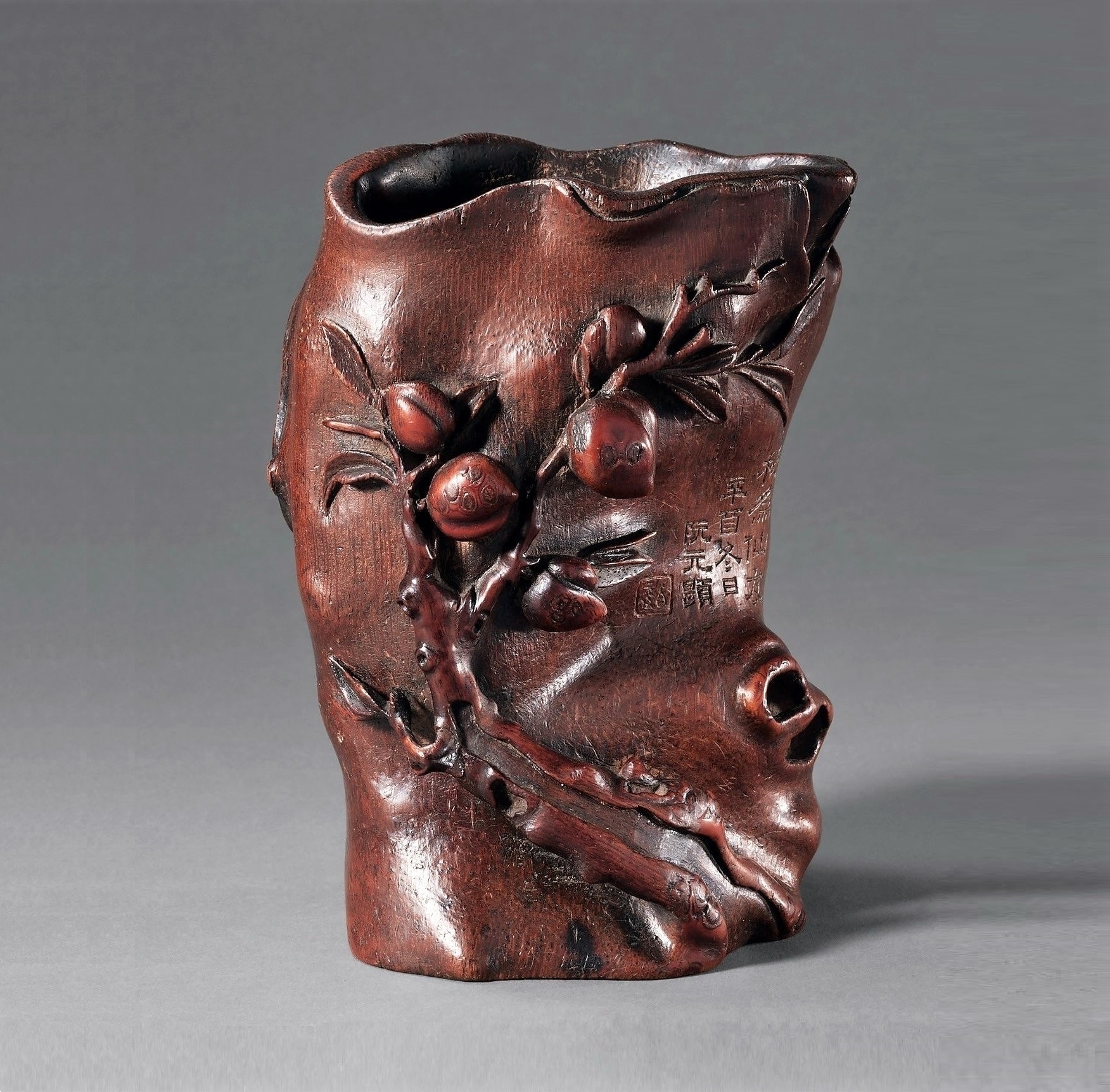
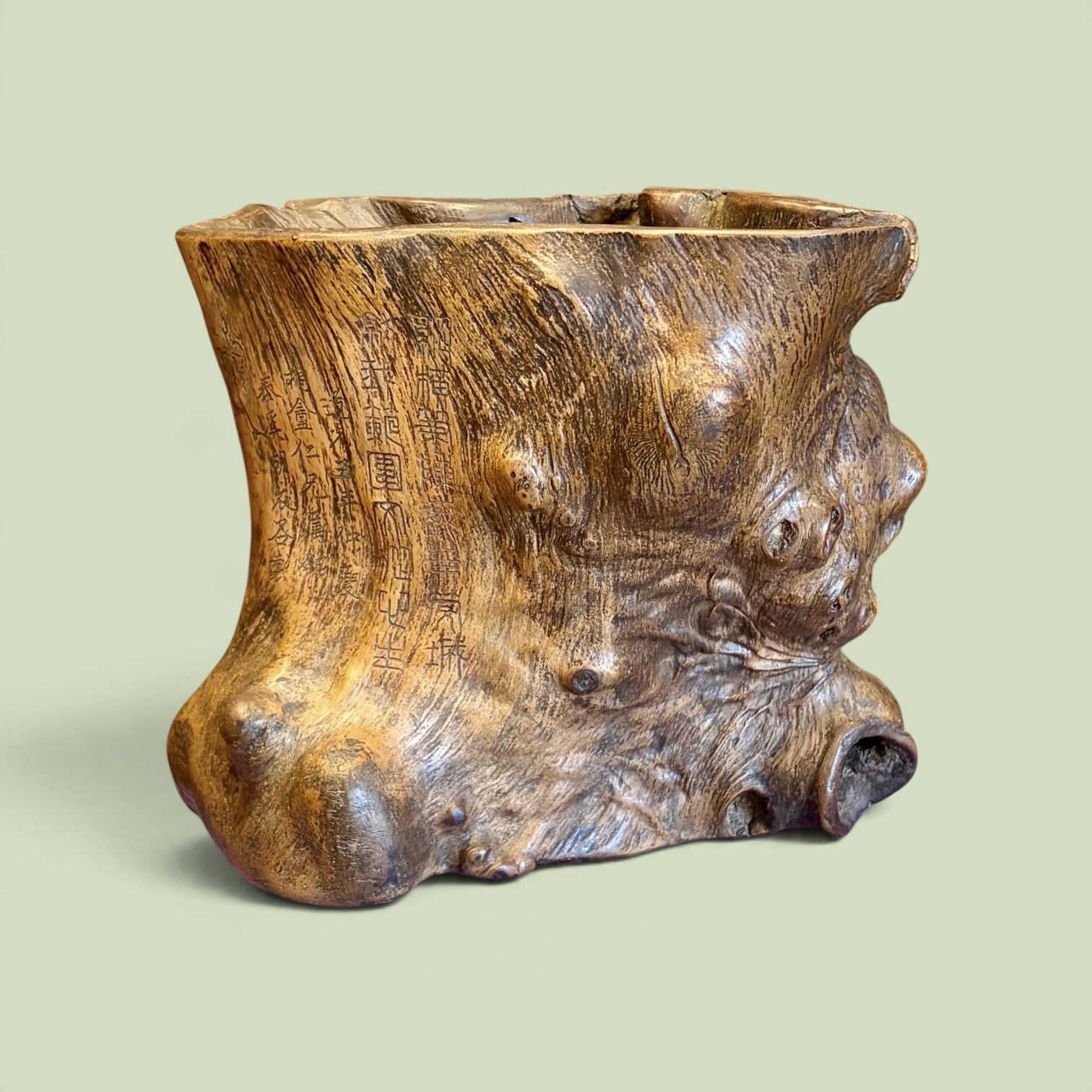
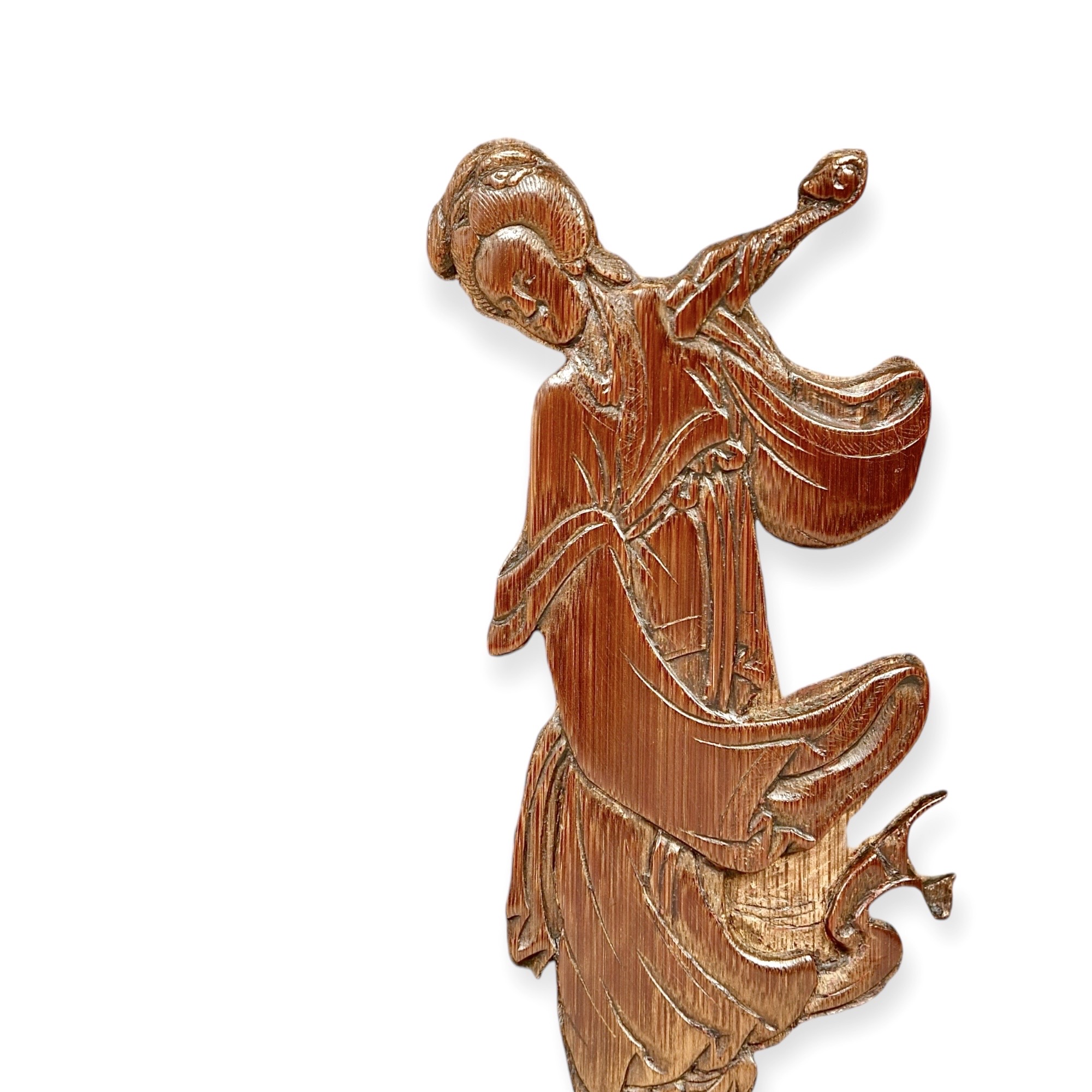
A woman holds a brush and the child looks up from a book. An inkstone and a small vessel stand on the table before the screen. A furnishing for a writing desk thus carries a scene of writing at another desk. The Qing pot with nine peaches makes different use of its bamboo: branches follow the curve of the stem. A root-burl example carries the irregularity out to the silhouette itself. Following the rim down to the foot reveals choices that a frontal view alone can conceal.
Low relief and the fall of light
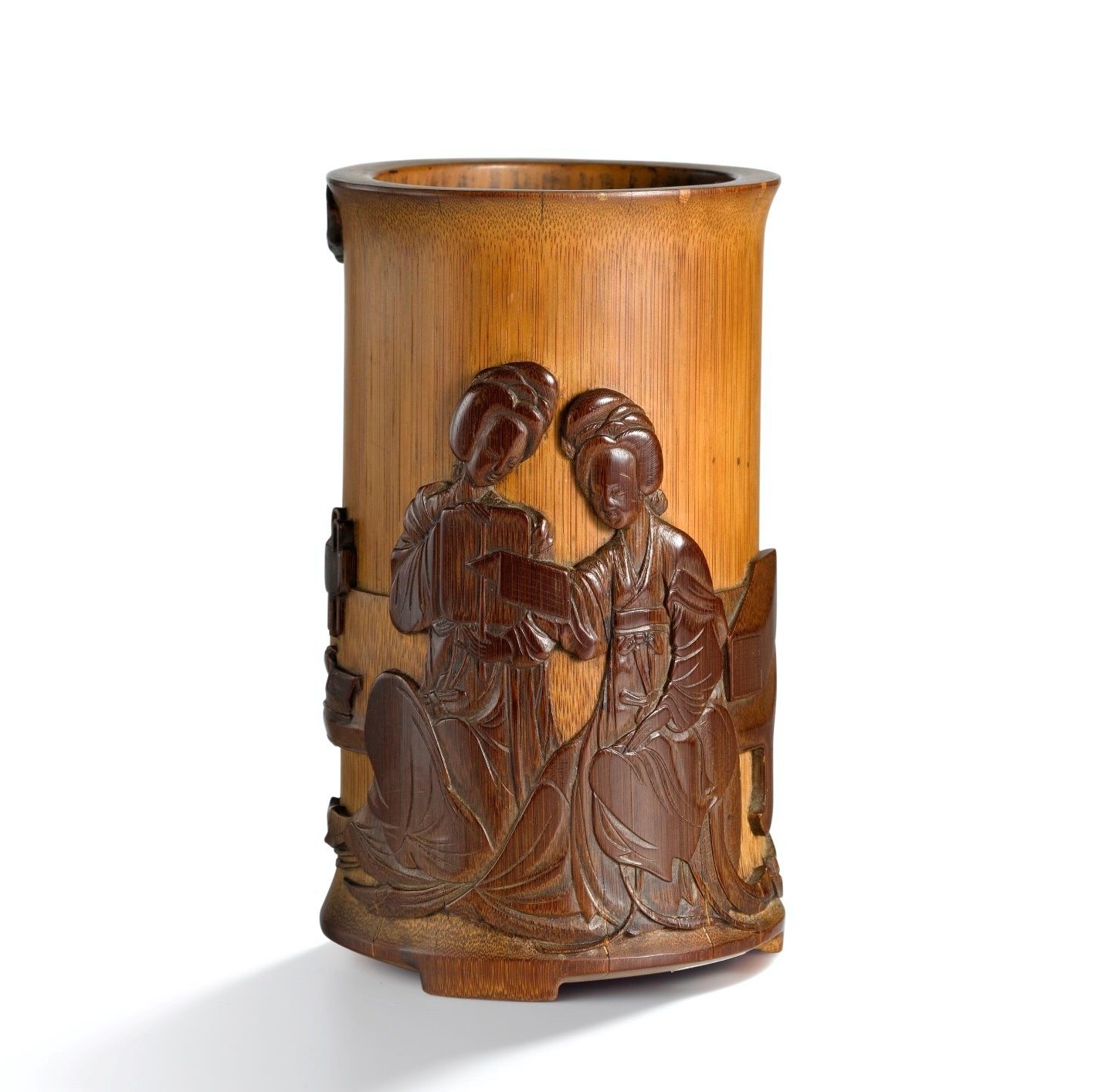
The Two Qiaos Reading Together sets two women at a desk. The line of the tabletop brings their attention to a common focus. Areas left smooth give small rises in the carving room to register. The catalogue describes the technique as bodi yangwen, low positive relief. The surrounding ground is cut back just enough for a fold or an edge to cast a fine shadow in raking light.
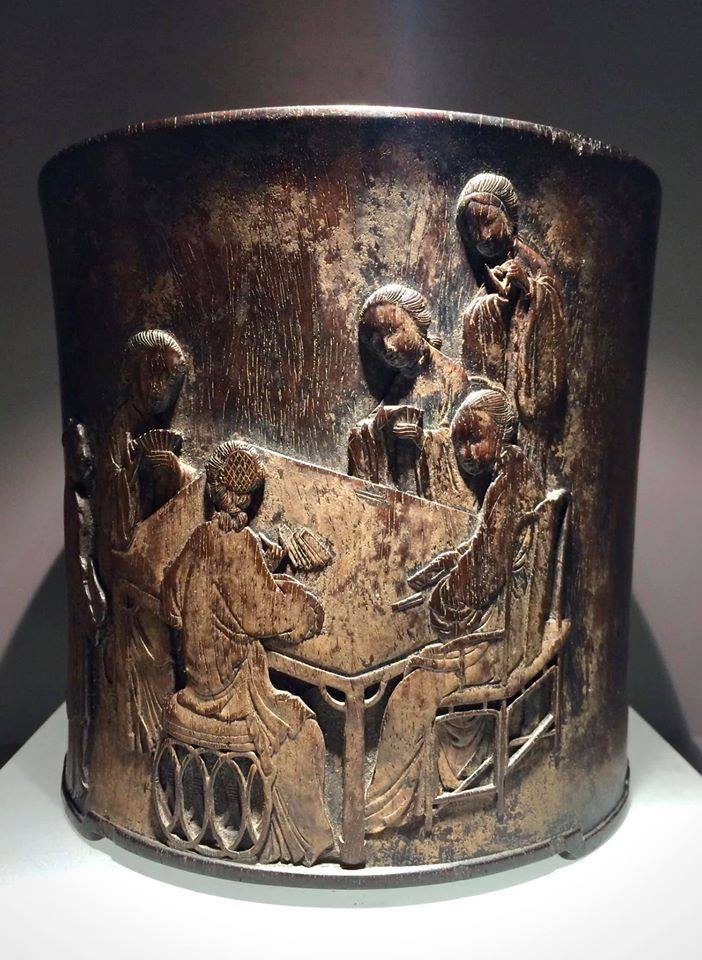
An early Qing zitan brush pot portrays women playing a board game in higher relief. In one work the direction of reading connects the figures. In the other, the board determines where the players sit and look. Their activities explain the compositions more precisely than the broad catalogue category of “ladies.”
Reading the Orchid Pavilion around a cylinder
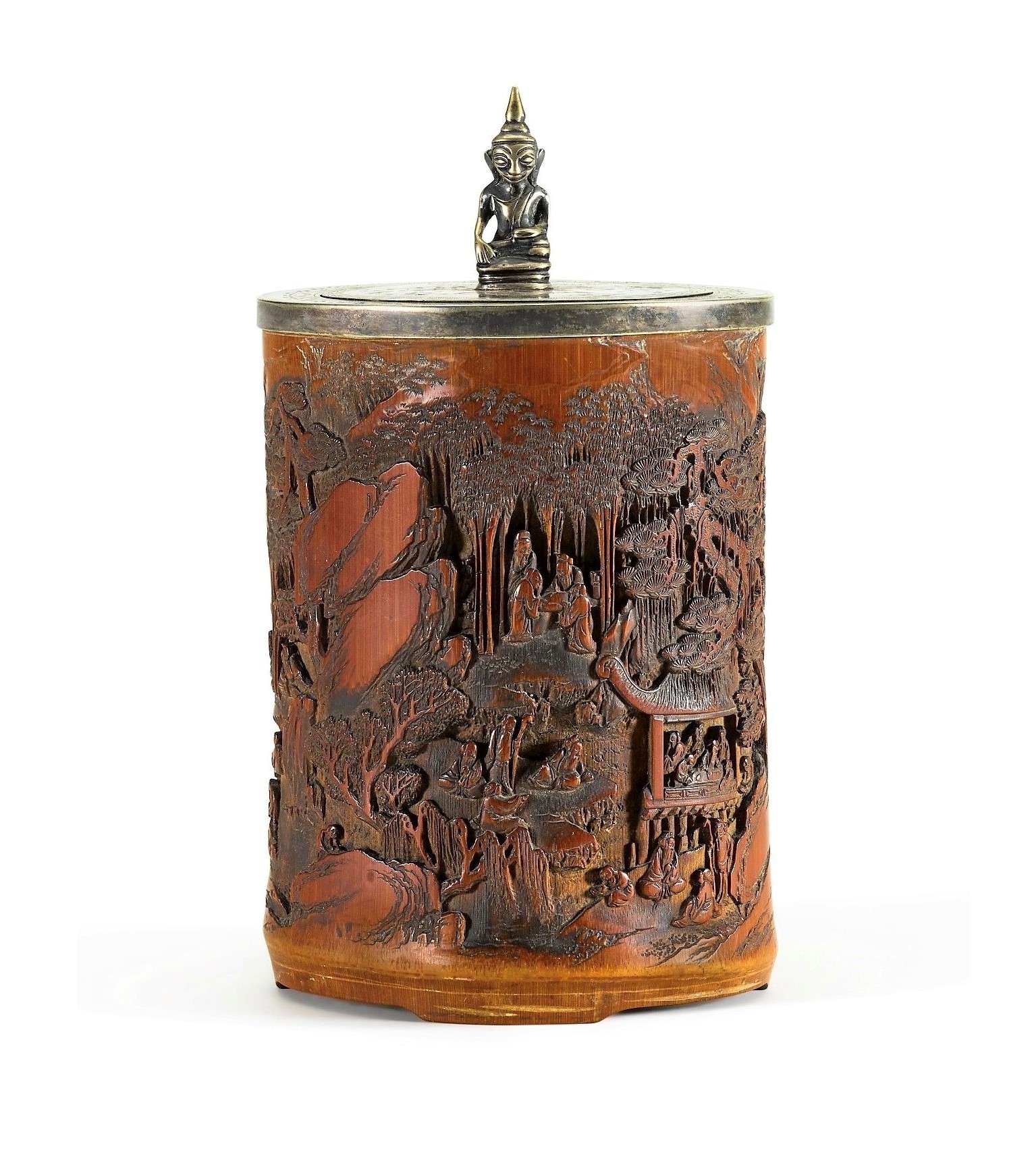
The museum’s mid-Qing bamboo Gathering at the Orchid Pavilion is 19.5 cm high and bears the mark Meilin. In 353, Wang Xizhi and his companions gathered at Kuaiji to drink and compose verse beside the water. A cylinder gives the carver a problem unlike that of a handscroll: the far side always eludes the viewer. A bank or a rock can close one passage and lead the eye into the next as the pot turns.
The Metropolitan Museum of Art holds an eighteenth- to nineteenth-century nephrite version, accession 02.18.679, measuring 20.3 cm high and 22 cm across. The comparison separates subject from medium. Which visual clues identify the gathering, and how clearly do figures emerge against stone or bamboo? A Ming zitan pot here tells a different Wang Xizhi story: the association of the calligrapher with geese replaces the gathering of poets as the identifying motif.
Wood grain, poetry and the inscribed line
The Qing huanghuali pot with plum blossom and poetry is 21 cm high and 22.3 cm in diameter. Both branches and characters are incised. Grain passes through the intervals between characters, and the spare branches recall a painted plum while retaining the distinct rhythms of cut wood. The catalogue distinguishes an inscription by Ruan Yuan from writing by Zhu Zhe. Composing a text, writing its model and cutting it into wood are separate acts to document.
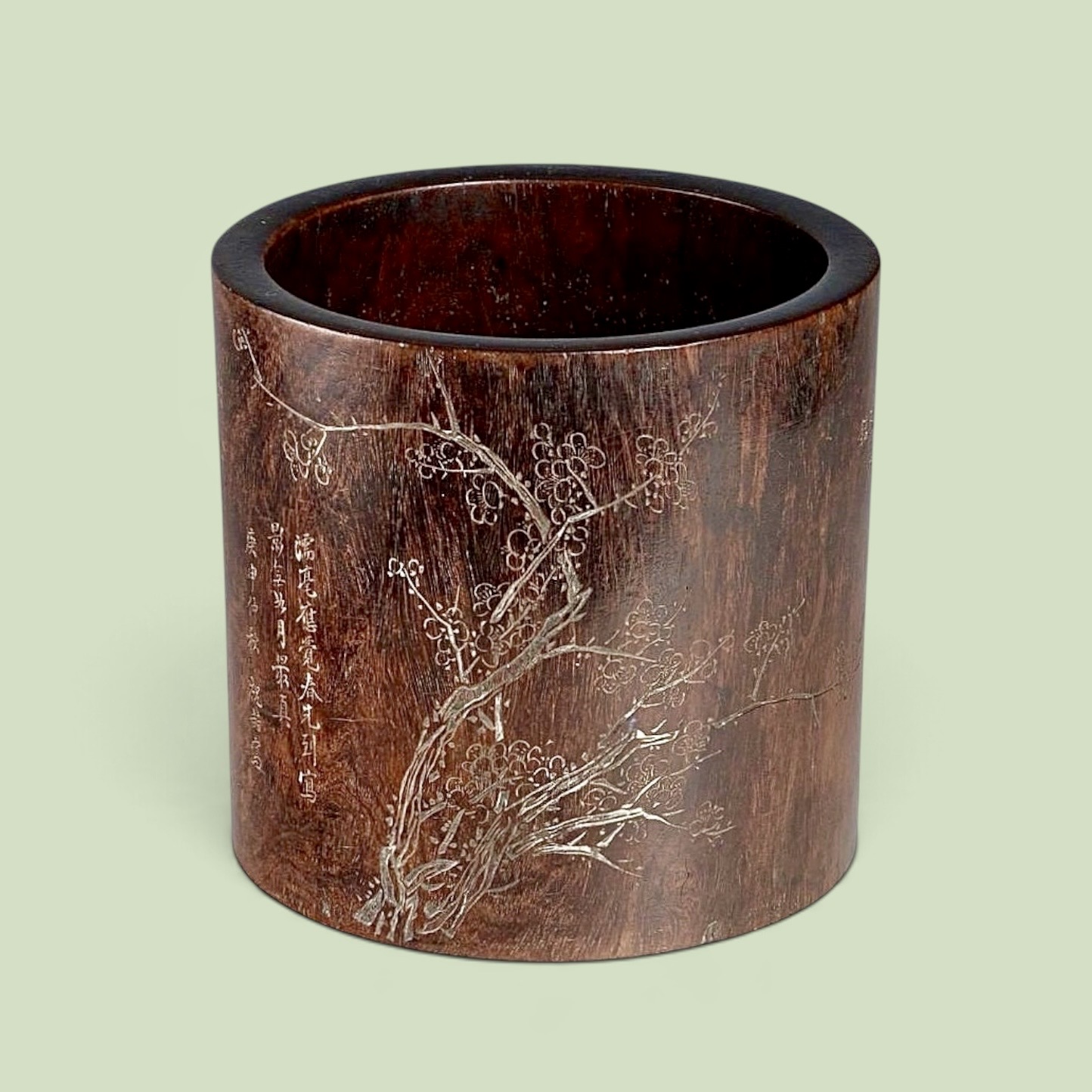
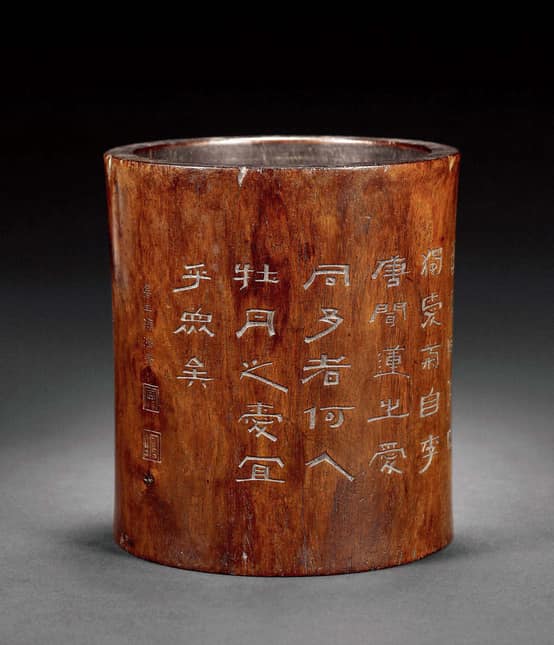
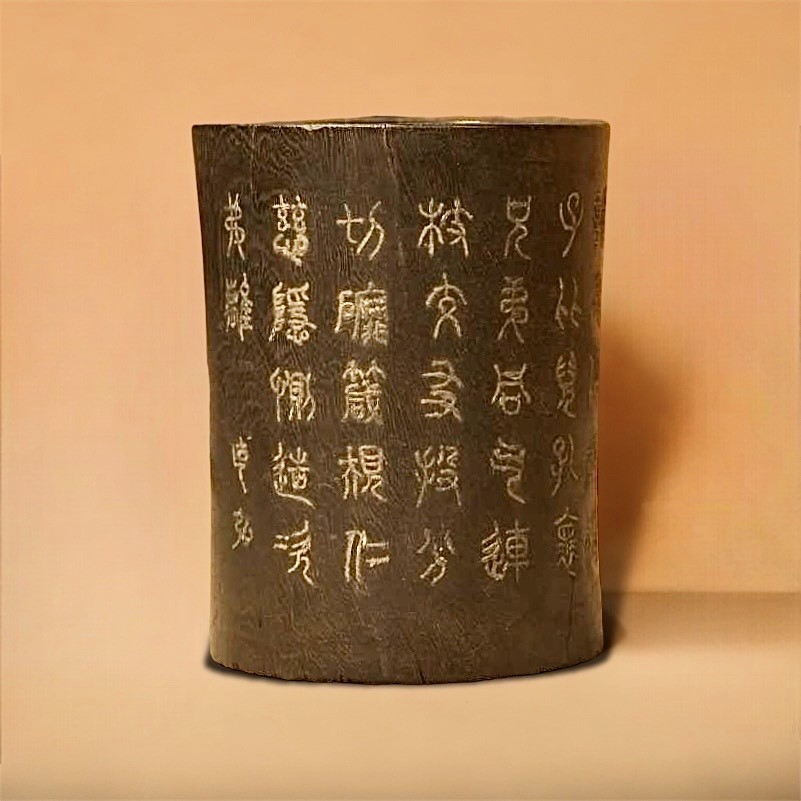
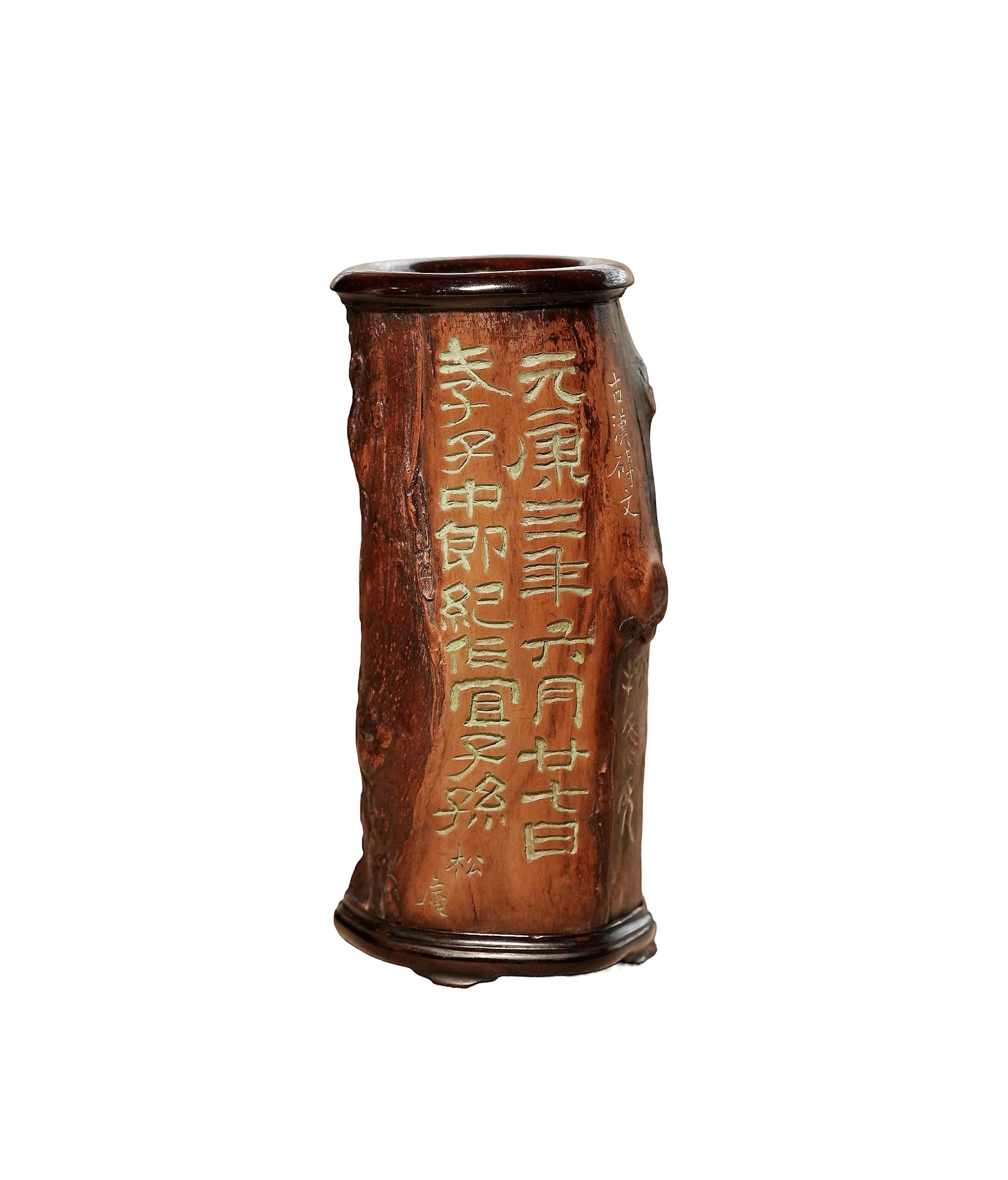
A second huanghuali pot carries Zhou Dunyi’s On the Love of the Lotus. Its columns require the reader to turn the vessel to continue the text. On a Ming bamboo pot the Goddess of the Luo River appears alongside verse. Moving between image and text allows the reader to ask what the inscription adds to the scene. For a seal-script inscription, photographs from several sides also help resolve characters compressed at the edges of a single view.
Three treatments of a wooden surface
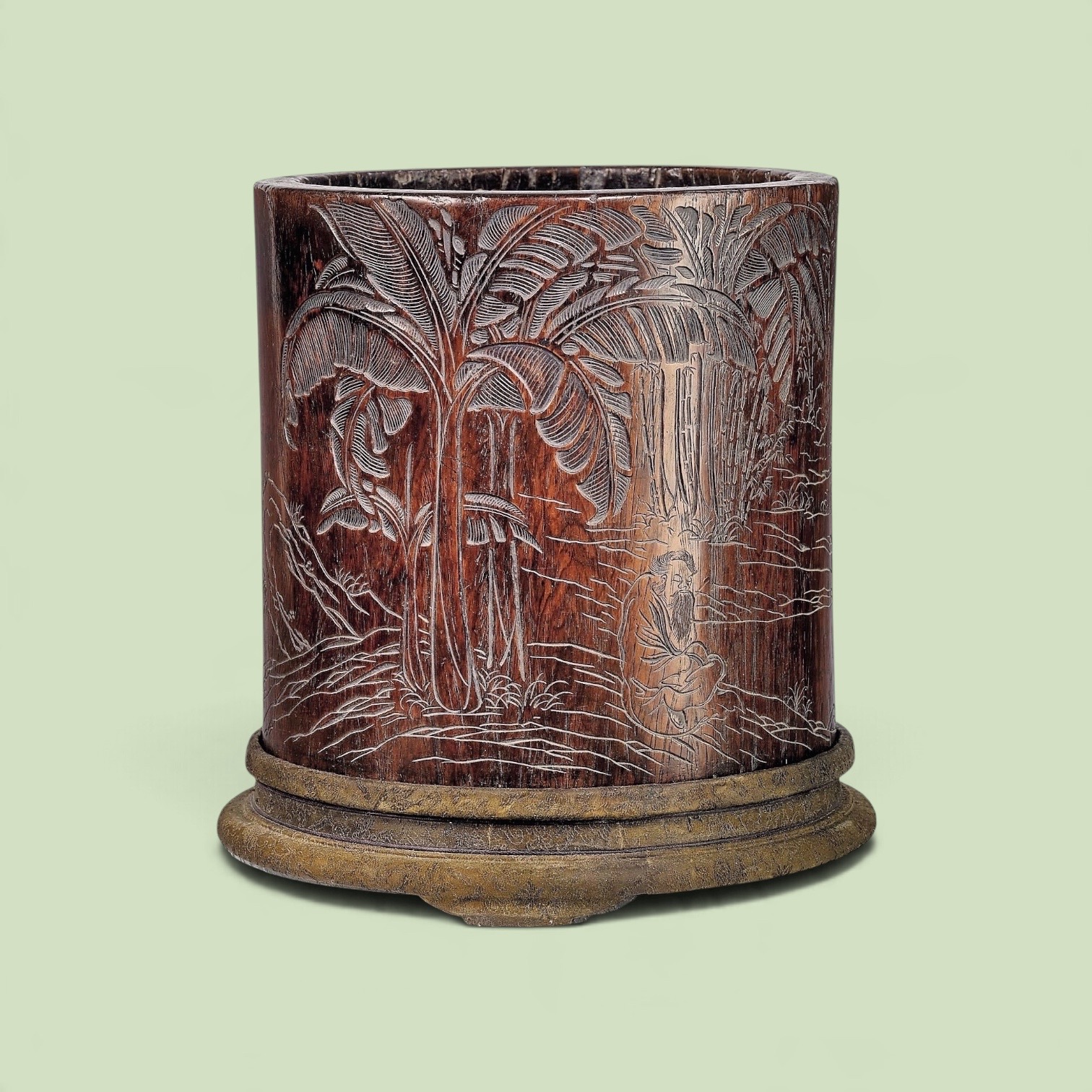
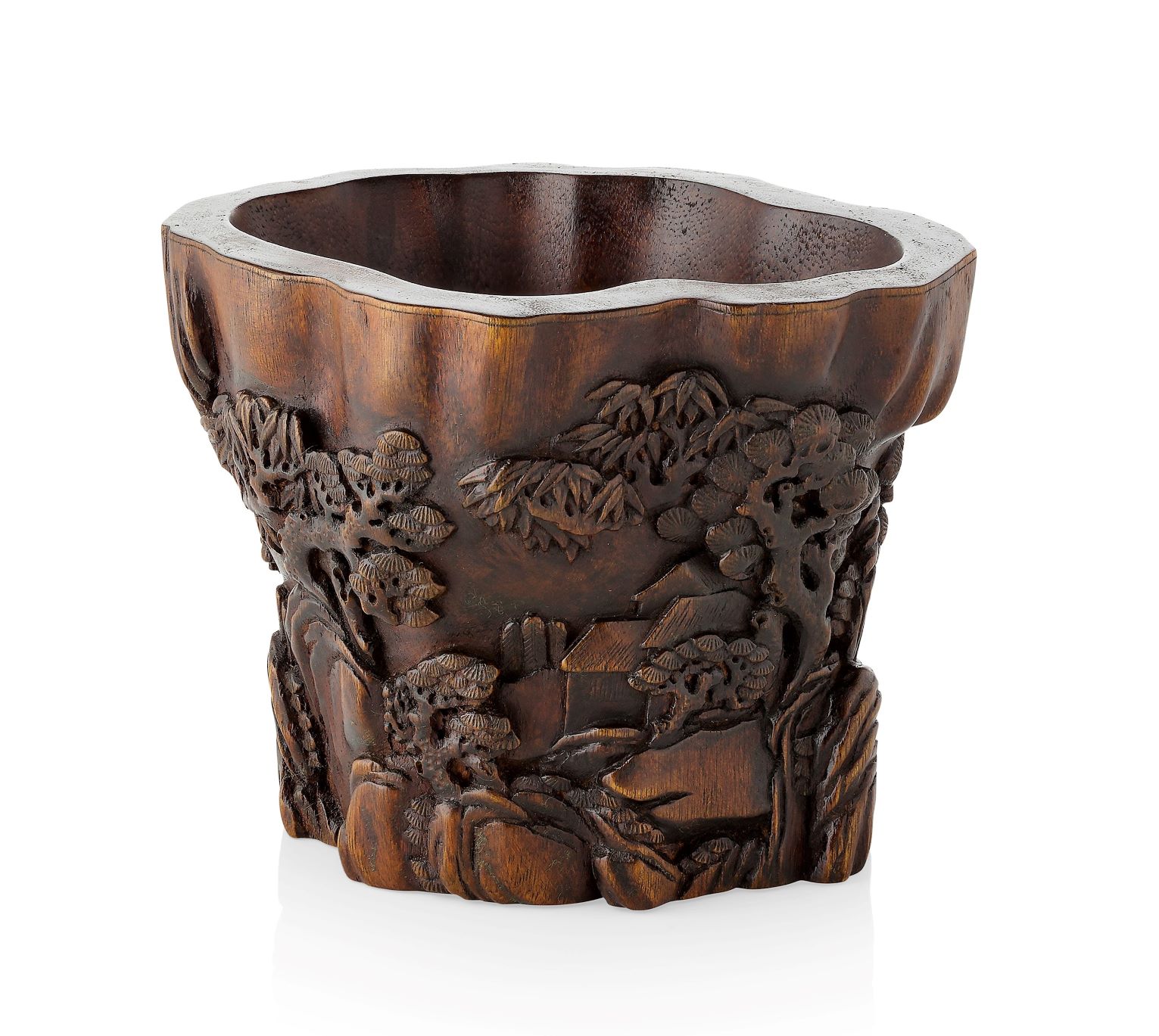
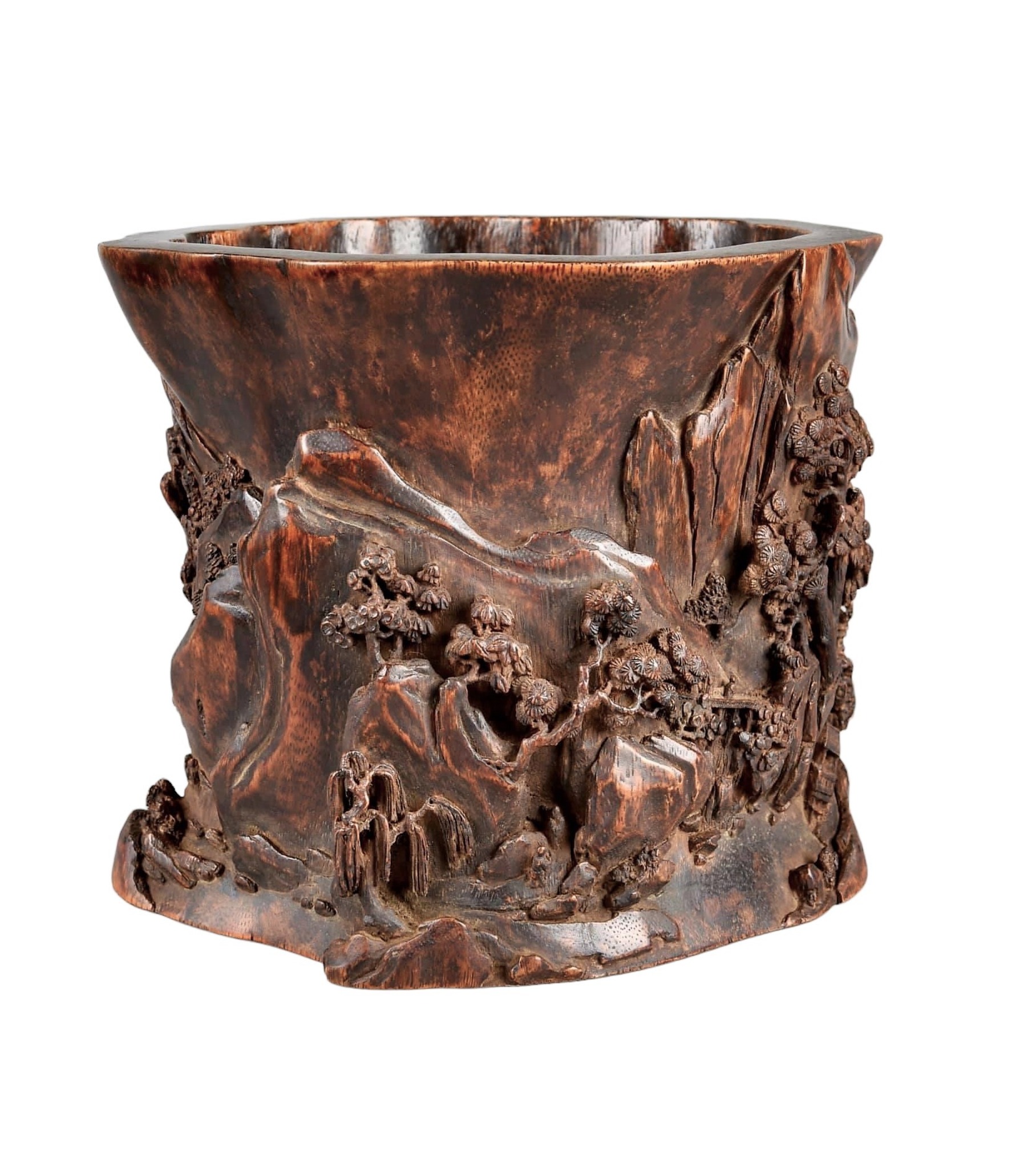
The huanghuali brush pot with Buddhist venerables measures 19.5 cm both in height and diameter. Its proportions give a procession of figures space to unfold. In two agarwood landscapes the problem shifts from the interval between figures to the depth between rocks. A building half concealed among trees can suggest a distance far greater than the thickness of the wall.
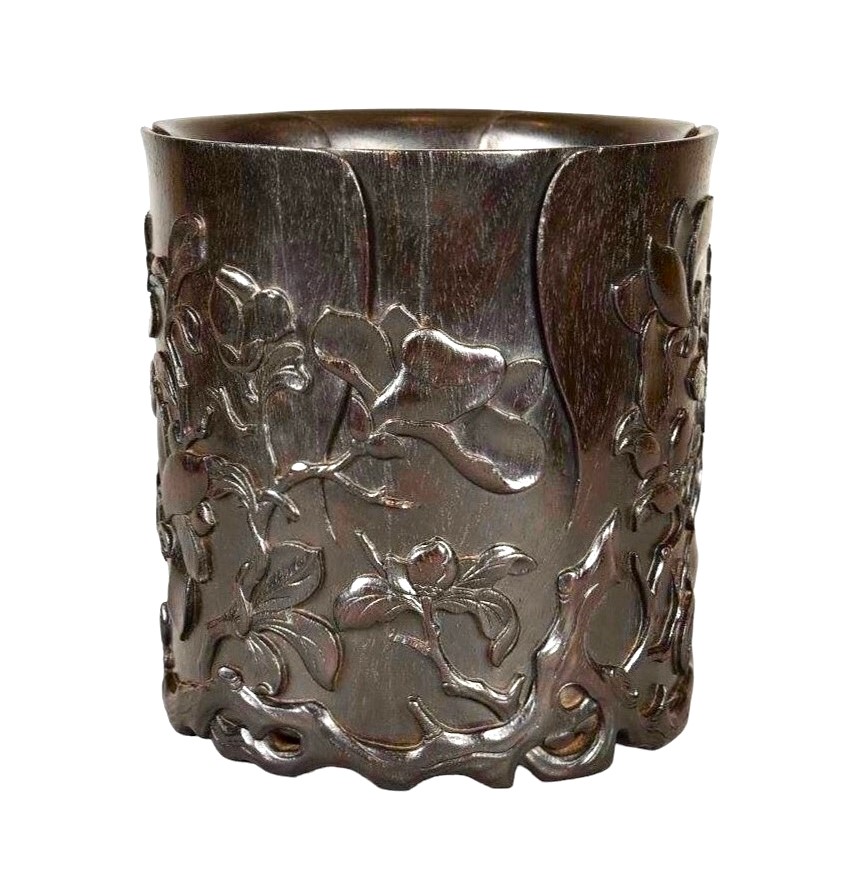
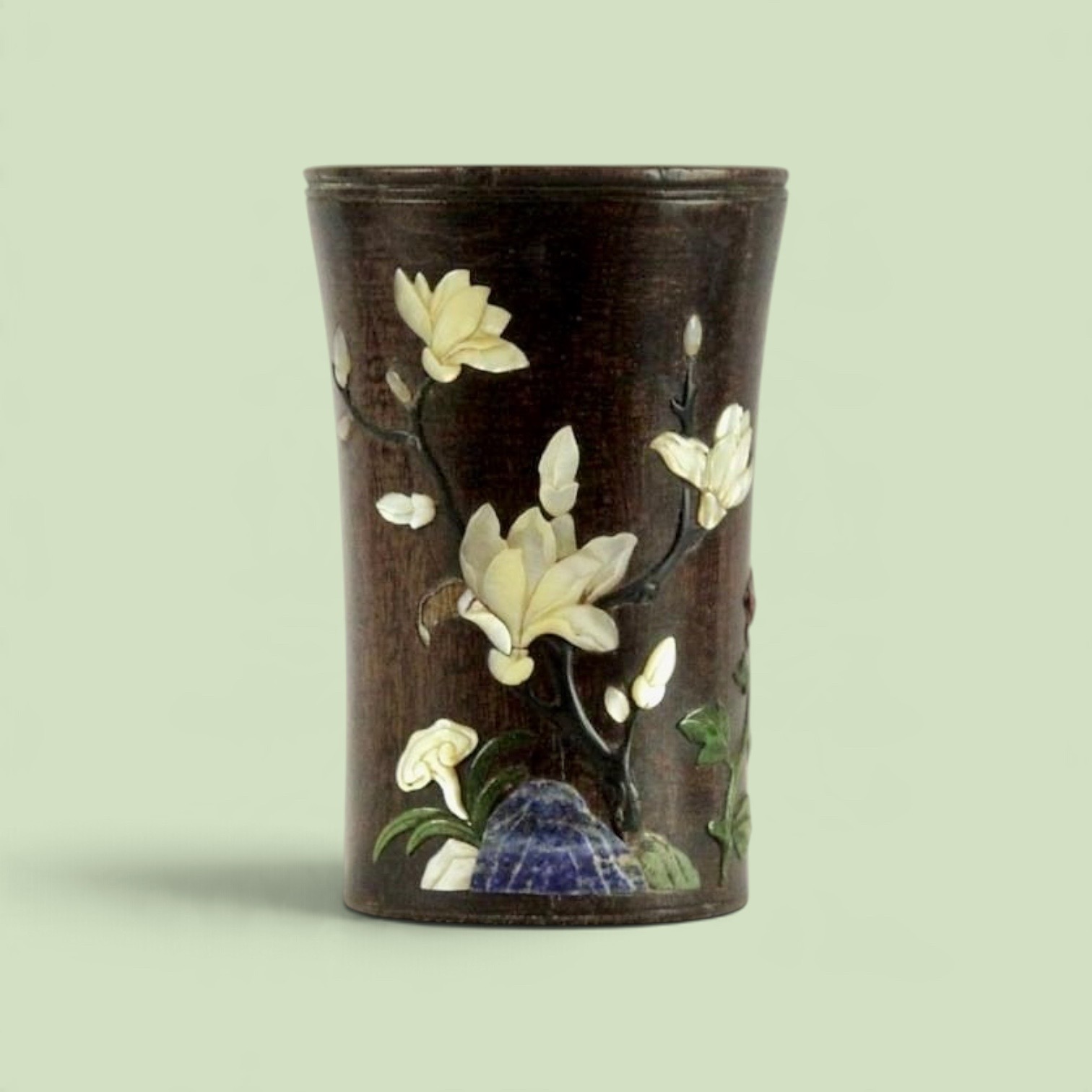
Two zitan flower pots offer a further comparison. On one, petals and leaves emerge in relief from a single piece of wood. On the magnolia pot, inlays distinguish blossoms from their ground through changes of color and substance. The fit of an insert, the meeting of leaf and stem and the dark intervals around the spray all help determine the shape we perceive.
Landscape in jade, porcelain and painted enamel
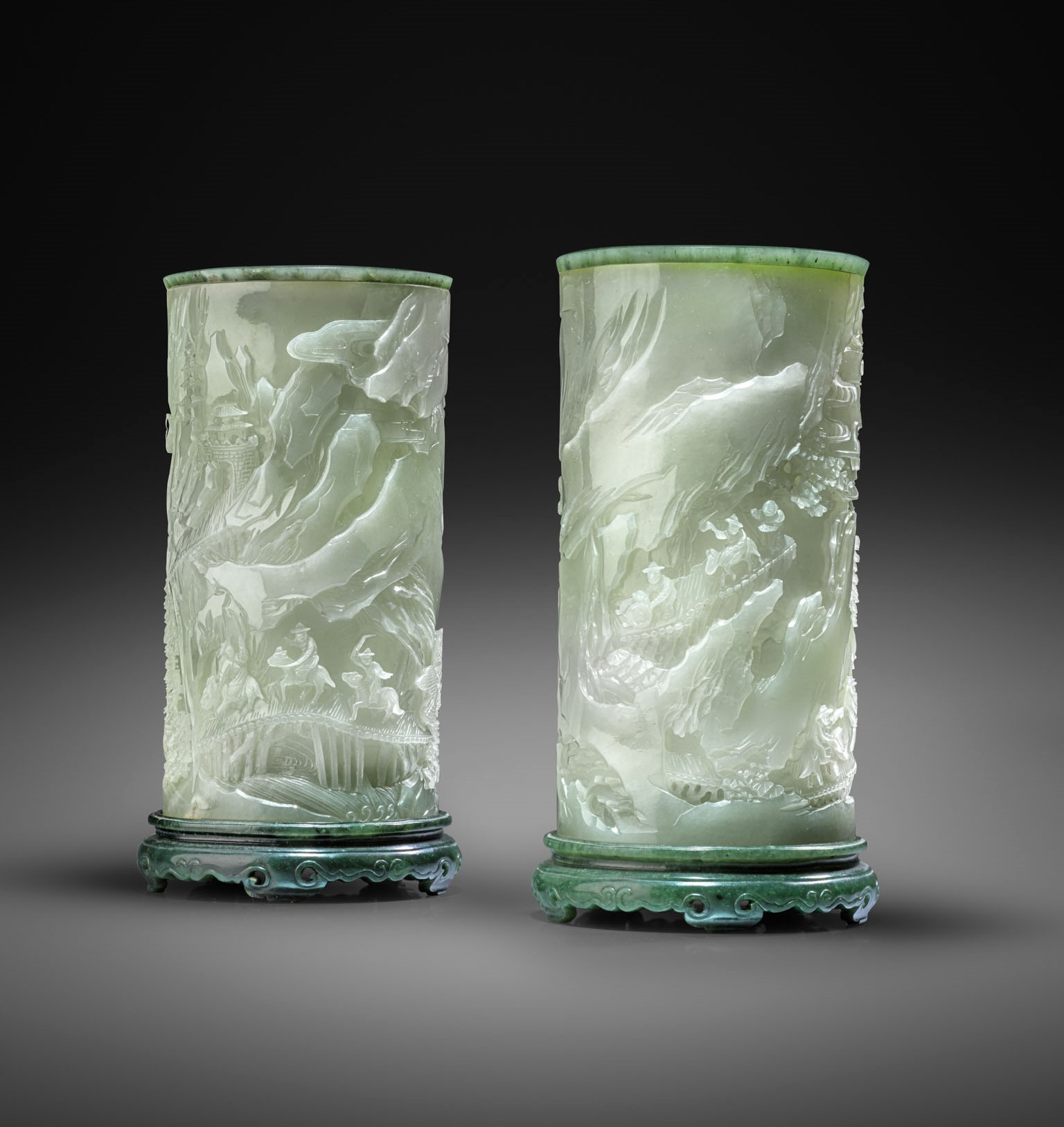
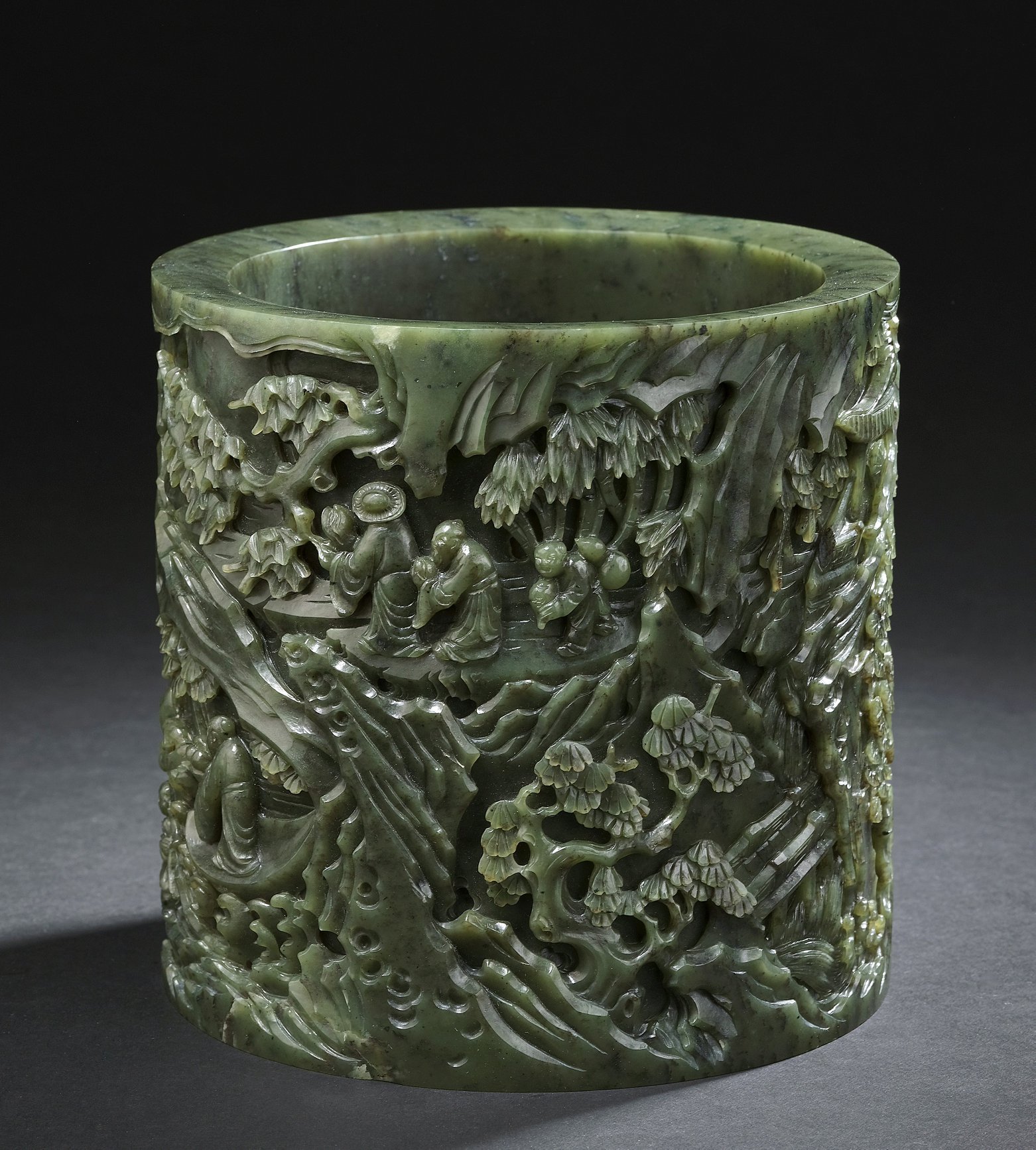
The Qianlong pair of pale and green jade brush pots uses contrasting stone at the rims and bases to frame the landscapes. On the green jade Five Elders, by contrast, figures, bridge and woodland emerge in relief against a ground of the same color. With the pair on a desk, the relation between the two silhouettes becomes part of the design. A photograph of a single face captures only one of these relations.
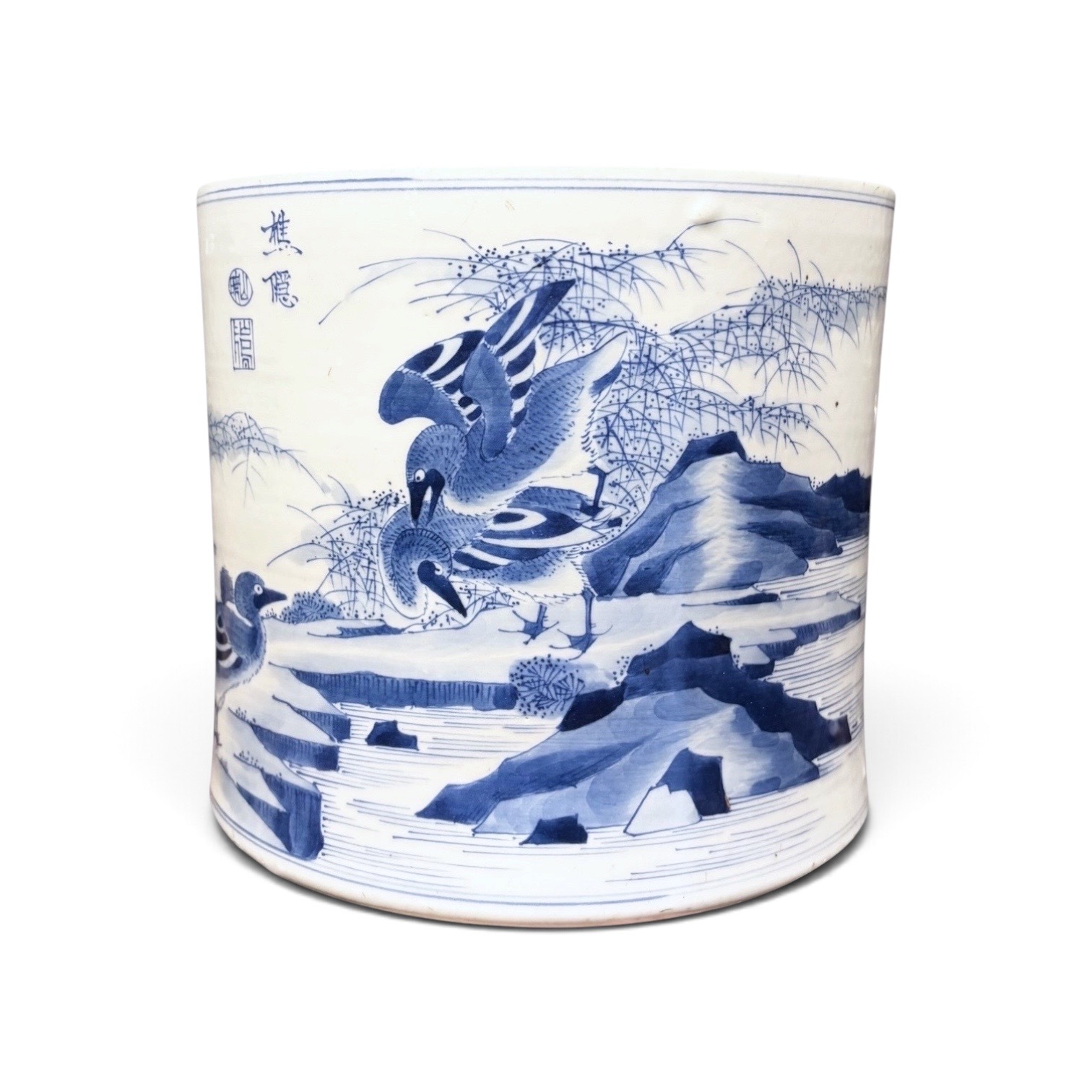
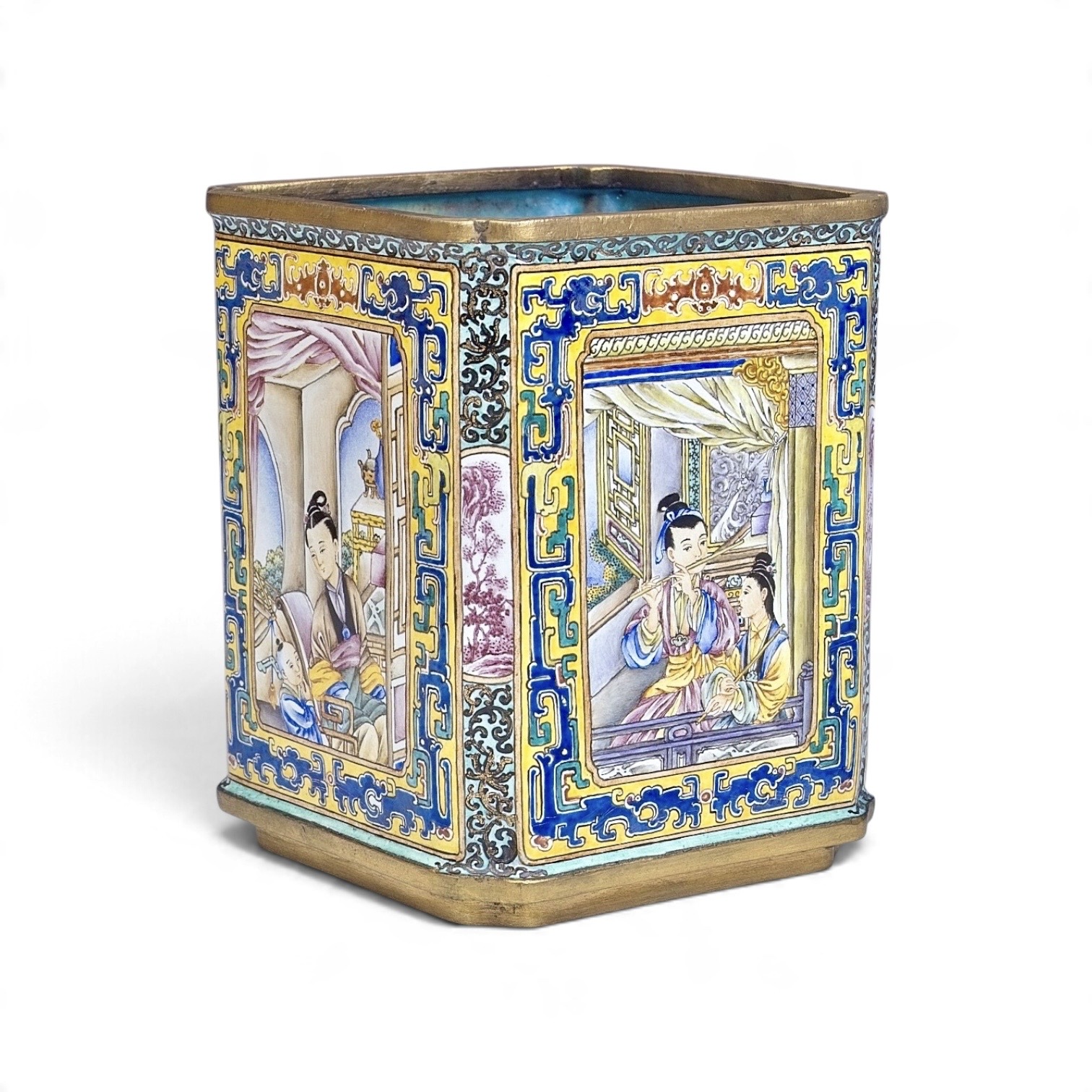
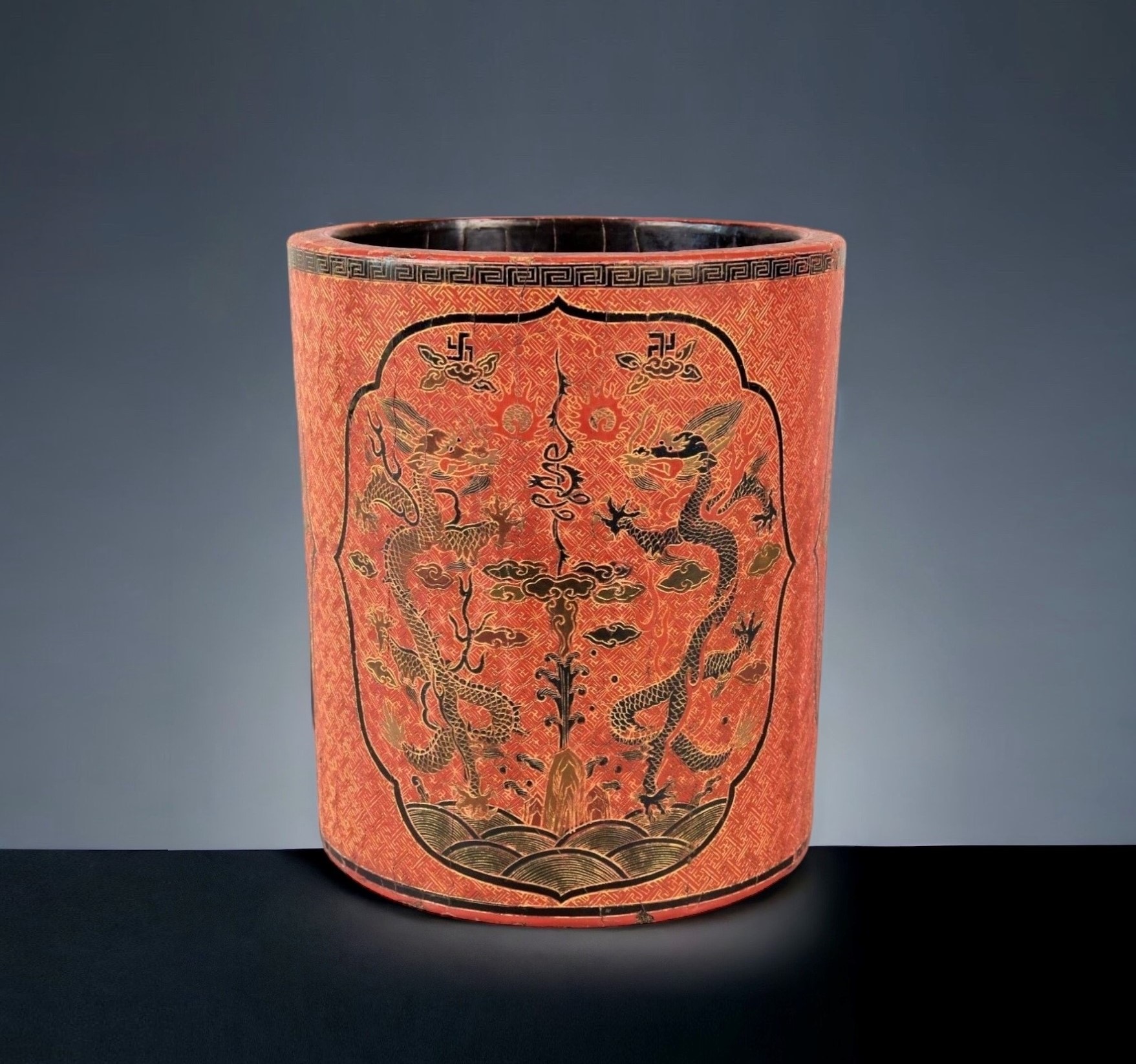
On blue-and-white porcelain, washes of cobalt carry reeds and geese across a white surface that can stand for water or sky. A square copper brush pot with painted enamels offers a different rhythm. Its corners divide the design into four faces, each reserve framing a scene of women or mothers and children like a window. The red-ground dragon design also demonstrates how a border defines the main field. Color alone cannot identify its underlying material.
The imperial desk: a brush pot read by an emperor
A bamboo brush pot in the former Qing palace collection bears the name of Wu Zhifan. The carving shows Liu Hai looking back at the three-legged toad perched on his broom. Turn the pot and another encounter comes into view: an imperial verse dated to 1782 records the Qianlong emperor’s response to the subject. The maker’s mark and the dated verse document distinct moments in the object’s history. Palace Museum collection entry
On a five-lobed carved red lacquer pot, narcissus, osmanthus, plum, chrysanthemum and orchid each occupy a panel beside lines of Qianlong’s poetry. Beside the narcissus, Cao Wenzhi identifies himself as the subject who respectfully wrote out the text. The emperor composed, a court official supplied the calligraphy, and the lacquer carver brought script and flower together. Compare the separate credits for composition and writing on the gallery’s huanghuali plum-blossom pot. At court the wording also makes rank explicit. Palace Museum collection entry
The imperial household participated in production through its workshops. The Palace Museum attributes a copper brush pot with aventurine glass inlays to the glassworks of the Qing Imperial Household Workshops. Metal partitions trace an ice-crack pattern, glass fills the intervals, and gilding finishes the rim and foot. The gallery’s Qianlong painted-enamel pot offers a comparison: a copper body here supports four framed figure paintings. Its pair of pale and green jade landscape pots offers a further way to consider paired display. Such comparisons concern technique and arrangement. A palace provenance for an individual work requires its own documentation. Palace Museum collection entry
Antiquarian taste and good wishes at the desk
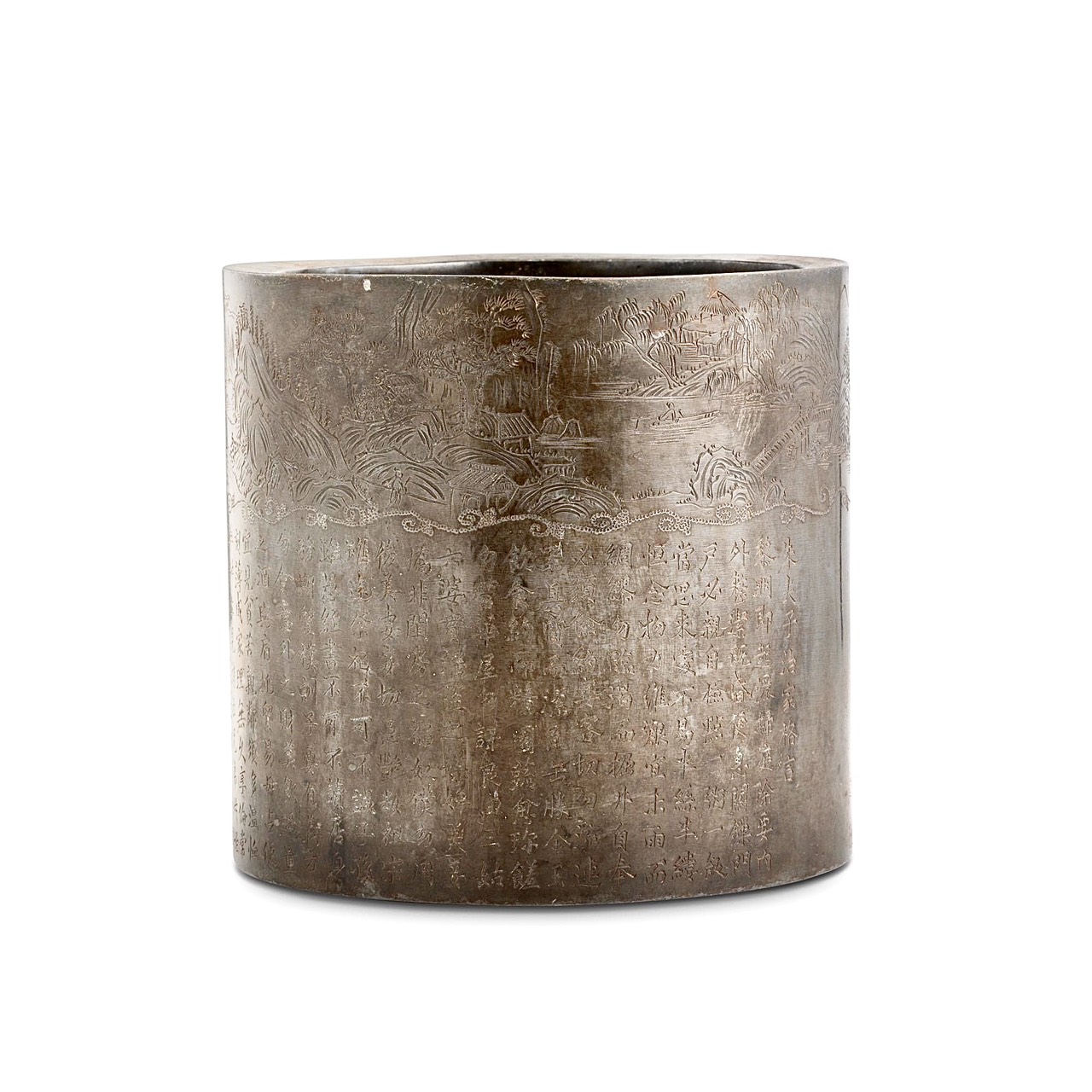
A Qing boxwood pot, 13.5 cm high, borrows ornament from Qin and Han bricks. Transferring a design from architectural clay to a small wooden vessel changes its scale and its relation to the hand, while preserving its antiquarian associations. A tin pot juxtaposes chased landscape with maxims on household conduct and bears a Ruan Yuan mark. As on the wooden examples, the wording of a signature matters when distinguishing authorship of a text from the hand that cut it.
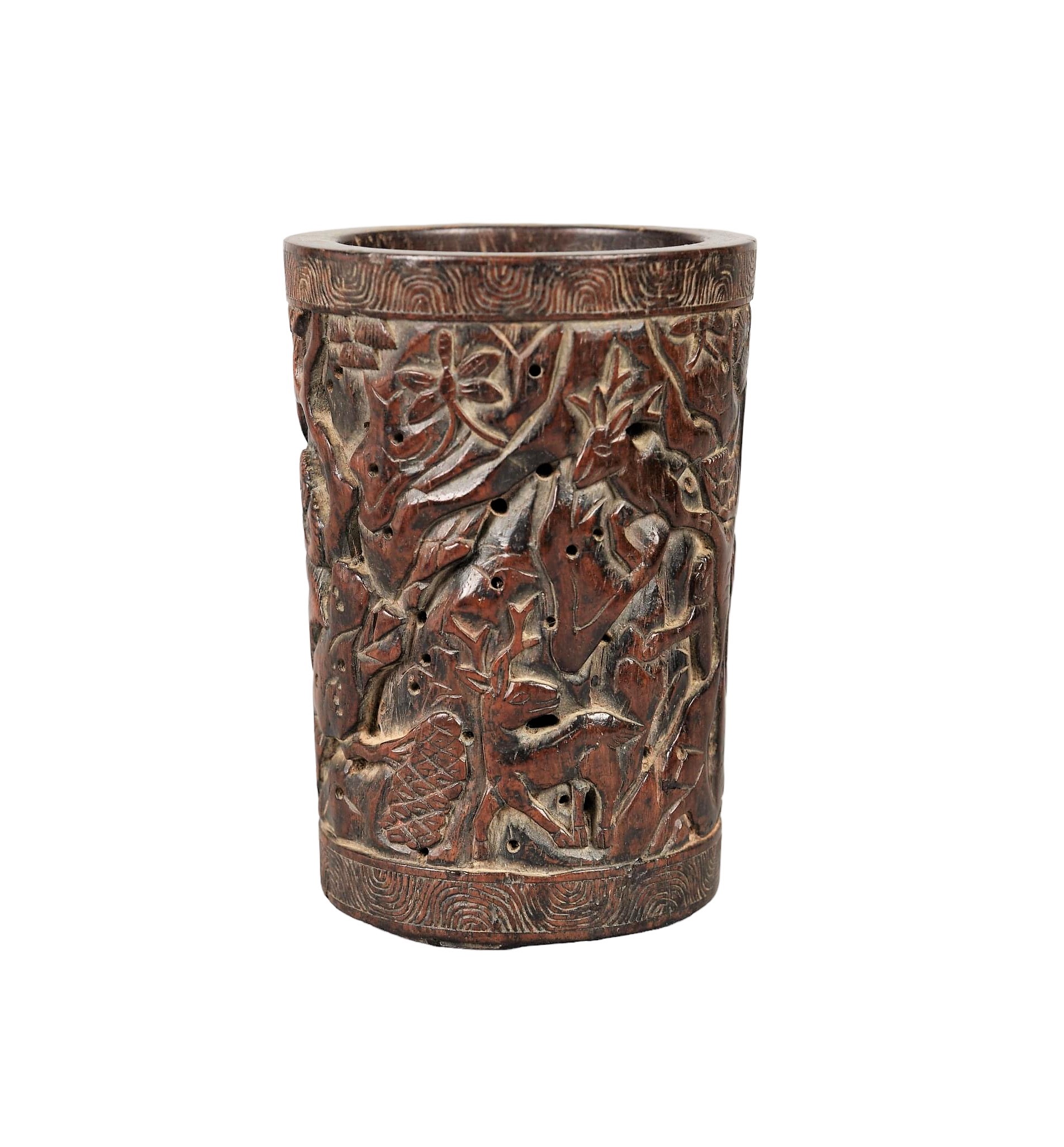
On the Ming huanghuali brush pot catalogued as Rank, Emolument and Ennoblement, the names of a magpie, deer, bee and monkey suggest the words of a wish for office and advancement. Recognizing that rebus calls for an ear for Chinese. Recognizing an Orchid Pavilion gathering calls for familiarity with a story. A reader reaching for a brush might encounter a wish for promotion on one desk and the memory of a poetry gathering on another.
Catalogue and comparative material
Figure captions follow the gallery catalogue where a work can be matched. The seal-script and red-ground dragon examples are described from the photographs. Dimensions and period designations in the text follow the cited entries.