

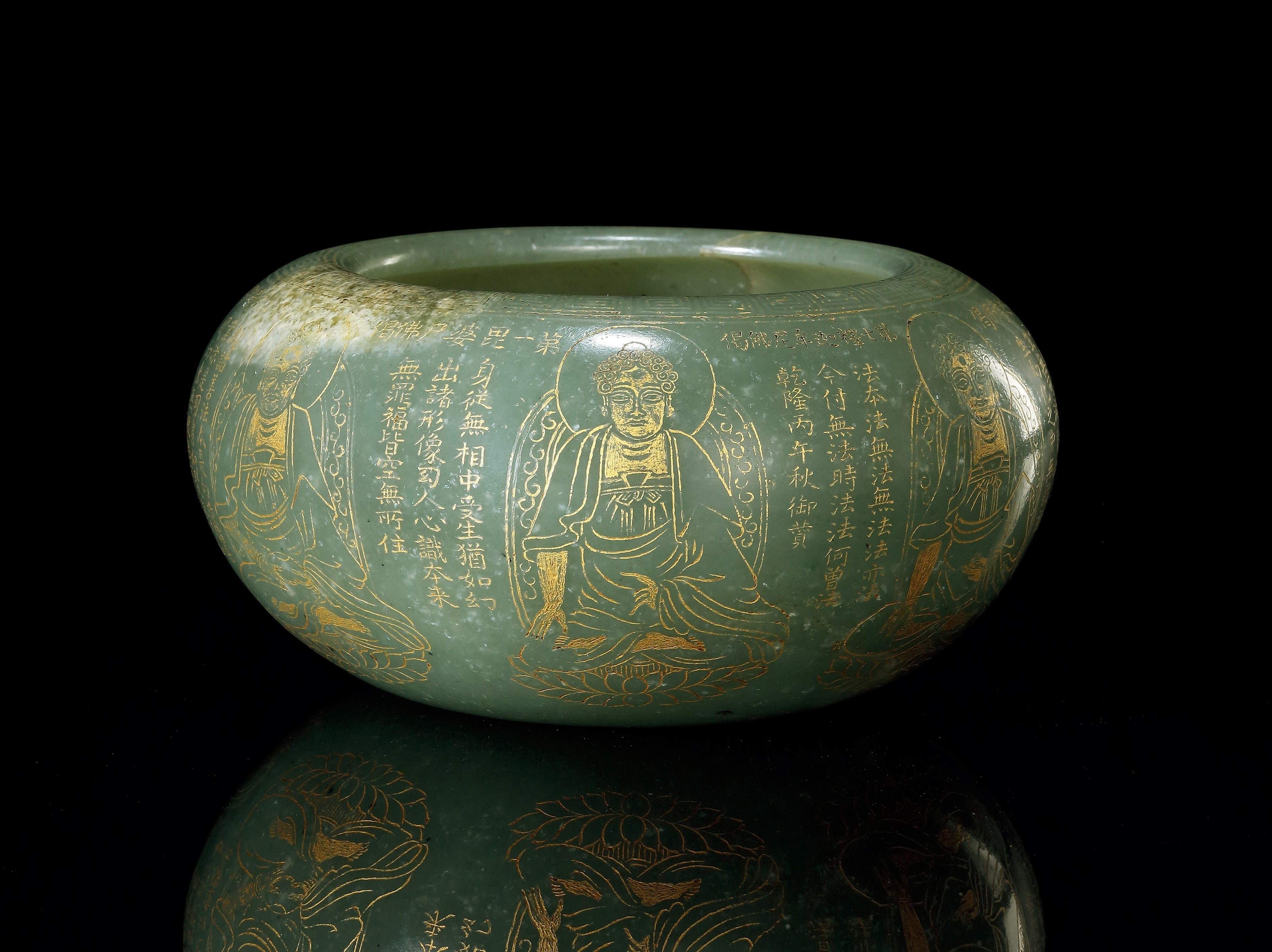
Qing dynasty, Qianlong period · Green jade with gold-filled engraving · Diameter 13.3 cm
Carved from green jade, the bowl has a low, broad profile, substantial walls, a gently incurving mouth and a rounded base. A band of key fret runs around the rim. Below it, the Seven Buddhas of the Past sit in full lotus posture, eyes lowered and hands resting one upon the other in their laps. Each has a halo behind the head and an aureole around the body. Beneath each figure, lotus petals open upward and downward in two tiers. Gold traces the engraved figures and, in the spaces between them, spells out each Buddha’s name and verse.
The inscriptions appear to draw on the Qianlong emperor’s Imperial Stele Inscription on the Seven Buddhas. In 1777, the forty-second year of his reign, scroll paintings of the Seven Buddhas were sent to the capital as an offering from the Panchen Lama of Tibet. Qianlong consulted his Buddhist preceptor, the Changkya Khutukhtu, on the sources for each figure before composing the stele inscription.
The Seven Buddhas
The group comprises Vipaśyin, Śikhin, Viśvabhū, Krakucchanda, Kanakamuni, Kāśyapa and Śākyamuni. Accounts of their origins appear in the Sutra of the Seven Buddhas, the Sutra on the Names and Lineages of the Parents of the Seven Buddhas and the Jingde Record of the Transmission of the Lamp. These accounts describe them teaching the Dharma, guiding sentient beings, exemplifying ethical conduct, receiving the monastic robe and bowl, and seeking awakening. Their practice joins personal discipline to a commitment to the liberation of others.
The Seven Buddhas at the Qianlong court
In Dragon Robes and Kāṣāya Robes (龍袍與袈裟), Palace Museum scholar Luo Wenhua traces Qianlong’s interest in the Seven Buddhas back to the twentieth year of his reign (1755). The emperor ordered a nanmu-wood case for three scrolls of their verses at Miaoying Temple, now also known as the White Stupa Temple. Commissions for ritual objects followed. The figures were first drawn and then carved, following the model of the sandalwood Buddha venerated at court.
The palace collections in Beijing and Taipei preserve examples in several materials, including a red lacquer bowl and a palm-bamboo bowl formerly in the Qing imperial collection. Court commissions included a palmwood bowl in the twenty-second year of the reign (1757) and a palm-bamboo bowl the following year. Other examples include a dyed white jade bowl, a bowl of carved red lacquer over copper, a Qianlong conch bearing the Seven Buddhas and a conch carved from lapis lazuli.
Verses of the Seven Buddhas
The following English renderings follow the Chinese verses transcribed in the museum’s account.
1. Vipaśyin
From the formless the body takes birth,
as if a conjurer called up a host of shapes.
The conjured being’s consciousness was never there of itself.
Wrongdoing and merit alike are empty, with nowhere to abide.
2. Śikhin
To bring forth wholesome deeds is like a conjuring,
and so too is the making of harmful karma.
The body is gathered foam, the mind a gust of wind.
What appears by conjuring has no root, no treasure of its own.
3. Viśvabhū
We borrow the four elements and call them a body.
Mind is unborn, yet appears through the mirror.
Take away the mirror before us and mind too is gone.
Wrongdoing and merit arise like illusions, yet have their effect.
4. Krakucchanda
See that the body holds no treasure: this is the Buddha’s body.
Know the mind as illusion: this is the Buddha’s illusion.
Once body and mind are understood to be empty in their own nature,
what difference remains between this person and a Buddha?
5. Kanakamuni
Buddha sees no body by which to know a Buddha.
If that knowing were a thing in itself, there would be no Buddha apart from it.
The wise know the nature of wrongdoing to be empty
and meet birth and death at ease, without fear.
6. Kāśyapa
The nature of every sentient being is pure.
Unborn from the beginning, what could there be to extinguish?
This very body and mind arise as an illusion.
Within its transformations, neither wrongdoing nor merit can be found.
7. Śākyamuni
At its source, the Dharma is the Dharma of no fixed teaching.
Even the teaching of no fixed teaching is a teaching.
Now that I entrust this teaching of no fixed teaching to you,
when has any teaching ever been a fixed teaching?
Catalogue record
Publication
Qian Kun Tang, Liegu yanzhen (獵古研珍), vol. 2, Hong Kong, 2009, p. 80.
Provenance
Christie’s Hong Kong, 1 November 2004, lot 1013.
Exhibition
Poly Art Institute and Poly Art Museum, The World of Hongli II: Giuseppe Castiglione’s Oil Portrait of Imperial Noble Consort Chunhui and Western Influences in Eighteenth-Century High Qing Court Art, Beijing, 15 October–2 November 2021.