

Qing Dynasty, Qianlong Period: Ivory Hayagriva Phurba
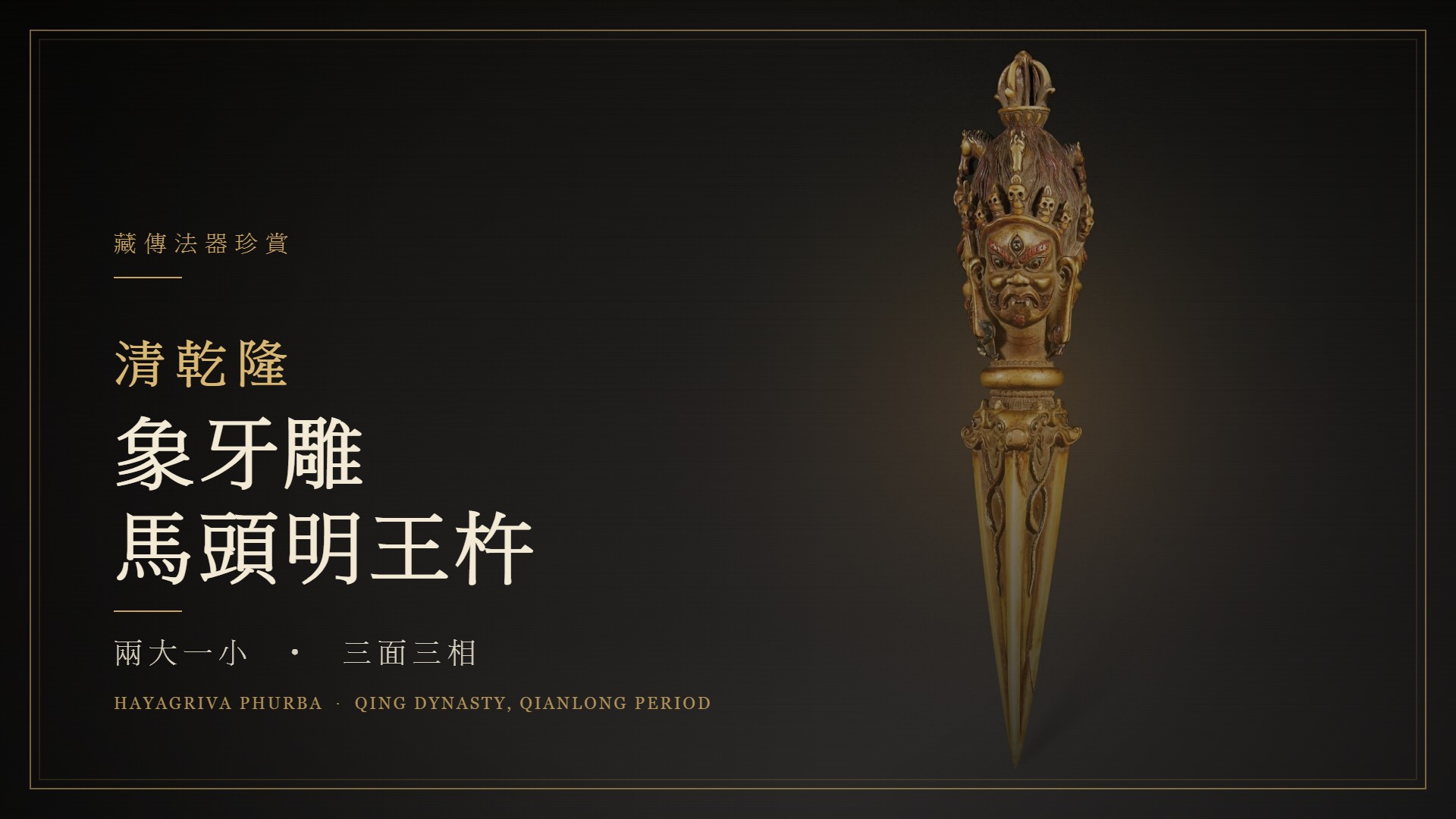
Among the ritual implements of Tibetan Buddhism, the phurba (Tibetan phurba, Sanskrit kīla; in Chinese, jingang ji, the “vajra peg”) is renowned for subduing demons and clearing obstacles. Its upper half is a deity figure and its lower half a three-edged blade, uniting a protector’s majesty with the decisiveness of a blade. Among the many deities that crown such daggers, Hayagriva, the Horse-Headed Wrathful King, is one of the most unforgettable.
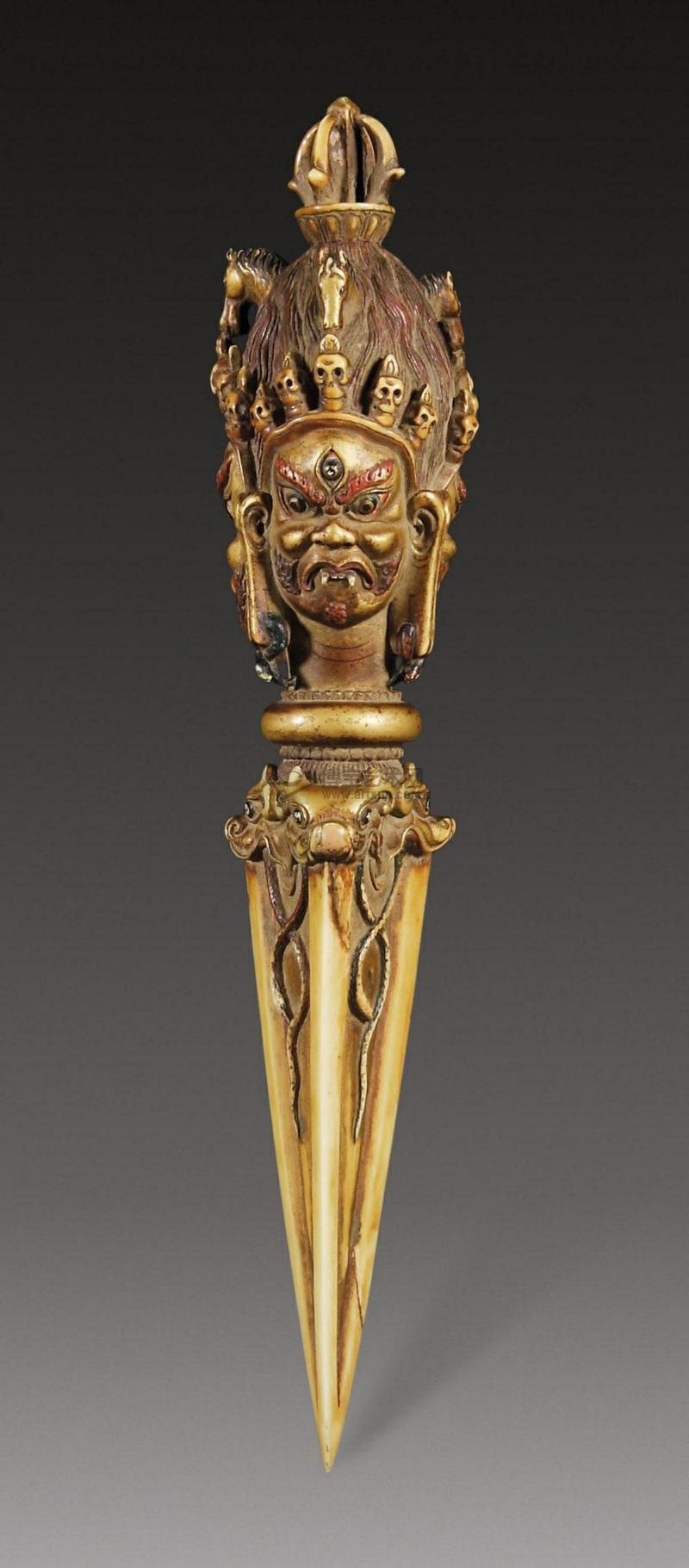
Upright front view — this is the “small face”
I. Hayagriva: A Neigh That Subdues Demons
Hayagriva (Matou Mingwang in Chinese) is a wrathful manifestation of Avalokiteshvara. Glaring and fanged, with flaming hair streaming upward, he bears a horse’s head above his crown. The horse’s neigh symbolizes the far-reaching sound of the Dharma: it awakens the deluded and sends obstacles fleeing. Placing this deity at the head of a dagger gives the implement two meanings at once, compassion and ferocity — wrathful in appearance, compassionate at heart.
II. Qianlong Ivory: A Gentle Material, a Thunderous Form
Under the Qianlong Emperor, the Qing court devoutly honored Tibetan Buddhism and kept close ties with the Changkya National Preceptor; ritual implements and images made for Buddhist ceremonies were renowned for their refinement. Ivory is fine-grained and warm, able to render both the softness of flesh and the sharpest detail. The blade of this dagger is honey-yellow, its natural grain running from top to tip like flowing water, in harmony with the gold and vermilion of the head: stately yet opulent.
III. What Makes It Rare: Two Large Faces, One Small
On the familiar three-faced phurba, the three faces are the same size and set evenly around the head, a symmetry that expresses completeness without bias. This dagger does the opposite: of its three faces, two are large and one is small.
The large faces dominate with commanding force; the small face sits to one side and answers them. The difference in scale creates hierarchy and rhythm, and as the viewer moves around the piece the faces unfold one after another, the view changing with every step. Such a deliberate departure from the standard format is rare among daggers of this kind, and it is clearly not mere copying but the considered design of a confident master. Its meaning is not recorded in any text: perhaps it was meant to emphasize the might of the principal deity, perhaps to create a play of stillness and motion between front and side. We can only reflect on it through the form itself, which makes the piece all the more intriguing.
IV. Three Faces, Three Expressions
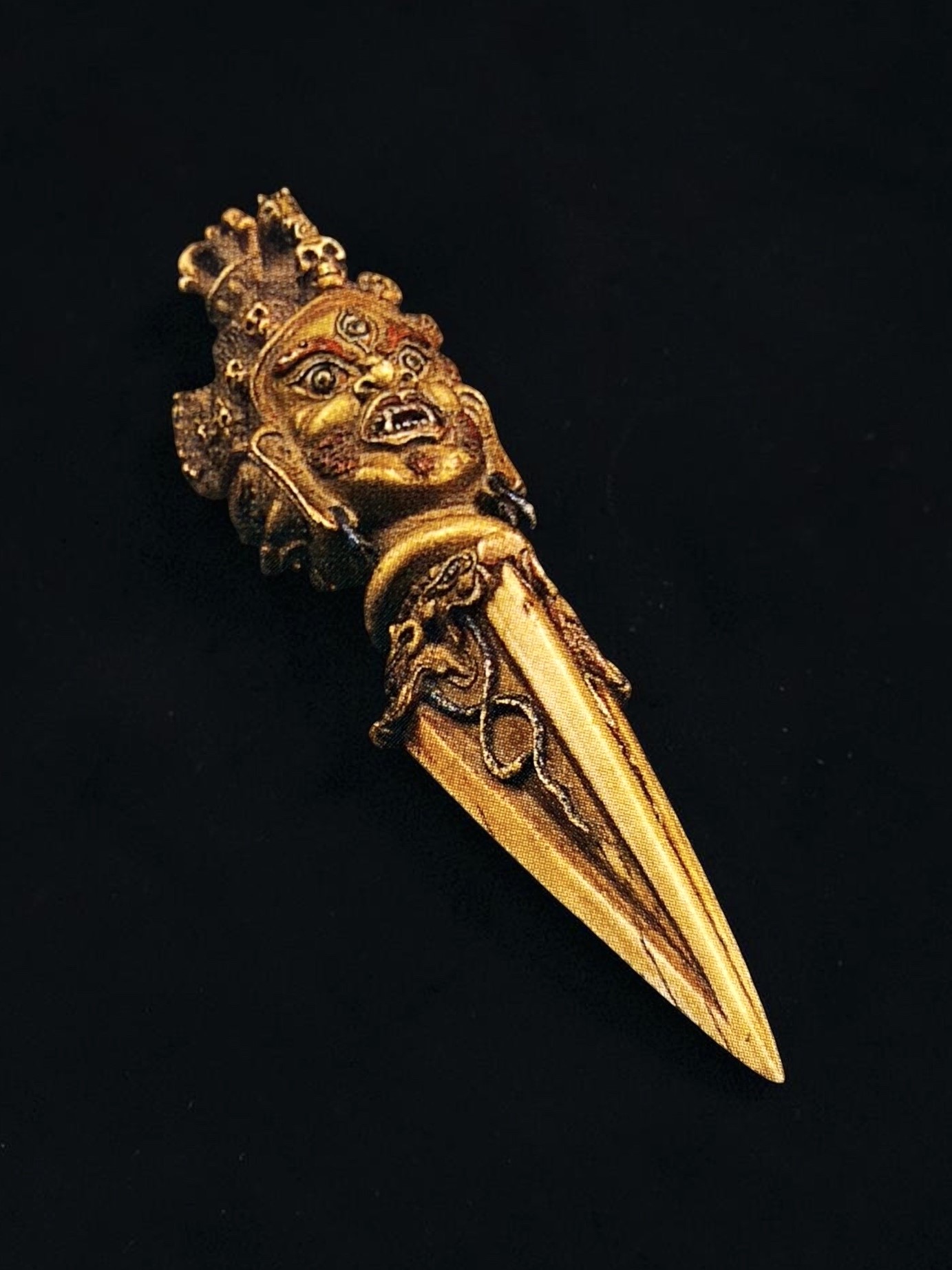
Angled side view — this is a “large face”
The large face: broad and full, with wide round eyes bulging and mouth open in a roar, teeth bared, like a sudden clap of thunder. The crown ornaments, flaming hair and horse heads behind it all gather around this face and heighten its ferocity.
The small face: small in scale but no less carefully carved. The third eye opens on the forehead, vermilion brows leap like flames, the eyes glare, the corners of the mouth turn down and the fangs show, while the beard is touched with red. Its expression is grave and imposing, majestic without a sign of rage. Against the roaring large face, it offers stillness against motion, and the two set each other off.
The other large face: equally monumental, it looks out from the other side of the head with an expression of its own. Seen together, the three faces hold the full range of wrathful majesty within a single dagger.
V. Crown and Details: Not a Point Left Slack
The head wears a crown of skulls, neatly arranged. Flaming hair billows upward and a horse’s head rises from it, with further horse heads on either side echoing it; at the very top stands a vajra finial, signifying indestructibility. Below the neck a round collar encircles the shaft, and beneath it makara heads are set around the base of the blade, jaws open as if gripping it. Two serpents coil along the blade, their bodies winding, head and tail clearly drawn, and the tip ends in a sharp point that exudes a stern authority.
VI. In Closing
In this single dagger one finds the might of the wrathful king, the warmth of ivory, the refinement of Qianlong-era court craftsmanship, and above all the unconventional invention of “two large faces, one small.” Its rarity lies not only in its material and age but in the fact that, within a highly codified iconographic tradition, its maker left a mark that is entirely his own.