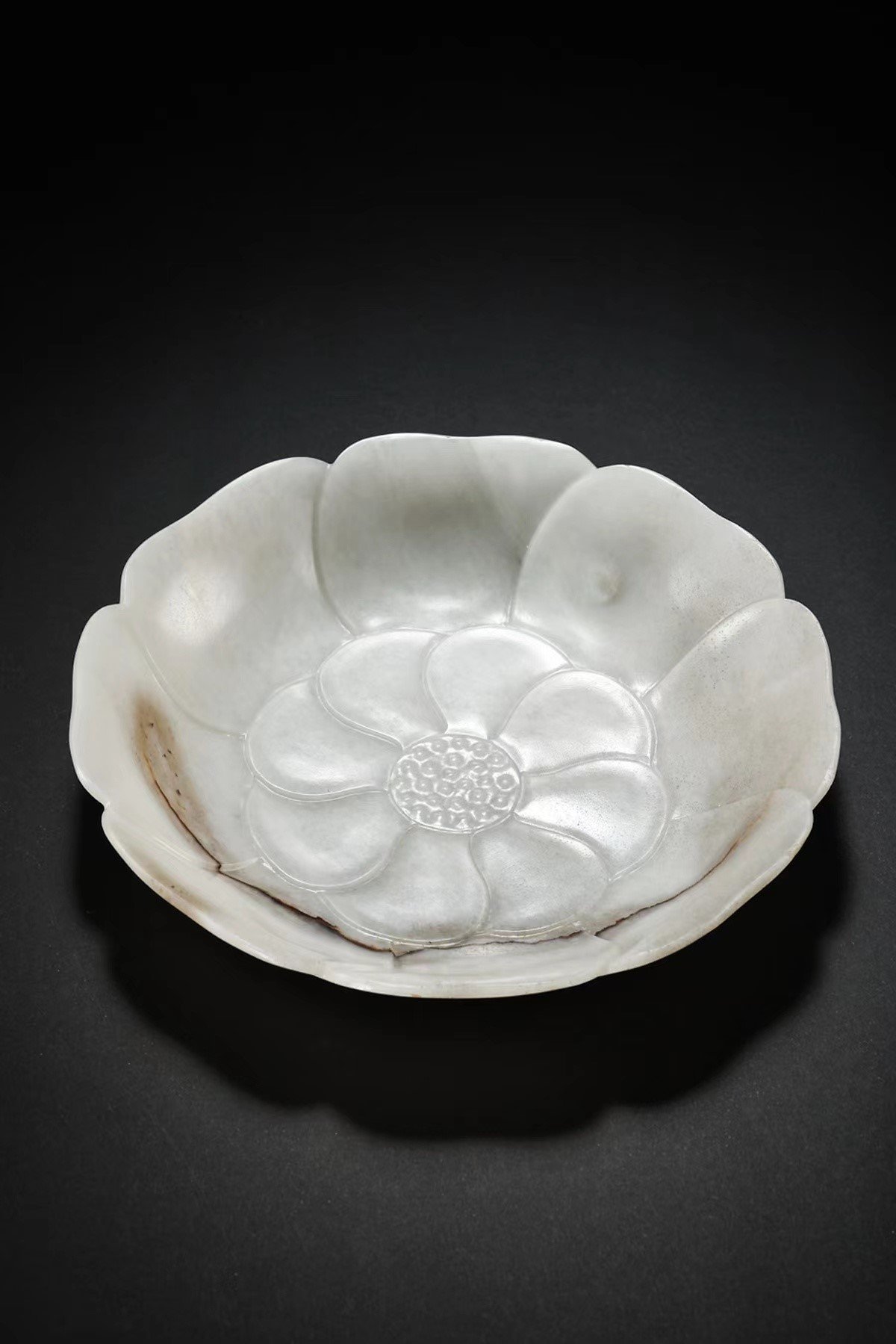
A Mallow-Flower-Shaped Jade Dish, Song Dynasty
Flower-Shaped Vessels and the Jade Dish
Naturalistic flower-shaped cups and dishes became widely appreciated during the Song period. Ouyang Xiu’s poem to the tune Yulouchun mentions a pear-blossom cup; other popular forms evoke plum blossom, lotus, hibiscus, chrysanthemum and mallow. These shapes developed from the lobed cups and dishes of the Tang period. Their demanding construction is more often encountered in gold and silver than in jade, and the vessels generally have shallow bodies.
Comparative examples illustrated in the Chinese article:
Figure 1: Gold mallow-shaped cup excavated from the tomb of Zhu Xiyan, Southern Song.
Figure 2: Silver-gilt mallow-shaped cup excavated from the tomb of Qian Yu, Wuxi, Southern Song/Yuan.
Figure 3: Silver multi-petalled flower cup excavated at Pingqiao, Liyang, Jiangsu, Southern Song.
Figure 4: Silver chrysanthemum-shaped cup with a bee-and-chrysanthemum design, excavated at Shidong village, Qiaotouhe, Lianyuan, Hunan, Yuan dynasty.
Figure 5: Gold four-lobed wine vessel excavated at Taiyi Road, Xi’an, Tang dynasty.
Flower-shaped vessels formed part of banquet tableware in the Song and Yuan periods. Paintings and literary descriptions help illuminate their use. The banquet passages cited from chapters 20, 22 and 34 of Jin Ping Mei describe small dishes, bowls, silver-mounted vessels and a gold chrysanthemum cup, placing such forms within a richly furnished dining environment.
Figure 6: Principal forms of Song and Yuan banquet utensils, as discussed in Yang Zhishui’s 奢華之色.
Figure 7: Literary Gathering, attributed to Emperor Huizong of the Song, National Palace Museum, Taipei.
Such vessels could also be used for offerings, including fruit presented in Buddhist settings. A silver dish with chased coiled-dragon decoration from the heavenly palace deposit of the North Pagoda at Chaoyang, Liaoning, provides a relevant example (Figure 8, Liao dynasty). Jade examples of related naturalistic vessel forms are comparatively uncommon.
Further comparisons:
Figure 9: Southern Song lotus-leaf cup excavated from the tomb of Shi Shengzu, Zhejiang.
Figure 10: Southern Song/Yuan lotus-leaf cup with a swimming turtle, National Palace Museum, Taipei.
Figure 11: Southern Song/Yuan mallow-flower-and-leaf cup, identified in the article as Hermann.
Figure 12: Song/Yuan chrysanthemum-and-butterfly bowl, Metropolitan Museum of Art, New York.
The Yun An Museum dish (Figure 13) takes the form of a many-petalled mallow flower with a central floral structure. Its overlapping petals create an impression of movement and require carefully controlled carving. The author proposes that its size could be compatible with either banquet use or the presentation of fruit as a Buddhist offering.
Although the news title identifies the piece as Song dynasty, the article discusses stylistic connections extending from the Southern Song through the Yuan to the early Ming. It notes the jade’s slightly granular character and contrasts it with the milky-white material frequently associated in the article with middle-to-late Ming examples from Dingling (Figure 14). The many-petalled design is considered consistent with this broader sequence.
Through these comparisons, the dish can be appreciated within the wider history of flower-shaped vessels, where material, craftsmanship and use meet.