

Yunmuseum Acquisition | Warring States Openwork Jade Dragon-Form Ornament with a Spirited Monkey
W : 10.6 cm
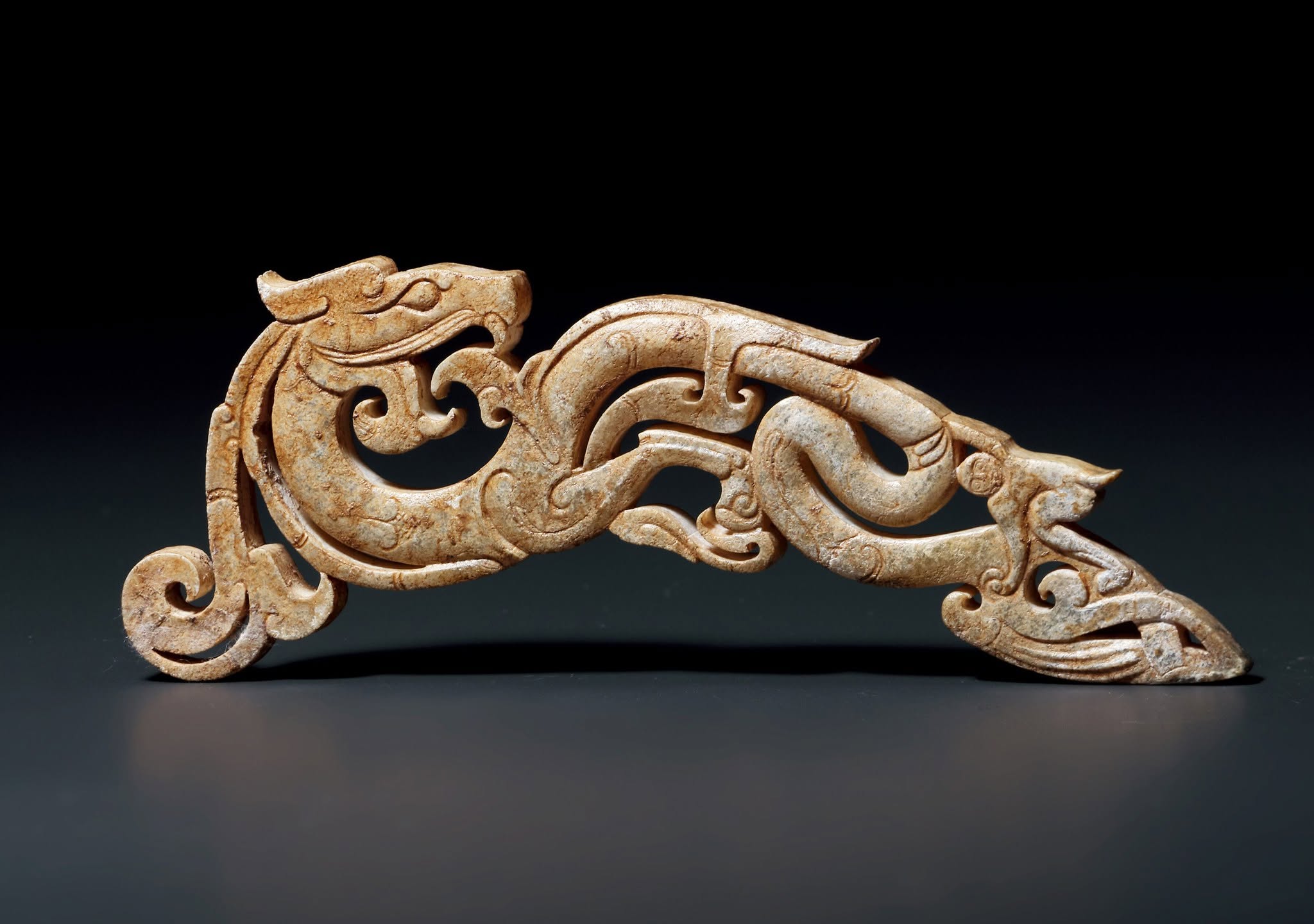
This openwork jade ornament of the Warring States period takes the form of a dragon with a spirited monkey at its tail. Ingeniously conceived, it is built around the sinuous, coiling body of the dragon, into which a monkey is skillfully woven, so that dragon and monkey seem to play with one another and echo each other from head to tail. The piece combines several jade-working techniques — openwork carving, low relief and fine hairline incision — with flowing lines and dense yet orderly ornament, fully displaying the superb craftsmanship and rich artistic imagination of Warring States jade carvers.
Among Warring States jades, the dragon is the most representative subject. Dragon-form jades of this period moved beyond the more regular shapes of earlier times and took on endless variety, coiling and surging with energy, marking an important stage in the evolution of Chinese dragon culture. Through the twisting turns of the body, the interlocking of limbs and the careful arrangement of pierced voids, the carver gives this still object a strong sense of rhythm and life.
The dragon’s head is carved in profile, with oval eyes pointed at the corners and a piercing gaze. The mouth is open and the muzzle slightly drawn in, giving a crisp, powerful outline. Behind the head, a scrolling, cloud-like mane joins the curling body below, forming a fluid, tensile line. The body winds and stretches, interspersed with wings, feet and scrolling-cloud appendages; solid and void alternate and interlock layer upon layer, making the whole form at once elaborate and splendid yet lively and natural.
Especially rare is the small monkey cleverly carved near the dragon’s tail. Agile and playful, it grasps the tail with one hand turned backward, as though leaping along with the dragon’s body. The monkey’s head and limbs merge naturally with the tail, adding vivid charm to the composition and revealing a lively, whimsical side of a subject normally associated with awe and divine power. The dragon’s head and the monkey answer each other from afar, and the lower end of the tail tapers to a point, so that the whole piece has a unified spirit and a complete, ingenious composition.
In carving technique, the piece makes full use of the solid-and-void spaces created by openwork, with the interplay of dragon body, cloud scrolls and limbs producing a richly layered three-dimensional effect. Low relief defines the rise and fall of the forms, while fine hairline incision depicts local ornament and surface texture, lending the flowing lines added delicacy. The composition is well balanced between dense and sparse, straight and curved, elaborate without confusion, and shows the splendid style and dynamic beauty characteristic of Warring States jades.
The dragon was a divine, auspicious creature of ancient China, symbolizing majesty, good fortune and the power to reach heaven, while the monkey is known for its agility, quickness and liveliness. By joining the two, this piece departs from the conventional single-dragon motif and sets the numinous against the playful, showing the ancient carver’s distinctive understanding of natural forms, mythic imagery and decorative art.
The dragon coils and clouds drift; the spirited monkey clings to its tail, full of life.
Extraordinary in form and original in conception, the piece shows a majestic, expressive dragon’s head, a body twisting with movement, and a monkey whose pose as it clings to the tail is especially inventive. The openwork is delicate and exquisitely pierced, the incision fine and fluent, and the ornament well balanced between dense and sparse, elaborate yet never confused, combining archaic charm, mythic imagination and lively spirit. The combined dragon-and-monkey subject is distinctive, and this is a very rare and fine Warring States openwork jade ornament.
Provenance: Yun Zhong Ju, Taipei; purchased in Hong Kong in 1994
Formerly in the Lantian Shanfang collection (SJ-016)
Mu Tao Collection of Jades, Taipei
China Guardian Hong Kong 2026