

A Study of Mid-Qing Baibao-Inlaid Screens with Children at Play | Materials, Courtyard Composition and Qing Craft
YUN MUSEUM · QING CRAFT AND VISUAL CULTURE
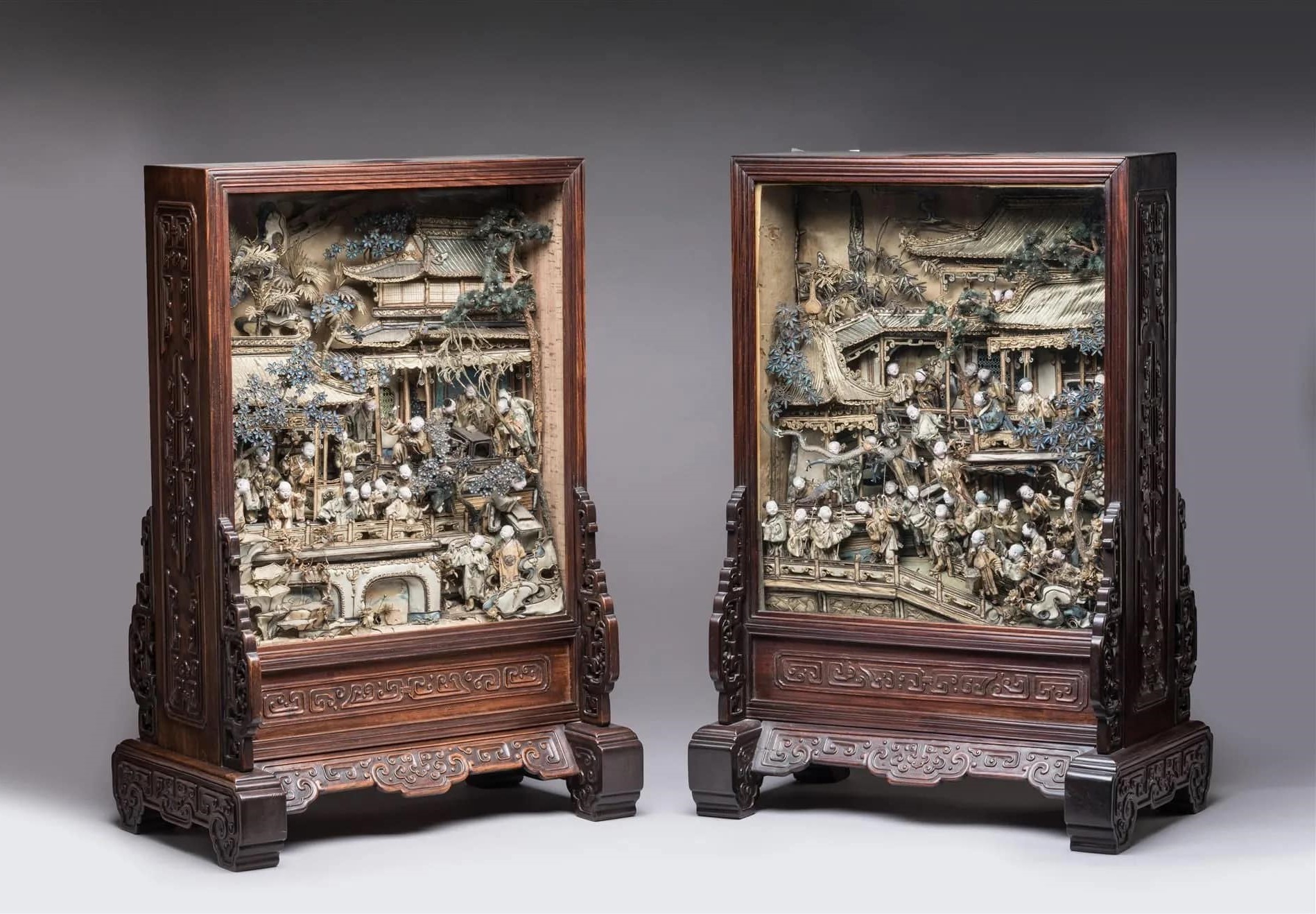
A Courtyard in Miniature: A Study of a Pair of Mid-Qing Baibao-Inlaid Standing Screens with Children at Play
The fascination of these standing screens lies in more than their abundance of materials. Each encloses a courtyard that invites looking, imagining and wandering. Roofs unfold in successive layers; branches pass across pavilions; children gather, turn and play at different depths. Figures, architecture and vegetation together create a crafted space between painting, relief and miniature theatre.
Object and method
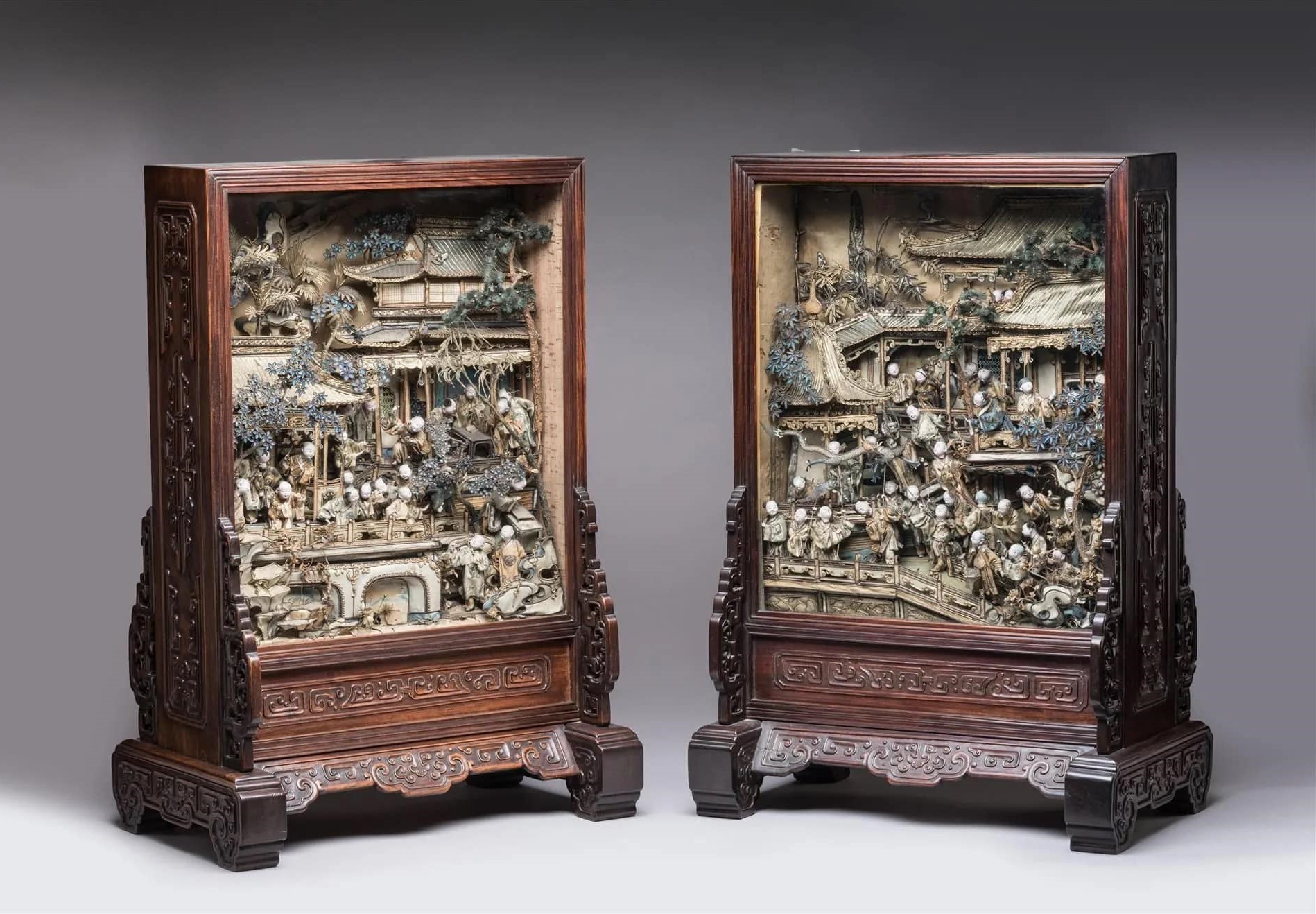
The object studied is the pair of mid-Qing baibao-inlaid standing screens depicting children at play in a courtyard, in the collection of Yun Museum. Collection records and ten selected photographs provide the basis for examining the relationship between frames, pictorial panels, figures, buildings, plants and assembled components. Comparable furniture and screens in the Palace Museum offer contextual points of reference.
Three questions guide the study: how do different materials construct figures and scenery; how does the paired format organise a courtyard narrative; and how can the individuality of the work be explained through visible structure and the coordination of techniques? The children have painted clay faces, the foliage incorporates kingfisher-feather appliqué, and the garments combine woven silk and embroidery. Other inlay materials, gilding methods and the place of manufacture require further examination.
1. What Makes the Pair Distinctive? From Decorative Panel to Miniature Courtyard
Both screens enclose courtyard scenes within dark frames of closely related proportions. Their compositions, however, are complementary rather than duplicated. The density of the scenery, the gathering and dispersal of children, and the placement of roofs and branches produce variations within a shared format. Their distinction begins with this relationship between matching structures and different scenes.
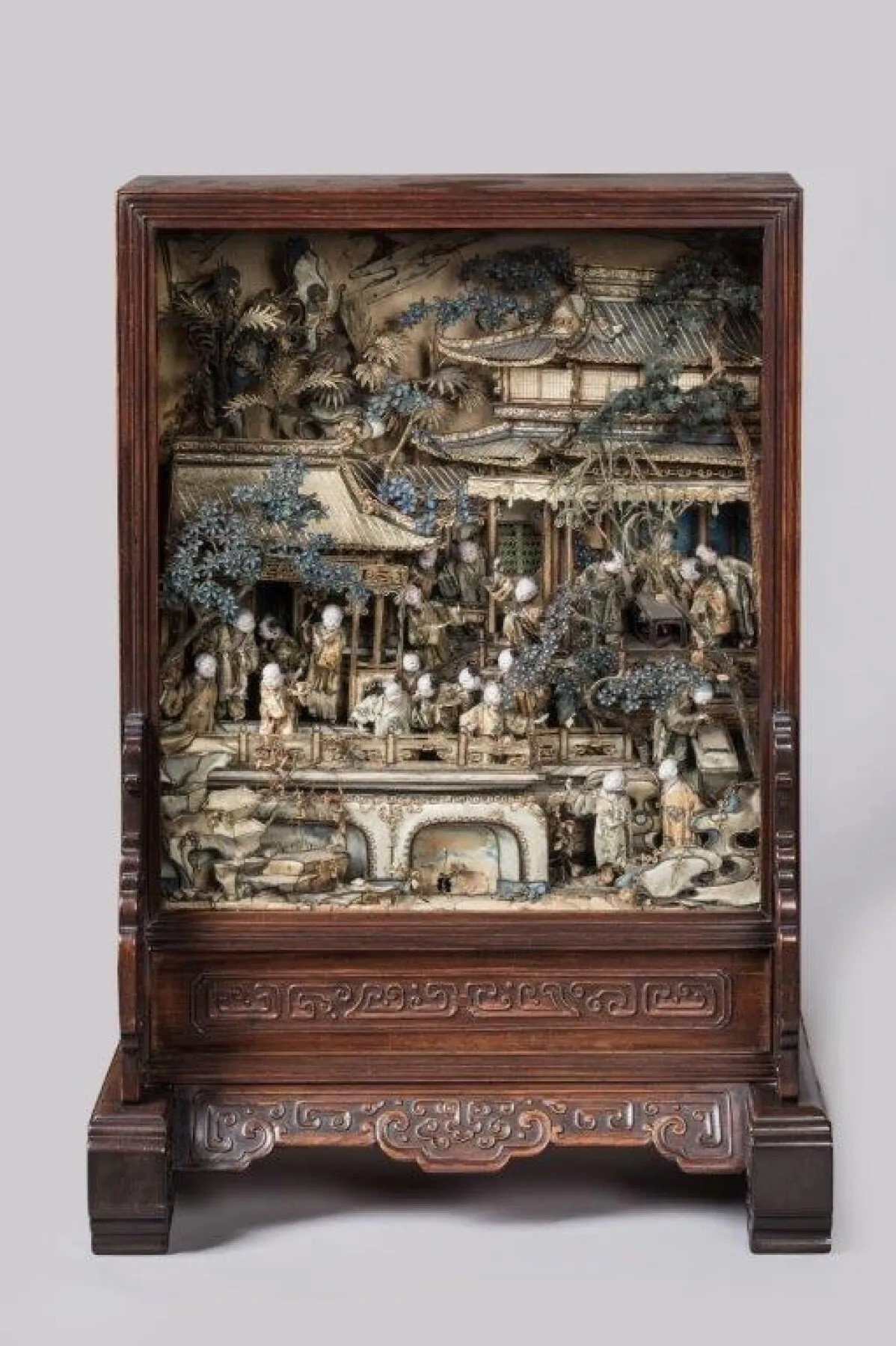
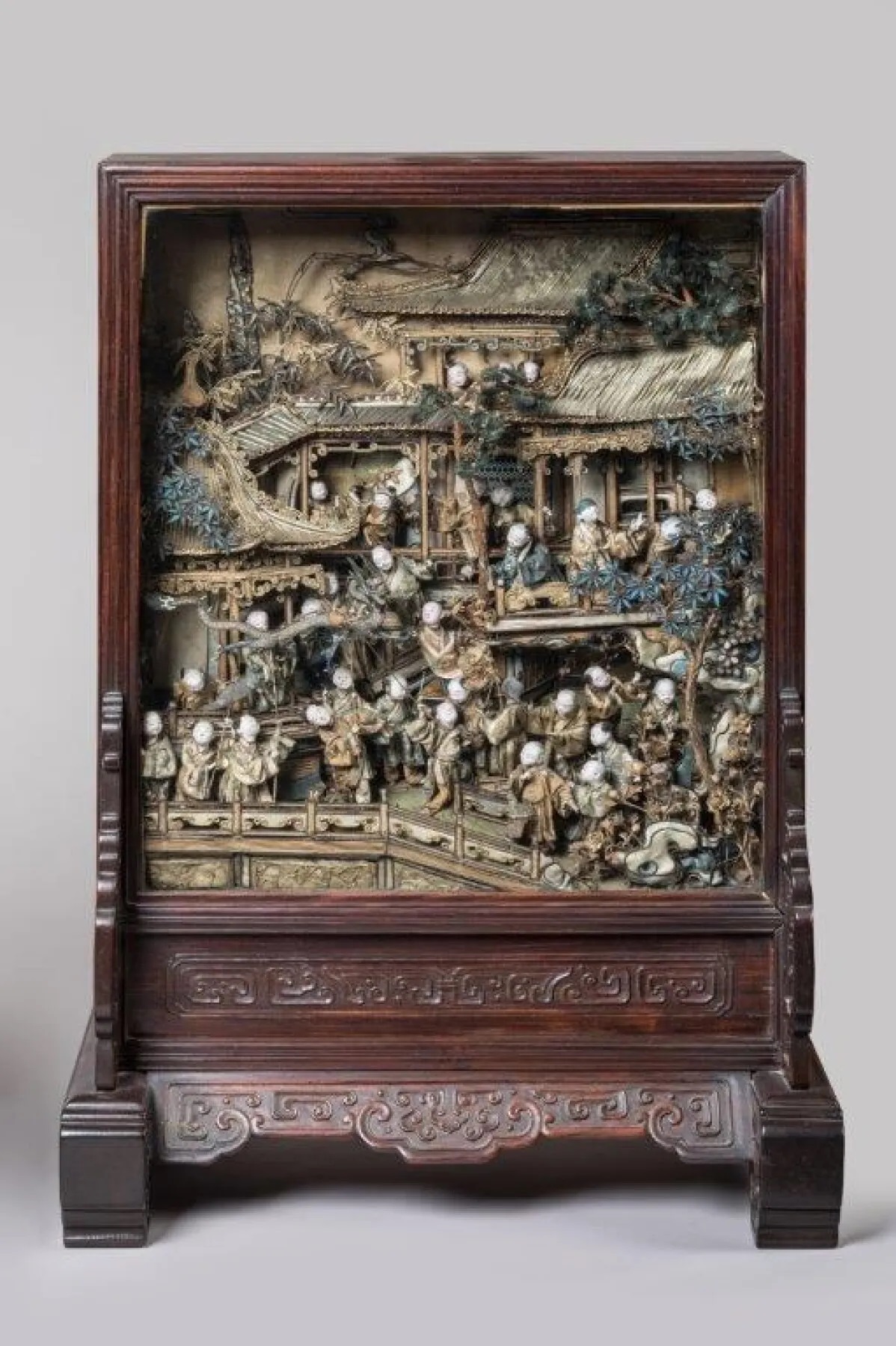
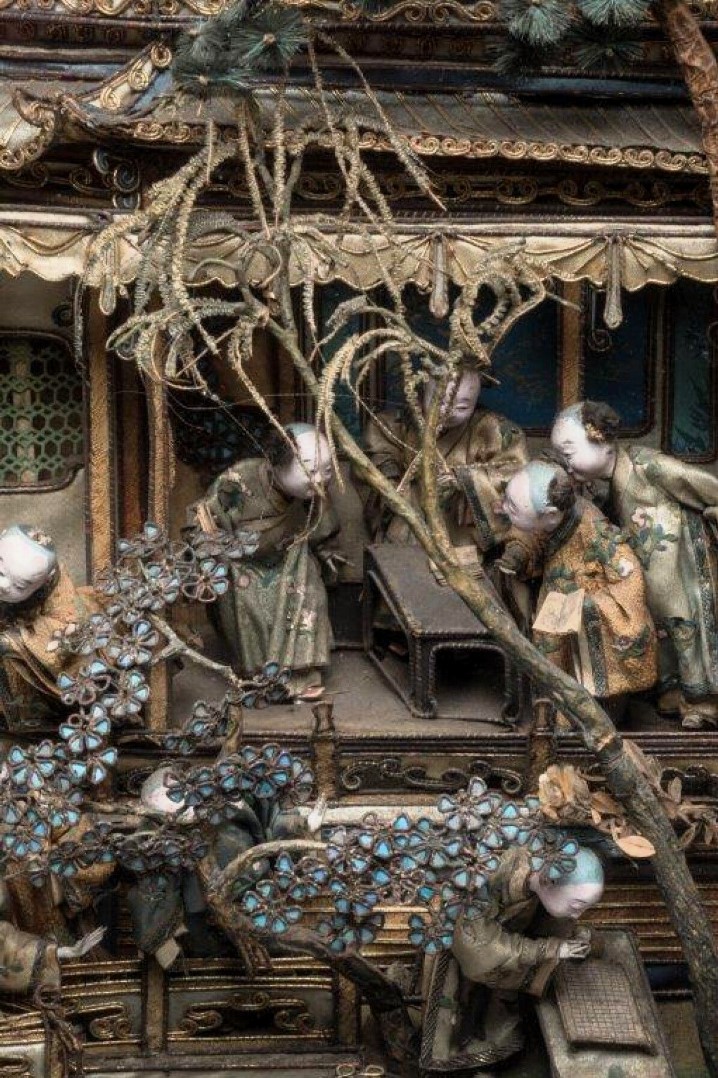
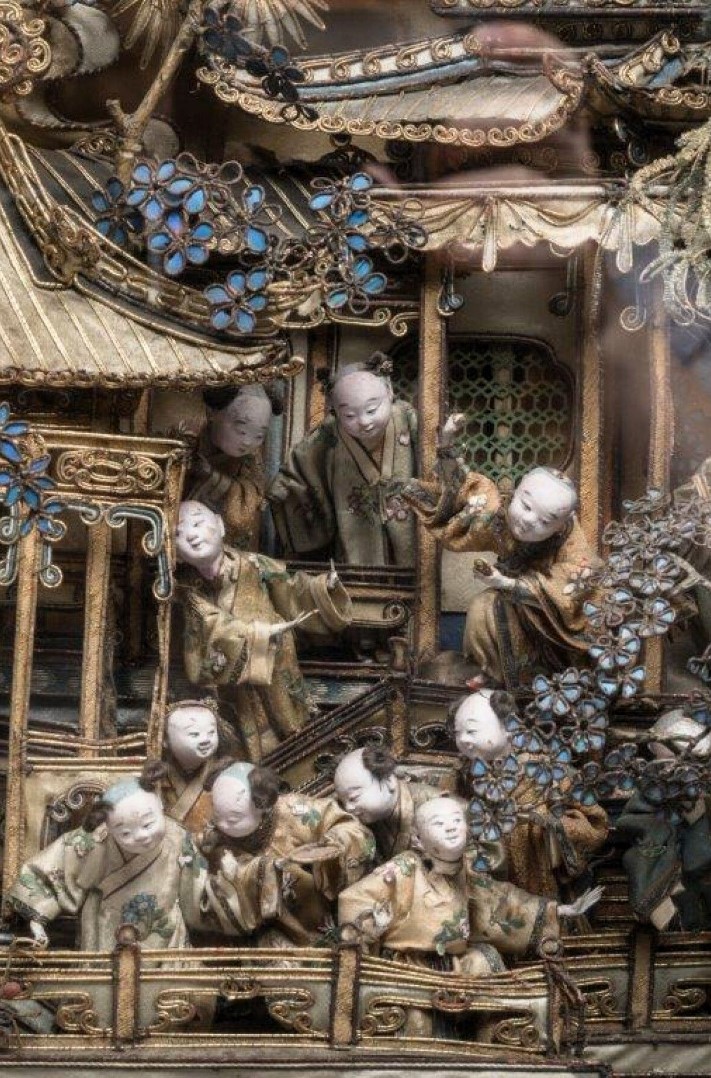
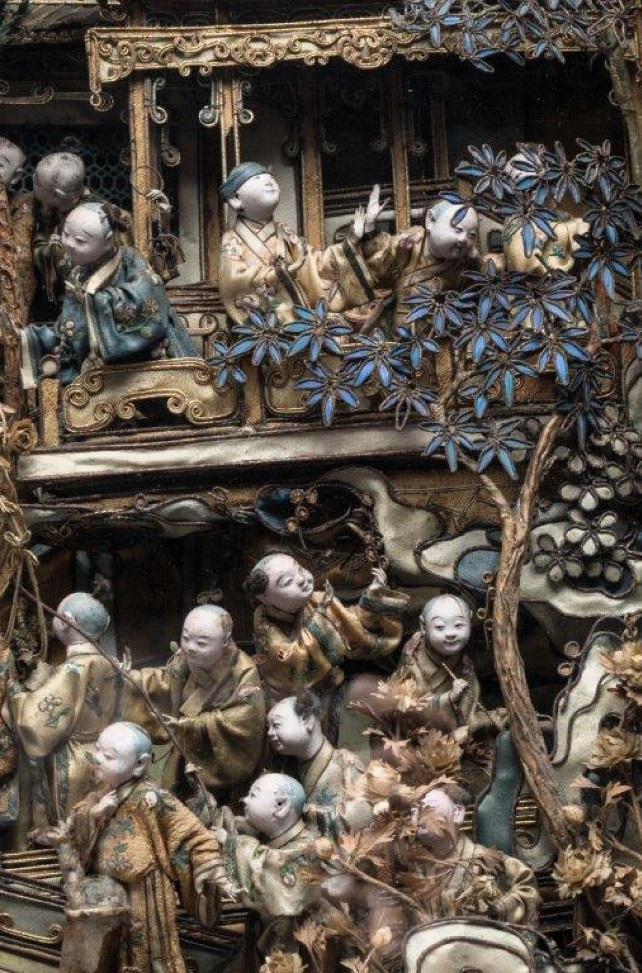
The figures are not distributed evenly. Some gather beneath pavilions, while others occupy balustrades and the areas around steps. Architectural elements divide activities into smaller episodes; trunks and branches cross those divisions and restore continuity. The courtyard can therefore be read passage by passage or appreciated as a coherent whole.
Individuality can be identified in composition, material selection, component shapes and traces of manual work. A claim that the pair is the only surviving example would require a much broader survey. The available evidence supports a discussion of its distinctive artistic character, without assigning it to an otherwise undocumented workshop.
2. Baibao Inlay: Materials as a Pictorial Language
Baibao qian, often translated as “hundred-treasure inlay”, employs the texture, colour and shape of diverse materials to construct images. “Hundred” does not prescribe an exact number. Definitions in the Ministry of Education dictionary and the Palace Museum emphasise selection, shaping and inlay [1–2]. The materials used vary between objects; a general list of possible ingredients is not an identification of every material in this pair.
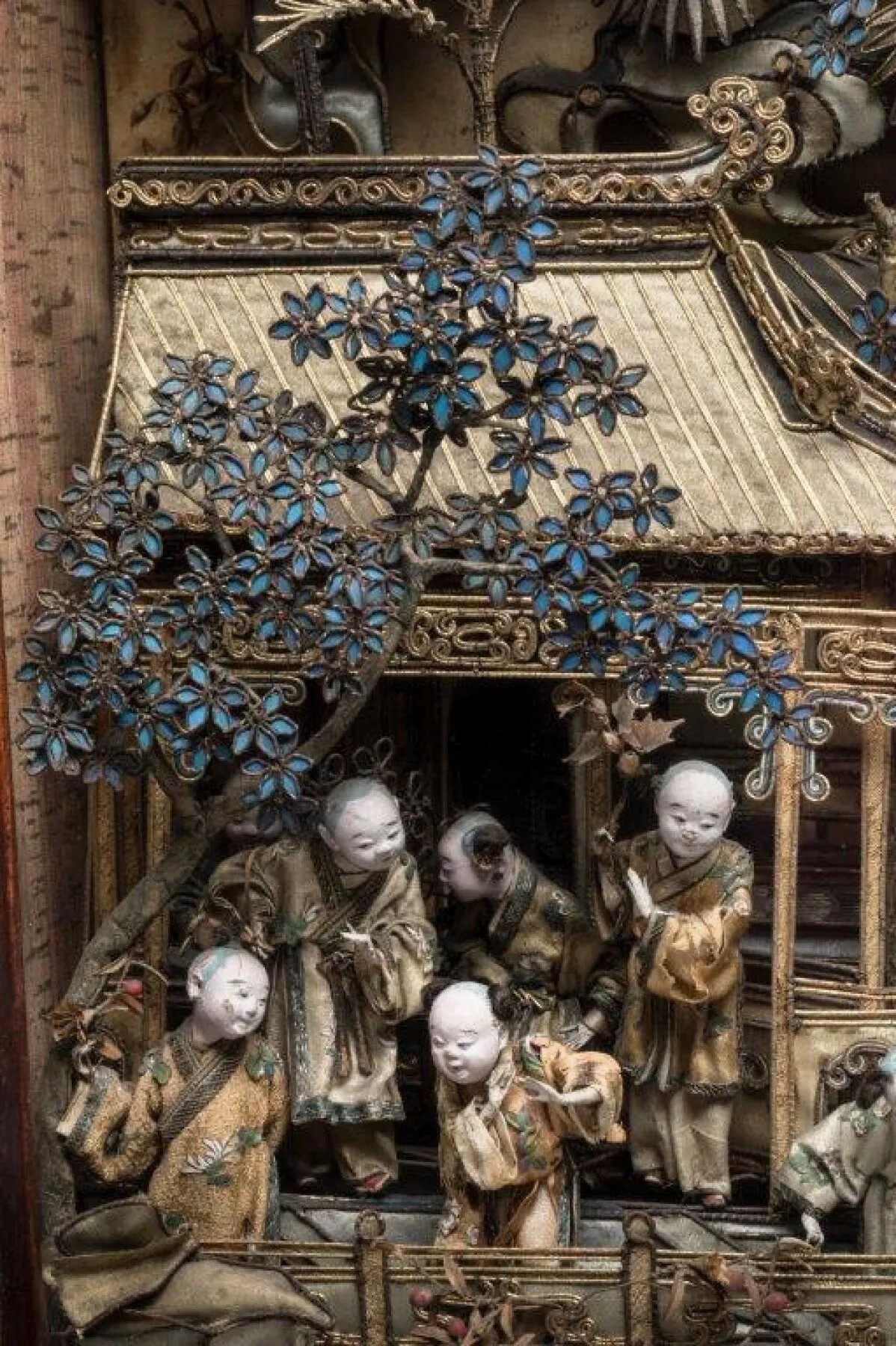
Light-coloured faces, contrasting garments, blue foliage and gold-toned linear ornament perform different pictorial tasks. Faces establish individual presence; clothing articulates bodies and movement; foliage connects spatial zones; architecture organises the setting. Materials function as a palette of textures as well as colours.
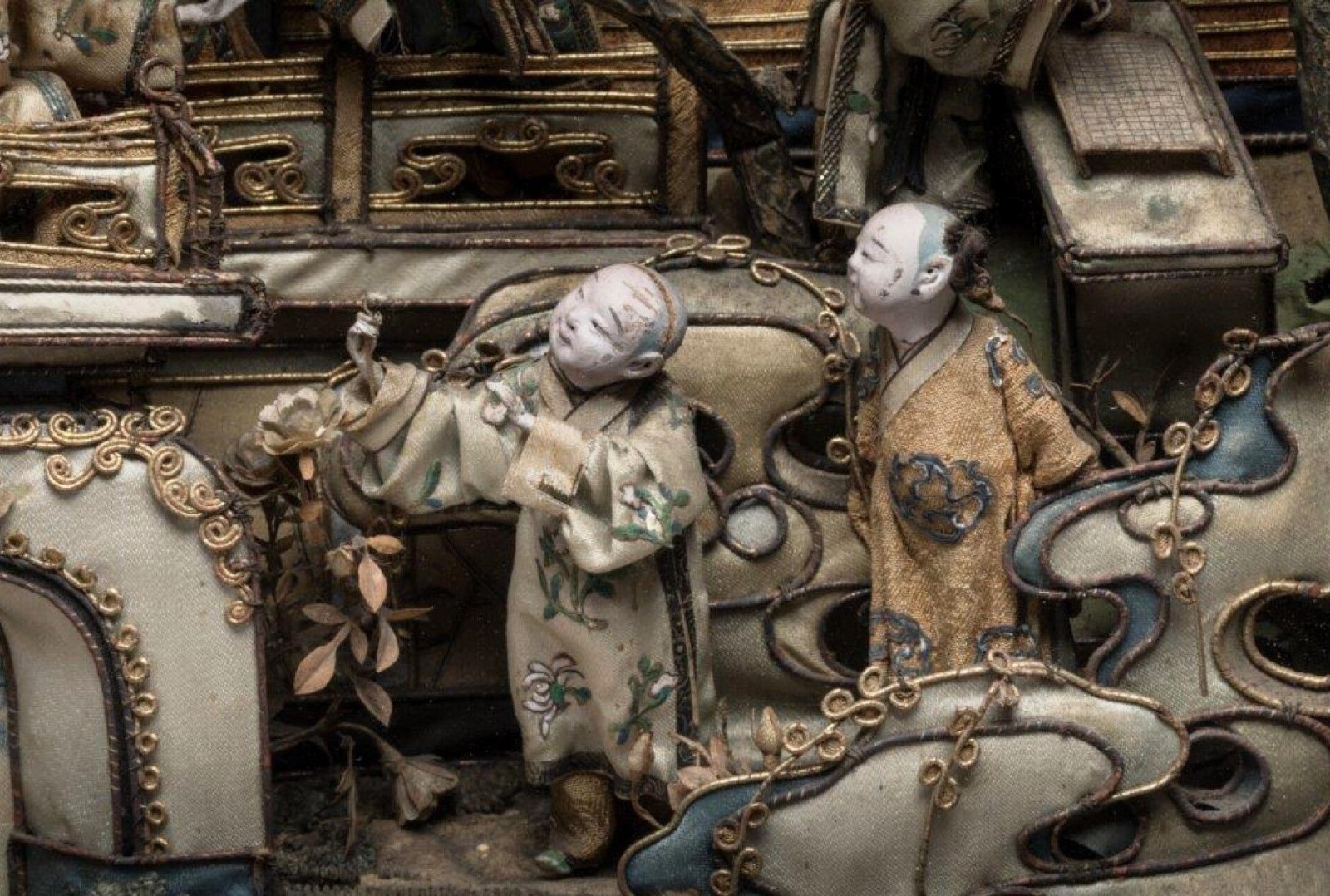
The painted clay faces, kingfisher-feather foliage, woven silk and embroidery are central to this effect. Clay gives volume to the face, while painting defines the features and complexion. Feather appliqué supplies the blue-green lustre of the leaves. Silk and embroidery connect textile surface, pattern and bodily movement. Fibres, pigments, adhesives and later repairs remain subjects for closer material recording.
3. Coordinated Techniques: Structure, Modelling and Surface
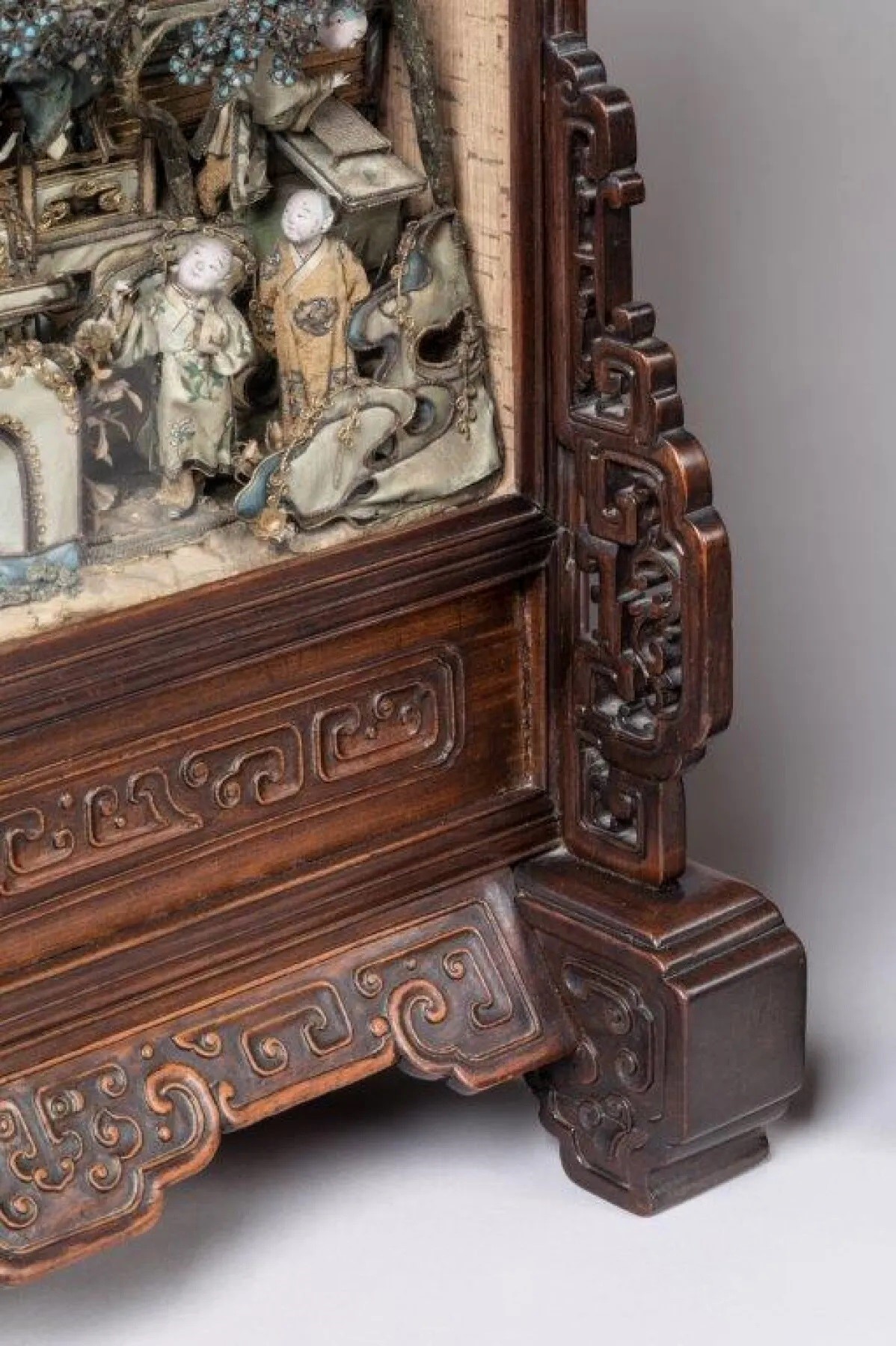
The visible construction brings together frame-making, woodcarving, the modelling and shaping of figures and scenery, component assembly, painted clay, kingfisher-feather appliqué, woven silk, embroidery and surface ornament. These are analytical categories of work, not proof of a particular number of craftsmen. Several stages might have been undertaken within one workshop or through cooperation between trades.
| Technique | Visible evidence | Interpretation and further examination |
|---|---|---|
| Wooden structure | Upright frame, feet and lateral supports | Supports the panel and establishes balance; wood species, joints and load-bearing structure require examination. |
| Carving and openwork | Relief and openings in the borders, lower panels and supports | Contours and shadows connect panel and base; individual motifs should be named only when identifiable. |
| Figure modelling and scenic shaping | Painted clay faces, textile garments and scenery at different depths | Facial volume and real textiles work together; other materials and fixing methods need closer study. |
| Inlay and assembly | Components of contrasting colour and texture form one scene | Joins, attachments and overlaps must be coordinated; adhesives and fixing systems remain to be examined. |
| Linear and gold-toned decoration | Fine lines and gold effects on garments and architecture | Accentuates contours and details; the exact use of gilding, paint or metallic elements requires verification. |
Craft Focus | Painted Clay, Kingfisher Feathers, Silk and Embroidery
Painted clay: expression through volume and brushwork
Clay modelling allows the brow, eye sockets, bridge of the nose, cheeks and corners of the mouth to be shaped independently. Painting then supplies the eyes, eyebrows and complexion. The children’s animation is therefore more than a matter of lively brushwork: facial modelling, head direction and painted detail must be considered together. Frontal and oblique close-ups of each figure would allow differences in the eyes, mouth and inclination of the head to be compared systematically.
Diancui: feather lustre as living foliage
The kingfisher-feather leaves introduce questions of cutting, placement, direction and surface texture as well as colour. Their effect differs from a flat application of blue pigment. Feather lustre, leaf outlines and overlapping branches jointly construct the garden. The backing, attachment of individual feather pieces and possible repairs require close inspection; photographs alone do not establish the entire production sequence.
Woven silk and embroidery: real cloth on miniature bodies
Silk weaving establishes the fabric and its structure; embroidery creates patterns with needle and thread on a ground. They are distinct techniques. Here, the use of textiles gives the drapery, borders and gestures a material continuity. Fabric thickness, the scale of embroidered patterns and the proportions of the figures must be reconciled. Enlarged images of fabric edges, seams, stitches and sleeve turns could distinguish textile ornament from carved or painted decoration.
Integration across materials
Clay and colour articulate the faces, feather appliqué shapes the foliage, textiles dress the bodies, and carved wooden structures frame the whole. Each medium retains its own texture while serving a shared scene. This purposeful allocation of materials is more revealing than a catalogue of precious ingredients.
4. Small Figures, Individual Expressions
Close views reveal differences in the inclination of heads, the bending of arms, standing and seated postures, and the distances between figures. Pale faces stand out against darker clothing and backgrounds, becoming points of attention despite their small scale. Garment folds and gestures establish bodily direction, while relationships between the children turn the arrangement into a sequence of events.
Activities in the courtyard include playing with a dragon lantern, watching fish, looking at picture albums, smelling flowers, studying and dressing as officials. These provide interpretive leads, but each episode should be assessed through its objects, gestures and neighbouring figures. Indistinct accessories should not be completed by imagination; a reliable figure count would require systematic numbering on clear overall photographs.
The original introduction invokes a traditional mnemonic for figure proportions, indicating an interest in bodily form. This does not establish that every child follows one exact ratio. Actual proportions, foreshortening and material thickness would require measurements or photographs with a scale.
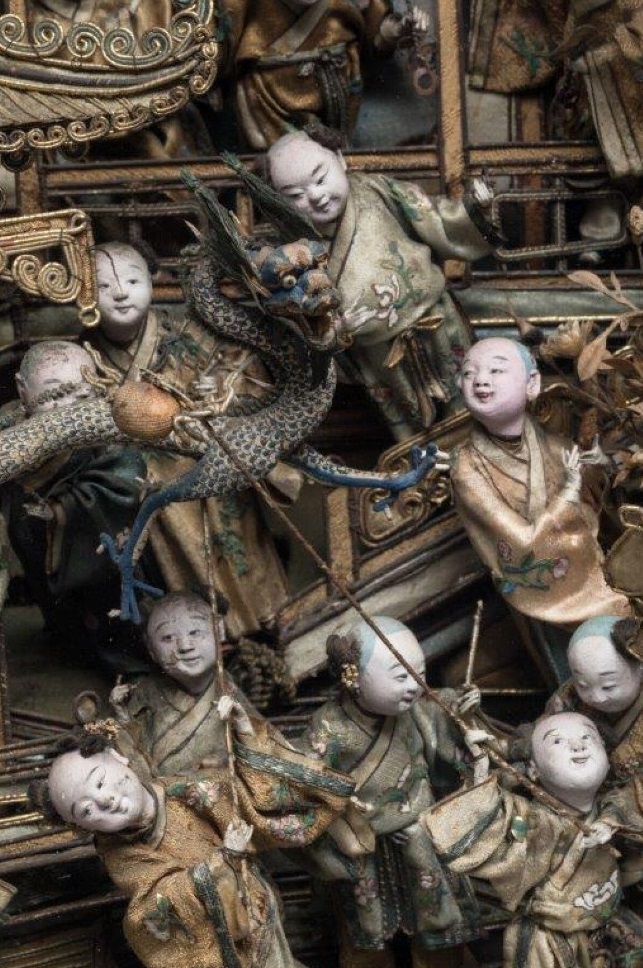
Image Focus | Different Expressions, Yet No Gaze Directed at the Viewer
Every child has a different expression, and none looks out towards the viewer. These features work together. Varied expressions make the children responsive individuals; their inwardly connected attention keeps them absorbed in play, observation and companionship. The courtyard becomes a world whose activities are not organised around an outside spectator.
The expressive life of a figure resides not only in its facial features but also in head direction, gesture, bodily inclination and responsiveness to others. As children attend to companions, objects or particular activities, gaze and movement explain one another. The scene feels alive because each figure appears engaged in something, rather than uniformly presenting itself for inspection.
This treatment can be understood through the Chinese artistic concern with chuanshen—conveying spirit—through situation and relationship. Limited physical means suggest inward feeling; posture and exchanged glances establish connections within the image; the viewer follows those connections into its world. The pair exemplifies a restrained, self-contained form of pictorial narrative.
The absence of an outward gaze also determines the spectator’s position. We stand quietly outside the garden, discovering its activities through pavilions, foliage and railings. This experience complements the multiple viewpoints of the composition: attention moves between groups without a frontal figure commanding the entire scene.
A systematic study could number the figures on each screen and record expression, head direction, apparent object of attention, gesture and neighbouring figures. Such a register would turn a compelling visual observation into a comparative record. No uncompleted figure-by-figure census is presented here.
From exchanged glances to a face-to-face encounter
The pair exemplifies a significant viewing strategy in Chinese courtyard and children-at-play imagery. Attention remains within the situation; glances, hands and bodily movement connect the figures, while spectators enter through those relationships. The children do not pause for the gaze outside the frame. Their independent thoughts and shared activities make the courtyard self-contained, understated and animated.
This can be compared with certain Western portraits in which a direct gaze establishes a face-to-face relationship, producing presence, exchange or psychological tension. The distinction concerns viewing strategies rather than an absolute division between cultures. Chinese religious images, ancestor portraits, imperial likenesses and other portraits include frontal encounters, while Western narrative paintings frequently show figures absorbed in activities within the image.
What this pair expresses with particular force is the capacity of Chinese art to convey spirit through relationships and circumstances, allowing the spectator to enter gradually through quiet observation. The artistic achievement becomes clearest when considered in the expression, gaze and movement of each child.
5. Pavilions, Balustrades and Trees: Multiple Viewpoints in Material Form
Buildings, terraces and plants organise the panel vertically and in depth. The spectator need not remain at a single vanishing point but can follow the activities from one zone to another. This resembles the moving viewpoints encountered in Chinese painting and is better described as a composition of multiple views and connected episodes than simply as accurate perspective.
Overlap is especially important. Branches cross in front of figures; railings define terraces; eaves project above children sheltered below. Relationships that painting can establish with line and colour become differences in material thickness, projection and shadow. Technical accomplishment therefore depends on the legibility of the assembled layers as much as the precision of each component.
Oblique views clarify how roofs, branches and bodies project from the background. The result is nevertheless a pictorial construction intended primarily for viewing as a screen, rather than an architectural model designed to be circled on all sides.
6. Children at Play: Joy, Education and an Ideal Social World
Children-at-play imagery celebrates vitality and can carry wishes for familial flourishing, peace and continuity. Specific meanings depend on the combination of motifs. Each child should not automatically be reduced to a symbol of abundant offspring, nor should the work be called a “Hundred Boys” composition without an actual count.
Reading, examining pictures and playing at official roles place recreation and education within the same courtyard. Joy is joined to cultural expectations: the children are lively individuals who also embody hopes for learning, growth and future social roles.
Pavilions, flowers, trees and balustrades locate many activities within a recognisable order. This is an artistically composed ideal of life, rather than a straightforward documentary record of Qing childhood. The poetic title used for the online exhibition is a modern interpretive title; it is not documented as an original inscription.
7. Paired Display and the Work of the Frames
The related proportions, borders, feet and ornamental vocabulary encourage the two screens to be viewed together. Within each, small figures and buildings create an intricate centre; outside it, the dark wooden silhouette gathers the composition into a stable whole. The contrast between an active interior and a composed outer structure is essential to the pair’s effect.
Lateral supports and feet contribute to stability, outline and the experience of side views. Palace Museum studies of screens offer useful comparisons for analysing frames, panels, uprights and bases [3]. The precise names, joints and original relationships of this pair’s components must nevertheless be checked against the objects themselves.
The photographs support reading the screens as a complementary pair. Establishing whether they were originally made together would benefit from comparison of backs, joints, grain, tool marks, dimensions and provenance. Without measurements or records of original placement, their use on a particular desk, in a hall or in a palace cannot be established.
8. Comparison and the Individual Character of the Pair
The Palace Museum’s black-lacquer cabinet with baibao-inlaid children-at-play scenes demonstrates that the combination of this subject and multi-material inlay has precedents [2]. Its zitan-framed baibao screen depicting lions at play provides a comparison for screen construction and animated scenes [3]. These objects illuminate subject and format; they do not independently determine the date, origin or workshop of the Yun Museum pair.
The distinctive features here are different courtyards within related frames, groups of children distributed through layered architecture, foreground foliage crossing spatial zones, and the joint narrative contribution of texture and depth. Artistic accomplishment lies in organising many techniques into a legible scene.
Handmade individuality resides in natural variations of colour and texture, the shaping of components, bodily movement and assembly. These qualities sustain the pair’s value for appreciation and research. A claim of sole survival would require a comprehensive survey of comparable works.
Conclusions and Further Research
Three interconnected features define the pair. First, children with individual expressions and internally directed attention inhabit a courtyard composed through multiple viewpoints. Second, painted clay faces, kingfisher-feather leaves, woven silk and embroidered clothing transform pictorial imagery into a world of texture, shadow and thickness. Third, matching wooden frames bring the intricate scenes into a stable, complementary display.
Priorities for further study include codes for the two screens and individual figures, material distribution maps, scaled frontal and side photographs, records of backs and joints, and documentation of loose components, replacements and surface restoration. These would help address material identification, original assembly, production sequence and workshop connections. They remain proposed work rather than completed investigations.
Frequently Asked Questions
Does baibao inlay contain one hundred kinds of gemstone?
No. The term refers to the skilful combination of diverse materials. The actual ingredients must be examined object by object.
Were these screens made for the Qing imperial court?
The available evidence includes no court record or provenance sufficient to establish imperial use. Fine workmanship and auspicious imagery alone do not prove it.
Can they be called unique?
Their individual composition, material choices and handmade figures can be described precisely. A claim that they are the only surviving examples requires broader comparative evidence.
References and Further Reading
- Ministry of Education, Revised Mandarin Chinese Dictionary: baibao qian. A terminology reference, not a material analysis of this pair.
- Palace Museum, Black-lacquer cabinet with baibao-inlaid children-at-play scenes, text by Hu Desheng. Comparative evidence for subject matter and furniture inlay.
- Palace Museum, Zitan-framed baibao-inlaid screen depicting lions at play. Comparative evidence for screen construction and animated scenes.
- Yun Museum, Online exhibition: a pair of mid-Qing baibao-inlaid courtyard screens with children at play, and related collection descriptions.
- Comparative reading: The Metropolitan Museum of Art, The Emperor’s Private Paradise: gallery descriptions; National Portrait Gallery, How to create a photographic portrait. References for frontal Chinese portraiture and direct-gaze strategies.
This study examines craft and imagery through collection records and photographs. It is not an authentication or scientific examination report. Photographs: Yun Museum. References consulted 6 November 2026.