
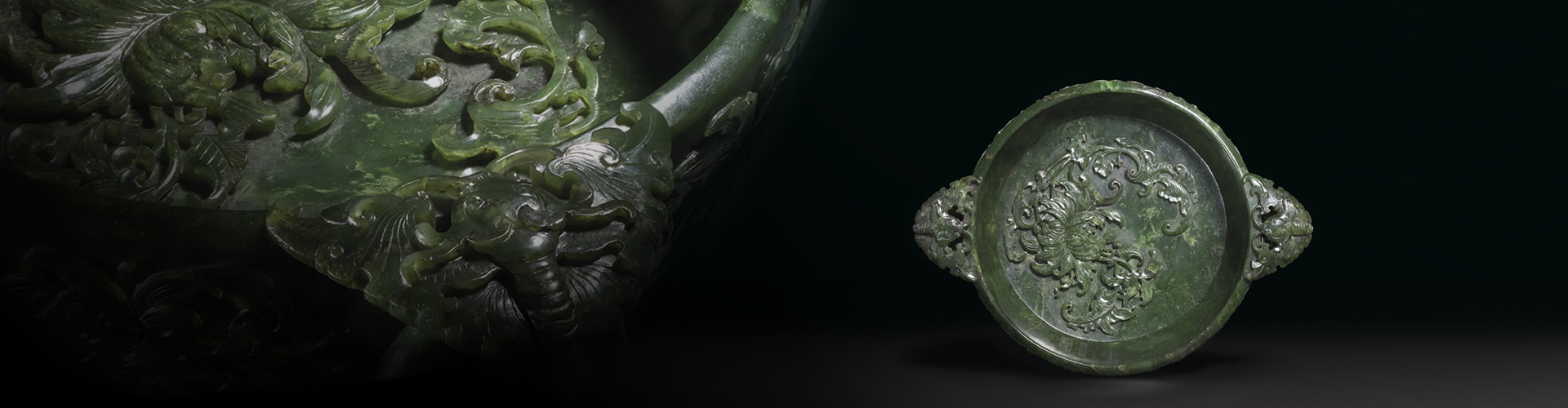
Imperial White Jade Fragrance Fan Inscribed with a Qianlong Poem, Qing Dynasty, Qianlong Period
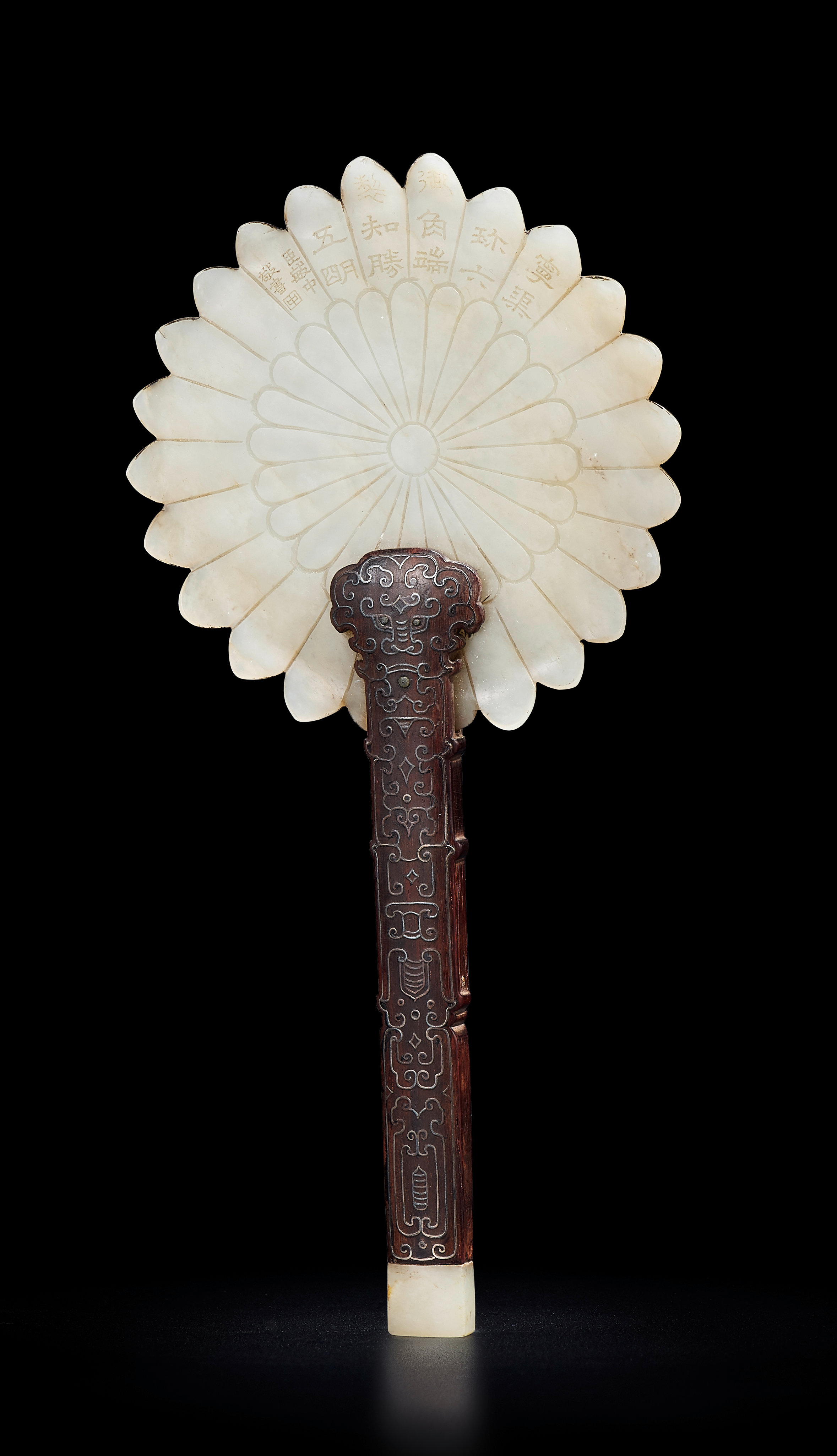
Length: 20.5 cm.
The pale celadon-white jade fan is carved in the form of chrysanthemum petals, their edges turning gently upwards. Near the top of the centre is the inscription “御製” (“imperially composed”), followed by the poetic couplet “寧渠珎六角,端知勝五明” and the signature “臣敏中敬書” (“respectfully inscribed by your servant Minzhong”). A carved seal reads “中” (Zhong).
The zitan handle is inlaid with silver wire forming archaistic taotie masks and cloud scrolls; traces of lacquer remain. The thinly worked, softly lustrous jade contrasts with the dark wood and silver ornament.
The couplet is drawn from Qianlong’s poem 扇薰榭六韻, composed about the Shanxun Pavilion at the Yuanmingyuan. The Chinese text is preserved below:
敞榭式文扇,扇薰因與名。
如常張月半,不動致風清。
寧渠珎六角,端知勝五明。
竹聲揺處爽,花影畫中榮。
曰禹慙無間,緬虞企載賡。
階泉奏琴韻,解慍切予情。
The poem describes an open pavilion shaped like a decorated fan, associated with a refreshing breeze, the sound of bamboo, flower shadows and the musical flow of a spring. Its reflections connect the pleasures of the garden with the emperor’s thoughts on exemplary rulership. The source is 御製詩三集, juan 24, in the Siku Quanshu edition. Based on the inscription and the poem’s setting, the Chinese article proposes that this object was used in connection with the enjoyment of fragrance.
Yu Minzhong (1714–1779), whose name appears in the inscription, was a major official involved in compiling and publishing the third collection of imperial poems and the Siku Quanshu. His literary and calligraphic accomplishments earned the Qianlong emperor’s appreciation. He served in the Maoqin Hall and was commissioned to transcribe the Avatamsaka and Shurangama sutras.