

YUN MUSEUM · STUDIES IN BUDDHIST ART
Between Form and Spirit: A Standing Polychrome Bronze Arhat
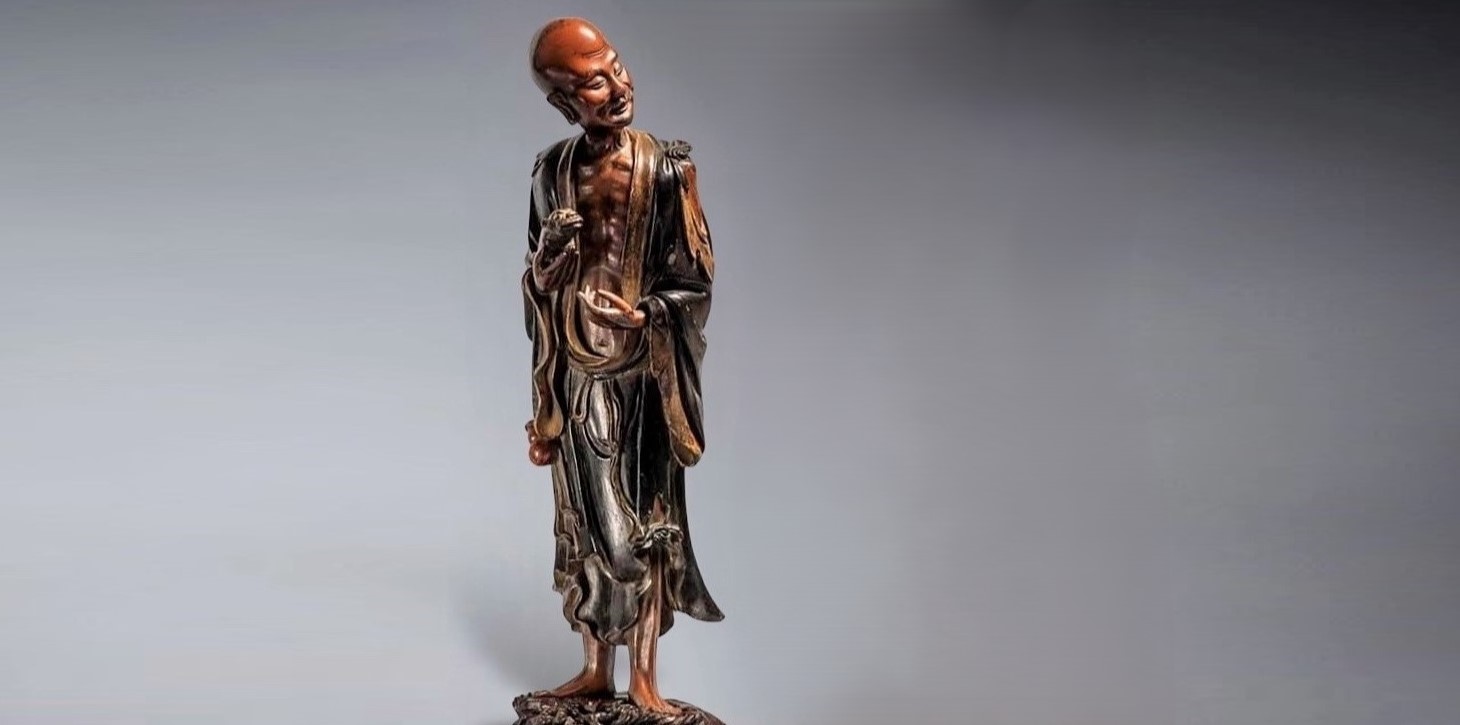
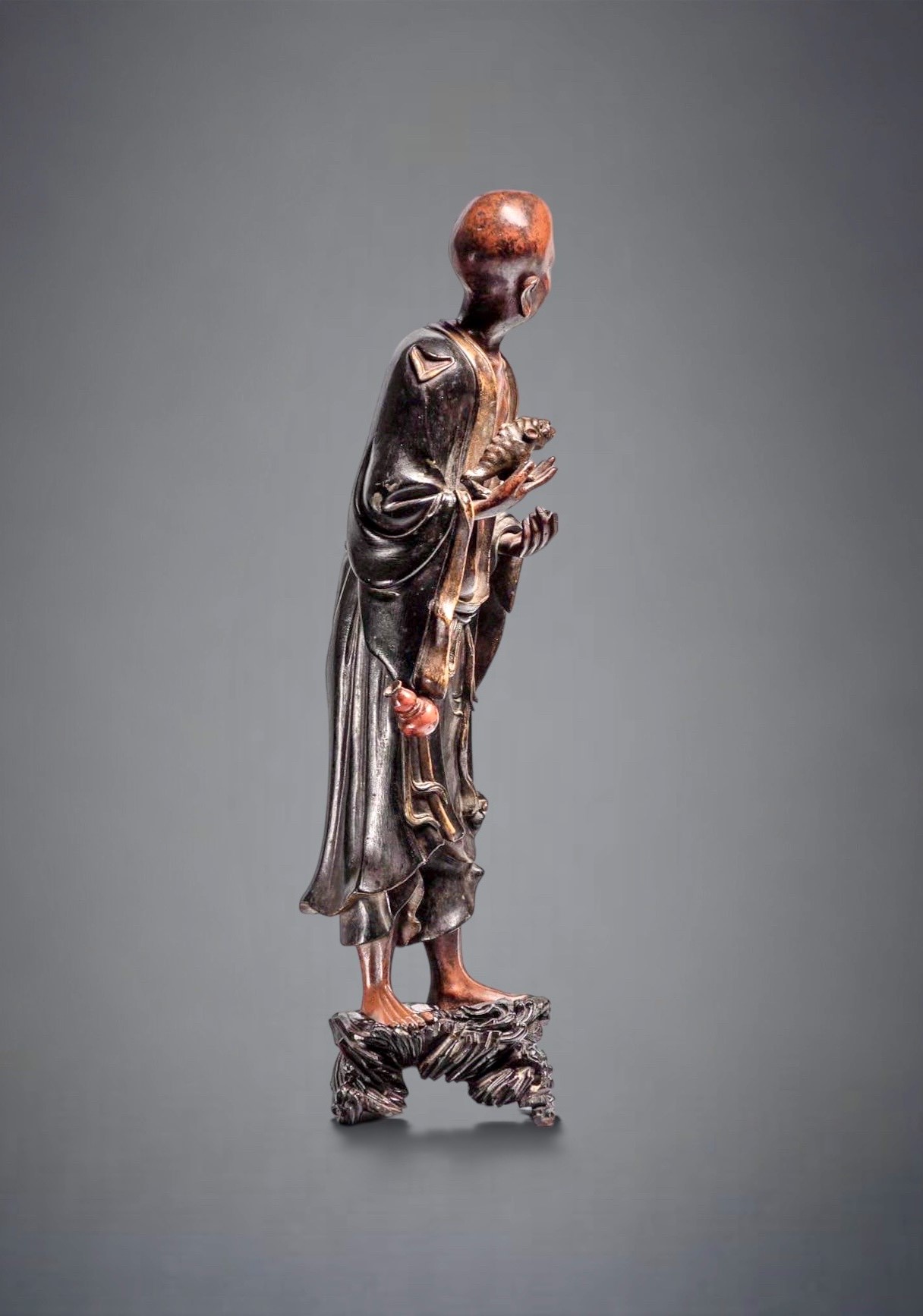
A slightly inclined head, a restrained smile, and a generous robe surrounding an attenuated torso: the standing polychrome bronze arhat in the Yun Museum collection, approximately 46 cm high, brings a monk’s human presence together with an image of spiritual attainment. As a work of Chinese Buddhist sculpture, it offers a focused case study in arhat devotion, metalworking, and the methods used to assess an object’s date.
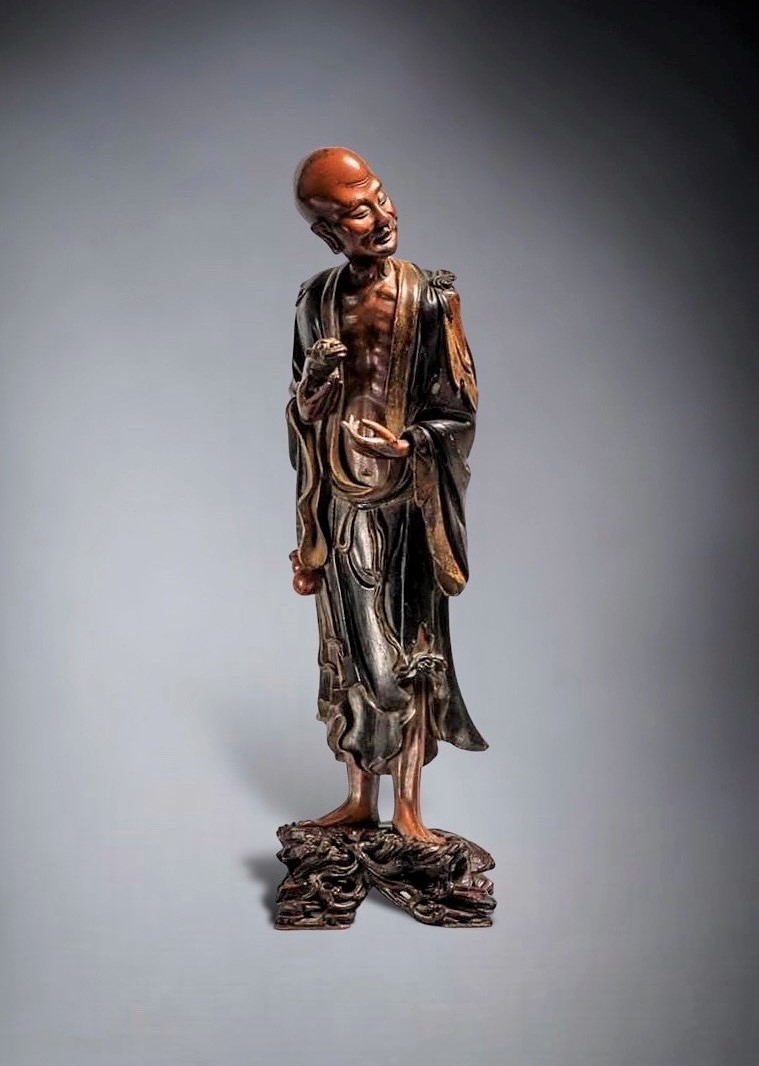
Title: Standing Polychrome Bronze Arhat (Luohan)
Museum attribution: Tang dynasty or later
Height: approximately 46 cm, according to the Museum
Material: copper-alloy sculpture with polychrome decoration; alloy composition and color layers await analysis
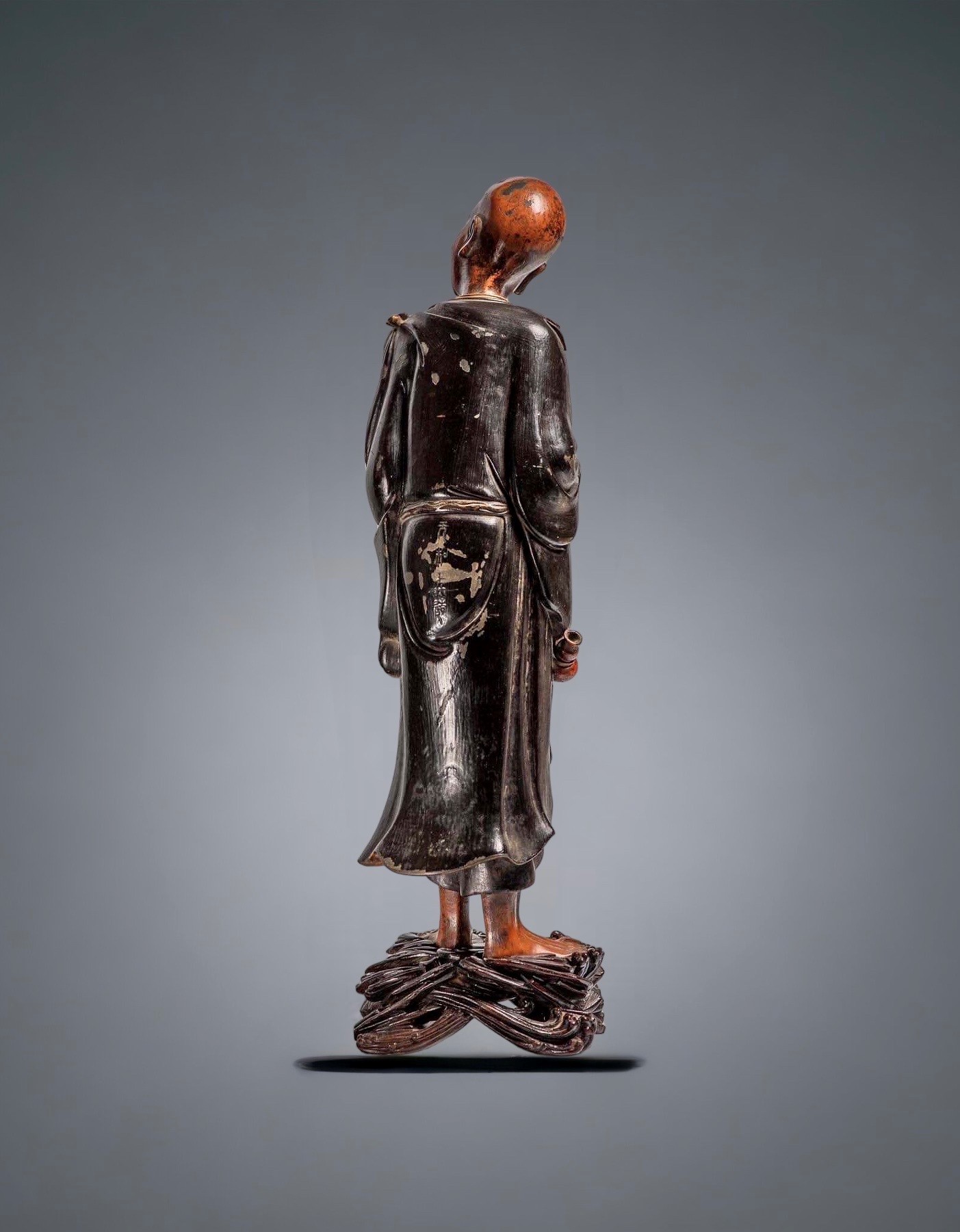
Inscription: 元和年製 (Yuanhe nianzhi, “Made in the Yuanhe era”), engraved on the back; whether it is contemporary with the named era or a later retrospective mark remains to be studied
Recorded provenance: a private collection in Amsterdam; acquired by the collector’s father around 1910 and subsequently inherited within the family. This account follows the Museum’s record and has not been independently verified here.
1. Arhat Devotion: Enlightenment in Human Form
Luohan is the Chinese rendering of the Sanskrit arhat, a practitioner who has overcome the afflictions and attained liberation from the cycle of rebirth. Arhatship occupies an important place in the śrāvaka path. Arhats should not be reduced to a third rank of deities beneath Buddhas and bodhisattvas, nor defined as attaining realization through teaching rather than personal practice. Cultivation, awakening, and the protection of the Dharma provide the essential framework for understanding their imagery.
The Record of the Abiding of the Dharma Spoken by the Great Arhat Nandimitra describes sixteen great arhats entrusted with preserving the Buddhist teaching and benefiting sentient beings [1]. Within this devotional narrative, arhats are more than disciples belonging to the Buddha’s historical past: they remain connected with the human world as guardians of the Dharma. The Chinese traditions of sixteen, eighteen, and five hundred luohans reflect different texts, groupings, and devotional contexts rather than one immutable roster.
Arhat art accommodates striking individuality. Age or vigor, contemplation or a smile, stillness or movement can all give visual expression to religious attainment. This essay follows the Museum’s identification of the figure as an arhat. Naming a particular disciple would require evidence from an original ensemble, an inscription, or securely established iconographic attributes.
2. Face and Posture: Spiritual Intensity in an Emaciated Body
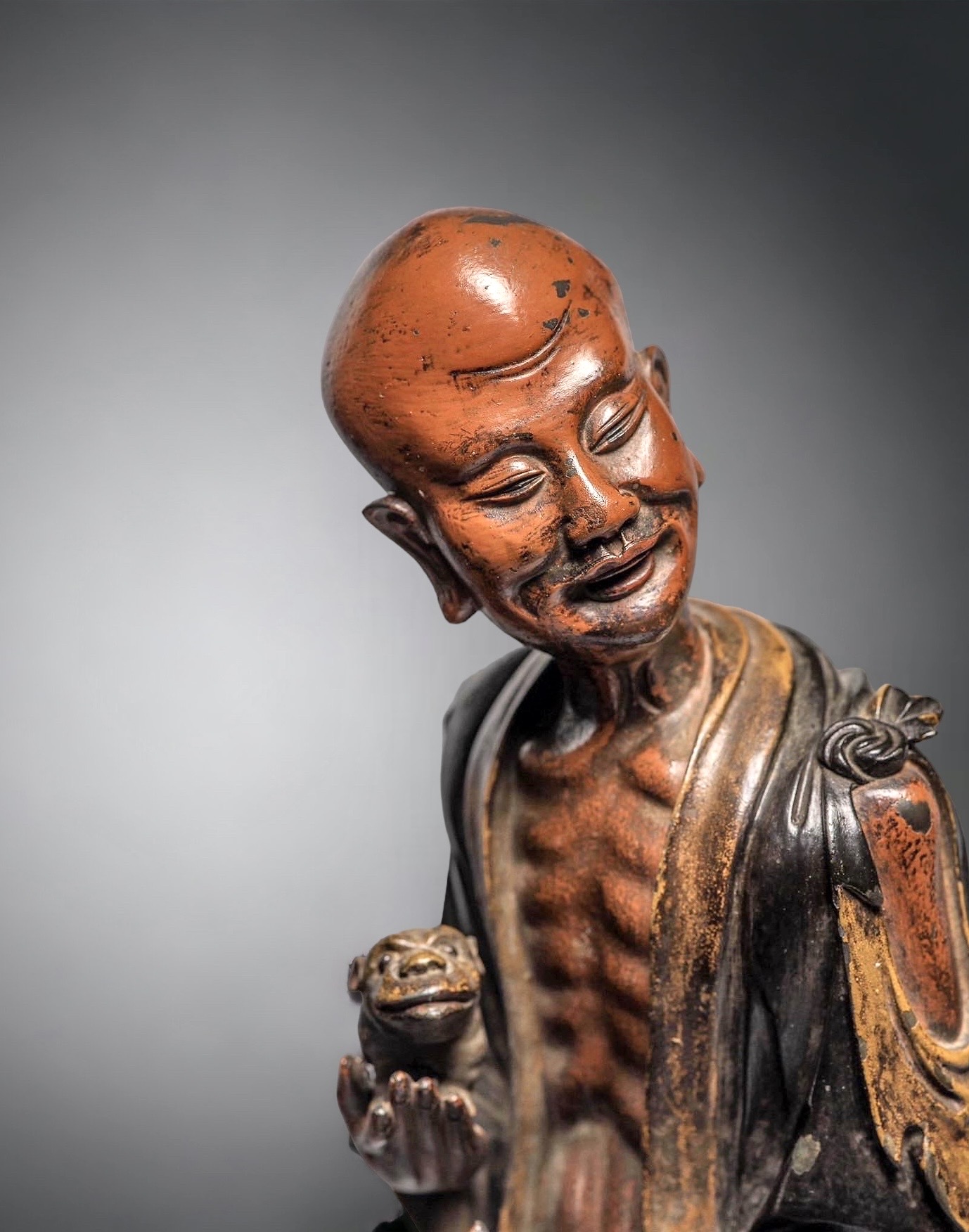
In the photographs, the head inclines slightly to one side. The brows, eyes, cheekbones, and corners of the mouth work together to create a restrained yet approachable expression. Warm reddish coloring on the head contrasts with the dark robe, directing attention first to the face and then down the neck toward the chest. The effect depends on subtle transitions in modeling rather than a dramatic gesture.
The partially exposed torso emphasizes the breastbone and ribs, set against the apparent weight of the robe. Such an attenuated body can be considered within the imagery of ascetic practice. Thinness alone, however, does not identify the figure as Kāśyapa, Bodhidharma, or any named arhat. The interpretation of an ascetic ideal and the identification of a specific individual are separate questions.
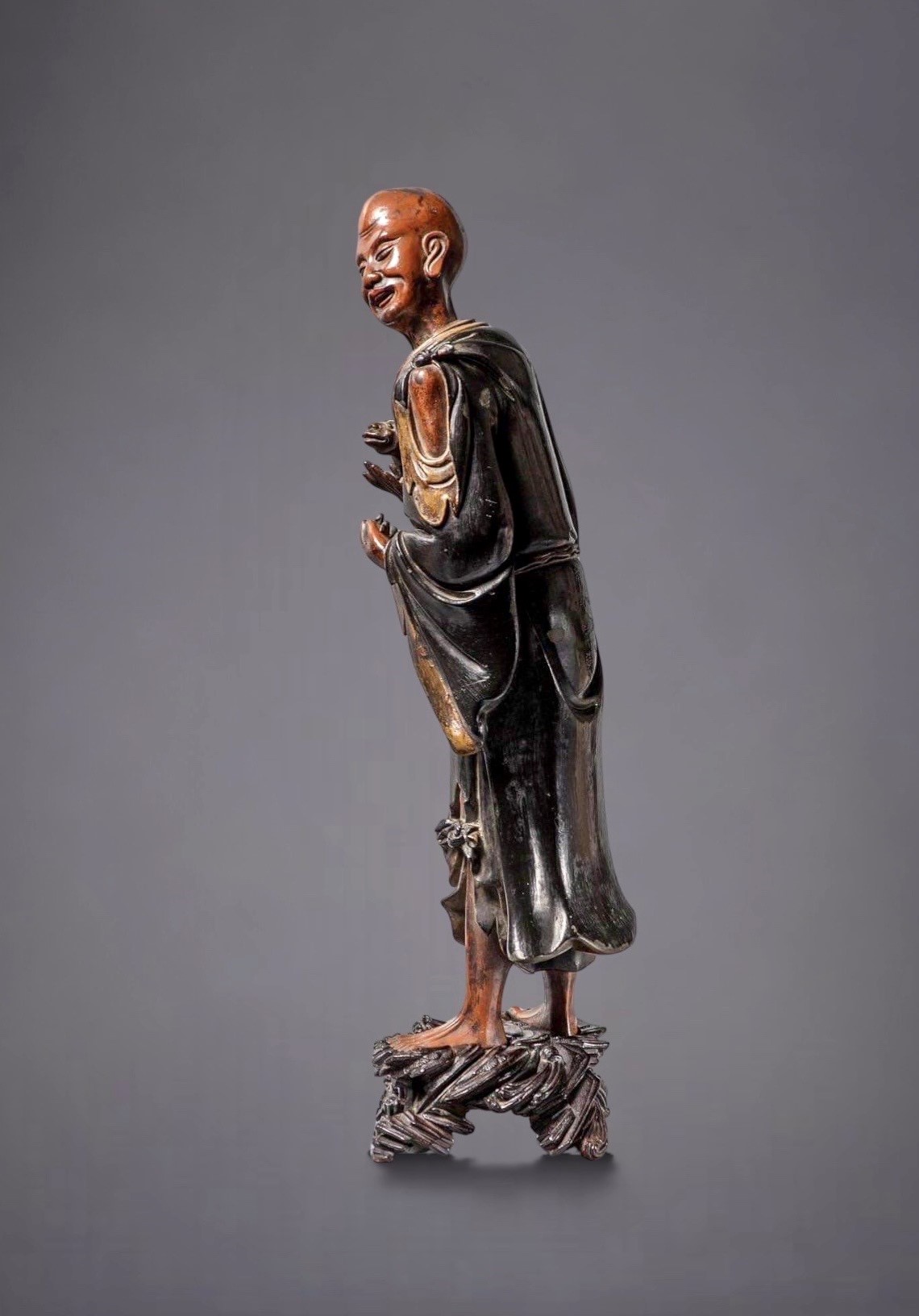
The feet rest on a small base, while the elongated silhouette and changing directions of the head and hands invite viewing in the round. Side views clarify bodily depth and the hanging garment; the back reveals how its folds continue beyond the principal view. Multiple photographic angles are therefore essential to the study of this standing polychrome bronze arhat.
3. The Sculptural Language of the Robe
Folds vary in density around the shoulders, elbows, waist, and hem. Recesses collect shadow while projecting edges catch the light, giving the metal a rhythm suggestive of falling cloth. The exposed chest and abdomen contrast with the enveloping robe, allowing the slender body and the garment’s weight to be perceived together.
Drapery also organizes the sculpture. Long lines draw the eye downward, while tighter turns near the arms concentrate attention on the held object. A comparative study should record the neckline, manner of wrapping, sleeve openings, and treatment of the hem against securely dated works. Descriptions such as fluid or archaic express an aesthetic response but cannot independently establish a date.
4. The Animal-Head Object and Gourd-Shaped Accessory
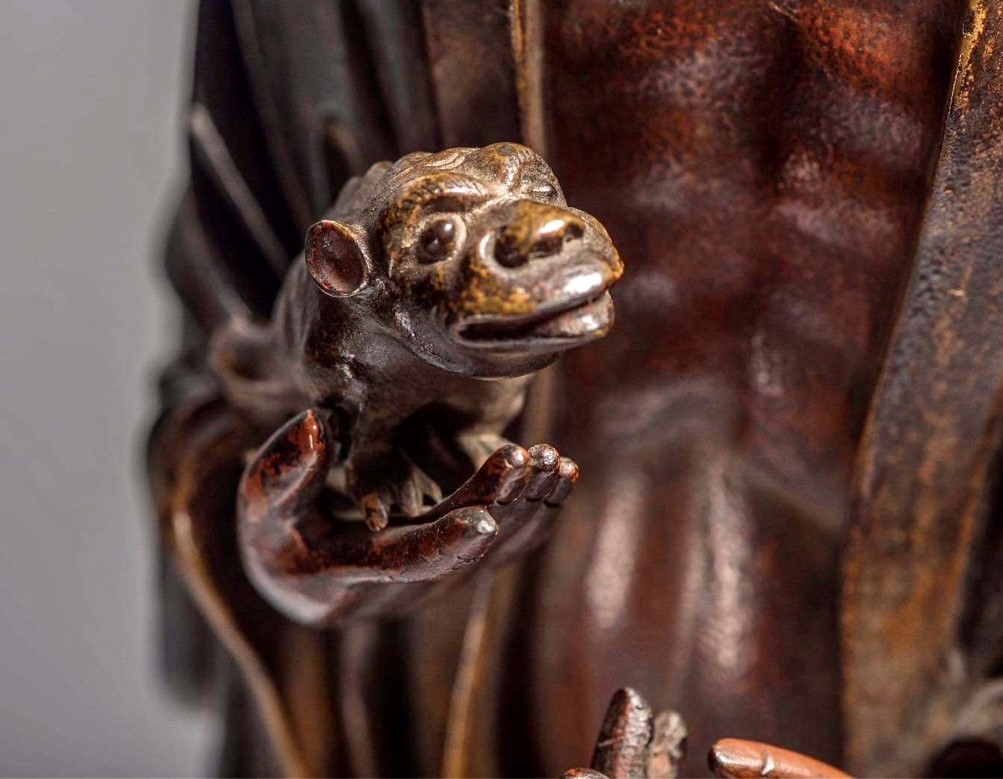
The Museum’s earlier description refers to the object held near the chest as an auspicious beast. The close-up shows an animal-head form and an opening, but its original function, completeness, and possible association with a specific arhat require further views and direct examination. This essay therefore uses the descriptive term animal-head object rather than identifying it as a lion, dragon, or particular ritual implement without sufficient evidence.
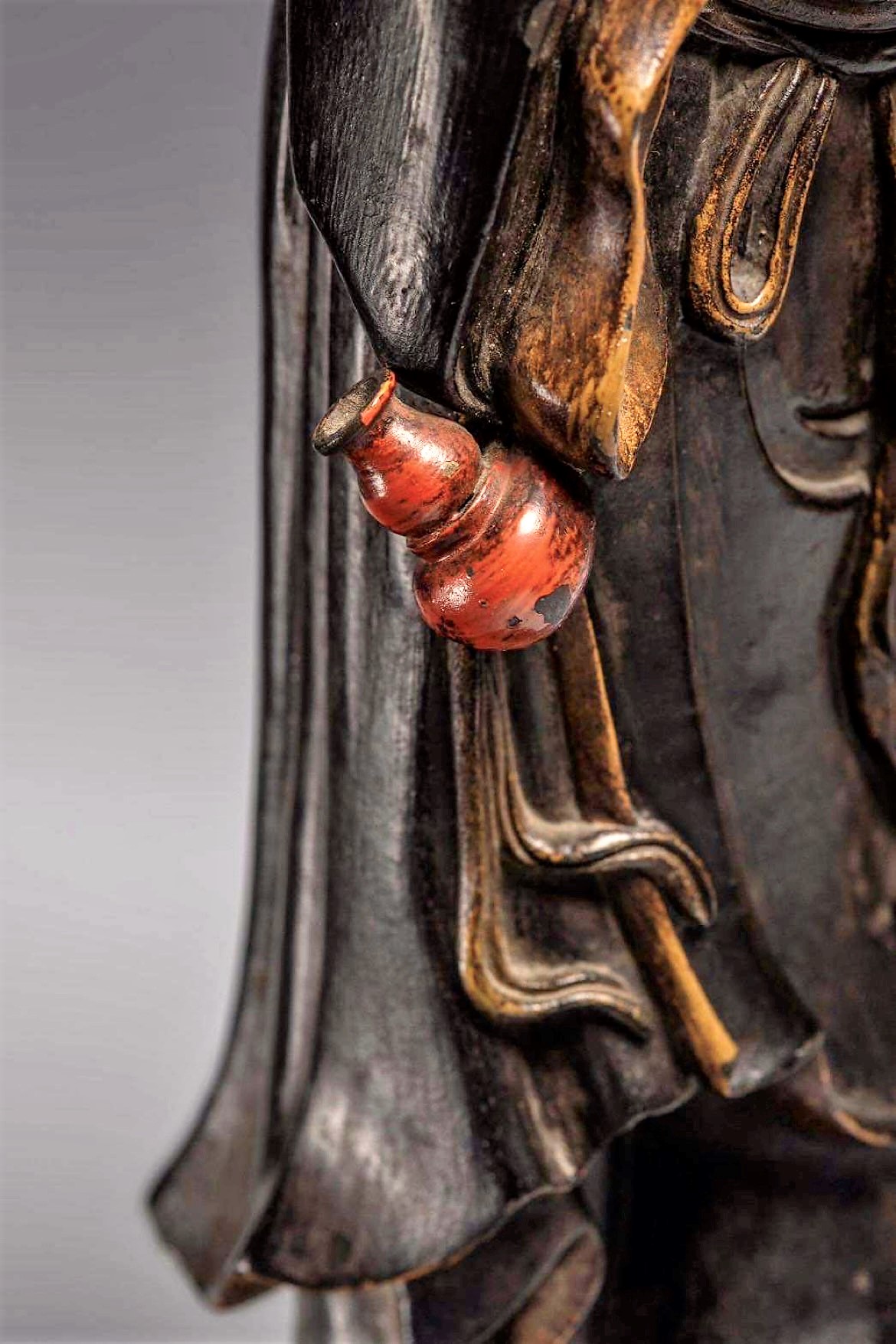
A red accessory beside the robe has a gourd-shaped outline, with a constricted neck and rounded body. Gourds carry varied practical and symbolic associations in Chinese religious and secular art. Their presence alone cannot determine the figure’s identity. The accessory must be considered together with facial features, clothing, the held object, inscriptions, and any evidence for an original devotional ensemble.
5. Polychrome Bronze: Casting, Color, and Surface History
The term polychrome bronze describes the combination of a metal body and colored surface decoration; it does not establish the alloy, pigments, or date of application. The photographs show warm red areas on the head, flesh, and accessories, together with dark garments and pale golden traces. Images alone cannot identify these as cinnabar, gold leaf, powdered gold, lacquer, or repainting from a particular period.
Metal sculpture may involve modeling, casting, finishing, assembly, and surface decoration. The casting process used here, the possibility of separately cast components, and the presence of a core require structural evidence. Radiography or computed tomography could help examine wall thickness, joins, and internal construction. X-ray fluorescence could provide information about near-surface elements, while microscopy and paint-layer analysis could clarify the sequence of decorative layers. These are proposals for future study, not tests already performed on this object.
An irregular surface may result from wear, corrosion, cleaning, repairs, and later applications of color. It does not by itself demonstrate prolonged temple worship, imperial ownership, or a precise date. For a polychrome Buddhist bronze, the casting of the body, the execution of the inscription, and the formation of the surviving color layers should be investigated as distinct events.
6. The Yuanhe Mark: Contemporary or Retrospective?
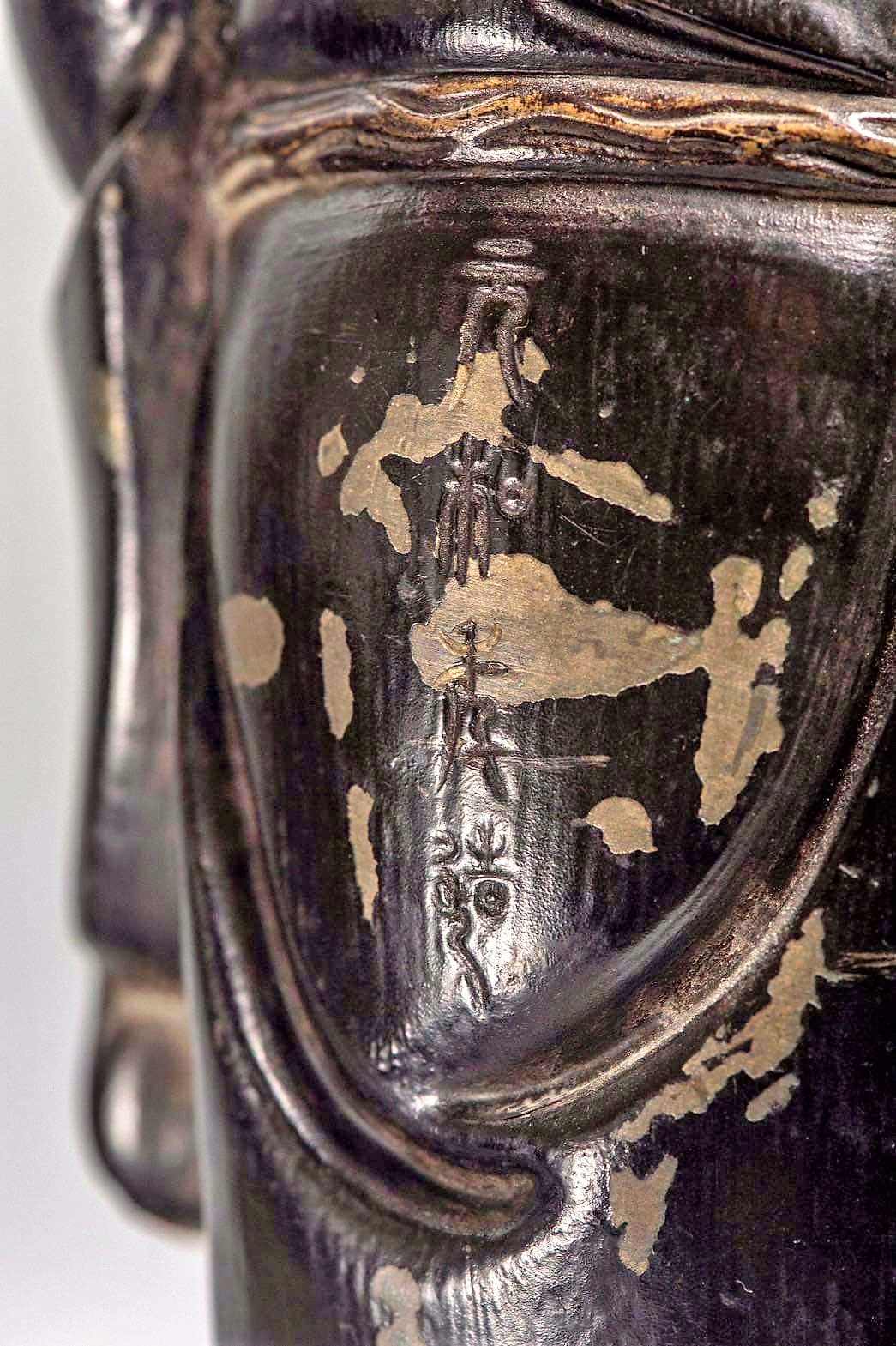
The back of the figure is engraved with 元和年製 (Yuanhe nianzhi), meaning “Made in the Yuanhe era.” Yuanhe was the reign era of the Tang emperor Xianzong, 806–820. With the reading established, the question is whether this is a mark contemporary with manufacture during that era, or a later retrospective mark invoking the Tang reign title. The historical period named in an inscription must be distinguished from the actual date of the sculpture.
A contemporary reign mark corresponds to the period in which the object was made. A retrospective mark, known in Chinese connoisseurship as a jituo kuan, uses an earlier reign title on a later object. Such marks may express admiration for the past, archaism, or continuity of tradition and should not automatically be equated with deliberate forgery. For this figure, the lettering and engraving technique, the relationship of the cuts to color layers and corrosion, sculptural style, casting structure, and reliable provenance should be considered together to assess whether the inscription and metal body are contemporary.
This essay retains the Museum’s provisional designation, Tang dynasty or later. Tang arhat sculpture remains a comparative direction to investigate. An attenuated body, expressive face, and elaborate folds can recur across periods. A reliable attribution requires mutually supporting evidence from inscription, style, construction, materials, and provenance.
7. Museum Comparisons: Monastic Traditions and Imperial Patronage
The Cleveland Museum of Art records a pair of gilt-bronze seated lohans dated to the twelfth through fourteenth centuries and notes differences in their robes [2]. The comparison draws attention to how monastic clothing covers or exposes the torso and demonstrates the variety possible in metal arhat sculpture. Differences in pose, scale, and modeling nevertheless prevent transferring the comparative objects’ date to the Yun Museum standing figure.
Arhat imagery also entered imperial devotional settings. An eighteenth-century jade arhat in a grotto at The Metropolitan Museum of Art bears an inscription identifying it as part of a set of sixteen commissioned by the Qianlong emperor [3]. Although different in material and date, it documents court participation in arhat devotion and shows how an inscription can establish an ensemble’s context. It does not demonstrate imperial provenance for the present bronze.
The combination of a standing pose, attenuated torso, smiling face, animal-head object, gourd-shaped accessory, and polychrome surface makes this figure a productive subject for further research. A corpus recording photographs, measurements, inscriptions, materials, and reliable histories could help distinguish broadly shared arhat imagery from choices associated with a particular region or workshop.
8. Provenance and Scholarly Significance
According to the Museum’s record, the figure came from a private collection in Amsterdam, having been acquired by the collector’s father around 1910 and subsequently passed down through the family. This provides a direction for provenance research, to be checked against old photographs, receipts, inventories, and early publications. Confirmation of an early collecting date would not, by itself, establish an ancient manufacturing date.
The artistic interest of this standing polychrome bronze arhat lies in its carefully organized body, individualized face, and interplay between color and metal. Its scholarly potential connects religious devotion with manufacture, conservation history, and collecting. Turning close looking into questions that can be compared, tested, and revised allows a museum essay to contribute knowledge beyond appreciative description.
Frequently Asked Questions
Is this arhat definitely a Tang-dynasty sculpture?
The figure bears a clearly identified Yuanhe nianzhi inscription. The unresolved question is whether it dates to the Yuanhe era itself or is a later retrospective mark. The attribution Tang dynasty or later is therefore retained pending direct examination, comparative study, and materials research.
How does polychrome bronze differ from gilt bronze?
Polychrome bronze emphasizes colored decoration on a metal body, while gilding describes the application of gold. The two may coexist, but the material and technique of the golden traces on this figure remain to be determined.
How should this standing arhat be viewed?
Begin with the inclination of the head and facial expression, then consider the contrast between the exposed torso and the robe. Continue around the figure to study the held object, accessories, and inscription, connecting visual appreciation with research.
View the Yun Museum collection entry and complete images of the standing polychrome bronze arhat
Sources and Research Notes
- The Record of the Abiding of the Dharma Spoken by the Great Arhat Nandimitra (大阿羅漢難提蜜多羅所說法住記), Taishō Tripiṭaka, vol. 49, no. 2030. See the CBETA text excerpt hosted by Smith College. Used for the discussion of arhat devotion and protection of the Dharma.
- Cleveland Museum of Art, Pair of Seated Lohan Figures, 1100s–1300s, no. 4.2023. Comparative reference for robes and metal arhat sculpture.
- The Metropolitan Museum of Art, Seated luohan (arhat) in a grotto, eighteenth century, no. 02.18.640. Comparative reference for imperial devotion and inscriptions.
- Yun Museum, Standing Polychrome Bronze Arhat collection entry. Measurements, provisional attribution, and provenance follow the Museum record.
This essay is based on the Museum’s public record and available photographs. Visual interpretations are offered for art-historical discussion and do not constitute direct authentication or a scientific examination report. Photographs supplied by Yun Museum. Sources consulted: 6 November 2026.