

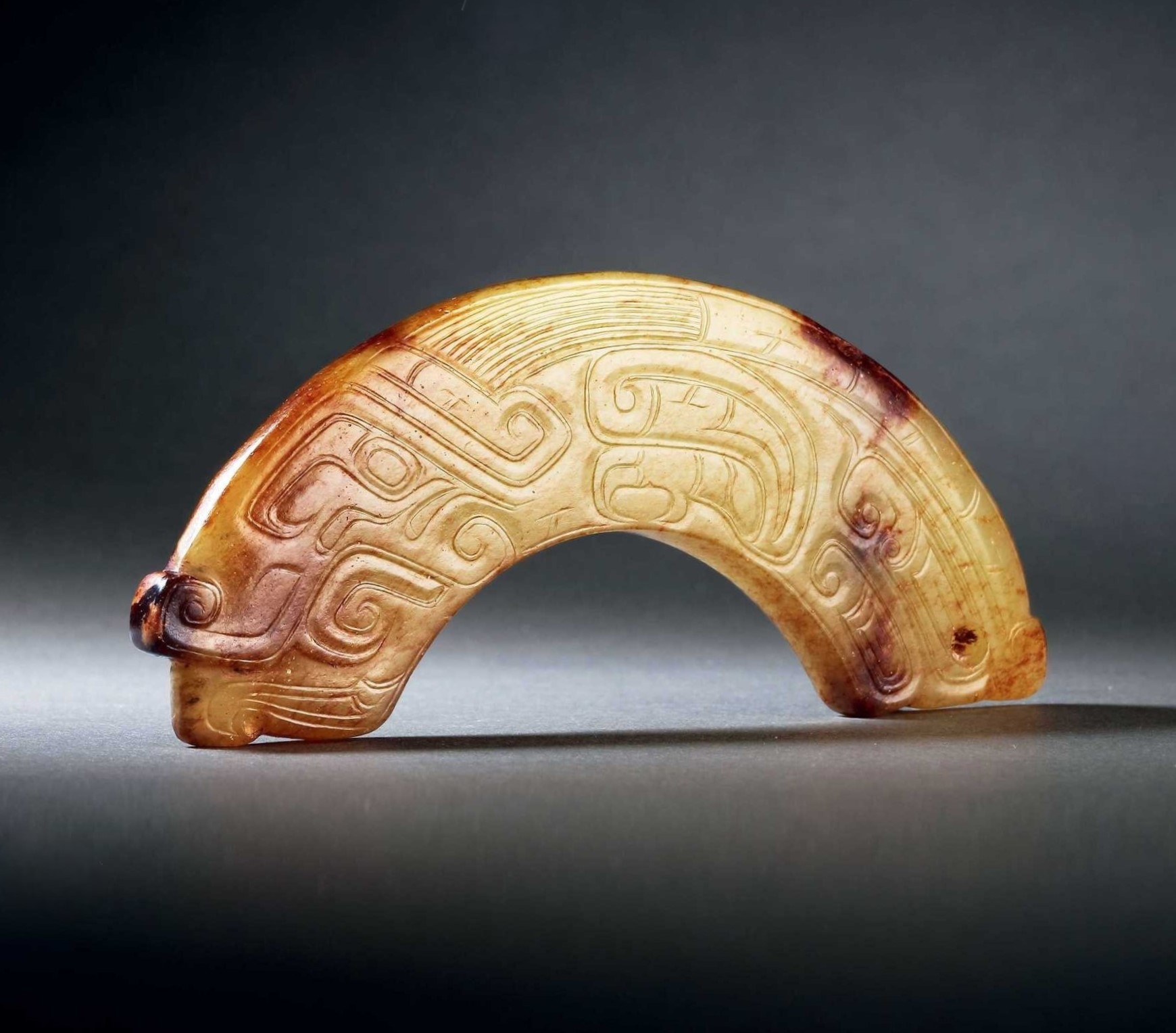
Dimensions Length 10.1 cm · Width 2.6 cm · Thickness 0.7 cm
Carved from fine white jade, this arc-shaped huang pendant bears red alteration across its surface. The stone retains a soft lustre beneath the colour. Its sweeping curve and measured proportions give the piece the quiet dignity characteristic of Western Zhou jade.
Dragon ornament fills both faces of the pendant. The design is intricate, yet the creature’s posture is easy to follow. It crouches with all four legs drawn in, its body still but poised to move. The long, narrow eye hooks inward in the shape conventionally likened to the Chinese character chen (臣), giving the dragon an intent gaze. At the other end of the body, the tail tapers to a point and curls sharply upward. The carver used the single-bevel technique known as yimianpo (一面坡): one side of a carved line slopes gently into the surface. As these sloping cuts turn along the body, light picks out its contours in a succession of rises and dips.
The huang has a long history in China as both a pendant and a ritual jade. Its rainbow-like arc is readily appreciated when worn or suspended, and it ranks alongside the circular bi disc among the classic forms of jade ornament. On this example, layers of carving give the dragon an elusive quality, while the disciplined arrangement of its parts lends the composition a ritual gravity. The sharply focused eye and the upward flick of the tail reward a close look, even as the broad sweep of the pendant draws the eye back to the whole.
The quality of the jade, the control of the bevelled carving and the complexity of the ornament suggest that the pendant may have been worn by a member of the royal household or the high nobility. It is a particularly fine example of the Western Zhou huang, also known as a heng (橫). Its craftsmanship and the light it sheds on the ornaments of the period give it a distinctive place in the collection.