

Dimensions Length 11.1 cm · Width 3.3 cm · Thickness 0.6 cm
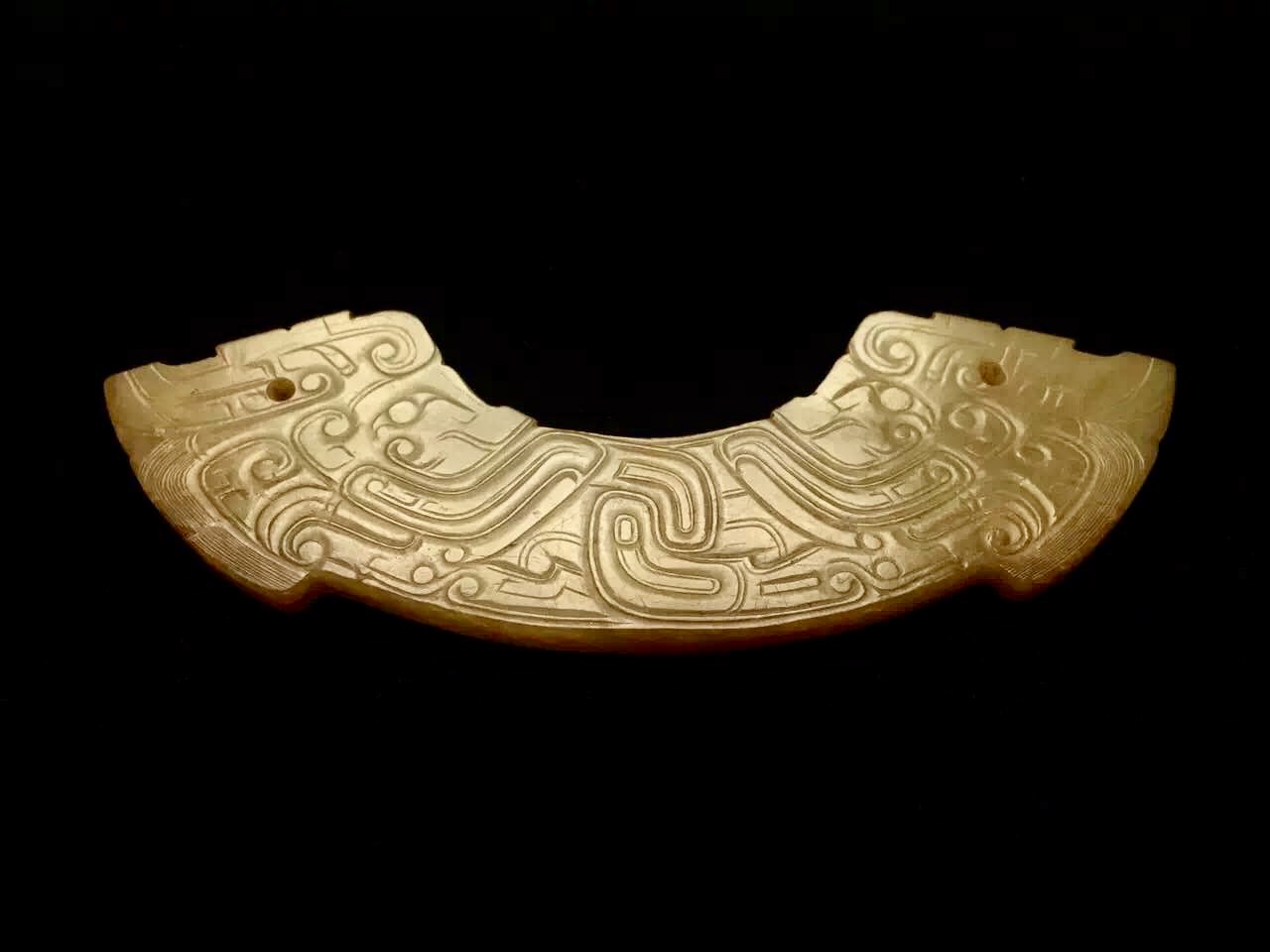
Carved from fine-grained yellow jade, this Western Zhou huang pendant has a rich patina and shades naturally from honey yellow to orange-brown. The thin, curved plaque recalls half a bi disc. The same design appears on both faces, its flowing, rhythmic lines revealing the carver’s command of the material.
At either end, a solemn human face appears in profile. Each has an eye shaped like the Chinese character chen (臣), a large ear curled like a cloud, a slightly upturned nose and parted lips. A tall phoenix crown rises above the head. Fine incised lines trace loose strands of hair swept back against the neck. A few economical strokes give each face a distinct presence. The crowns suggest high rank, a mandate received from Heaven and the power to communicate with it, recalling the close relationship between sacred and royal authority in Western Zhou ritual.
Below each head, the body takes the form of a coiling dragon. Hooked cloud scrolls repeat along its length, and rounded curves give way to sharp, angular turns. Projecting flanges accent the two ends. A circular hole drilled at either end allowed the pendant to be threaded and suspended. The paired profiles and balanced proportions lend order to the movement of the dragons.
Human head, dragon body and phoenix crown form a single image. This rare combination evokes the Western Zhou conception of jade as a medium of communication with the divine and suggests the elevated standing of its wearer in ritual and worship. The “Offices of Spring” section of the Rites of Zhou describes the use of six jade forms in rites honouring Heaven, Earth and the four directions. Within this ritual tradition, the huang belongs to a class of jades associated with royal sacrifice, ceremonies of investiture and the swearing of oaths.
The human heads may represent ancestral spirits or divine guardians, an interpretation that accords with the importance of ancestral worship in temple ritual. The carving combines restraint with tension, particularly where the calm profiles meet the turning bodies. An exceptional example of a Western Zhou jade huang, the pendant offers material evidence for the study of ritual jade, ideas about the human and divine realms, and the changing imagery of dragons and phoenixes.