Yun An Museum Acquires a Pair of White Jade Dragon-Decorated Xi Pendants with Russet Alteration, Western Zhou Dynasty
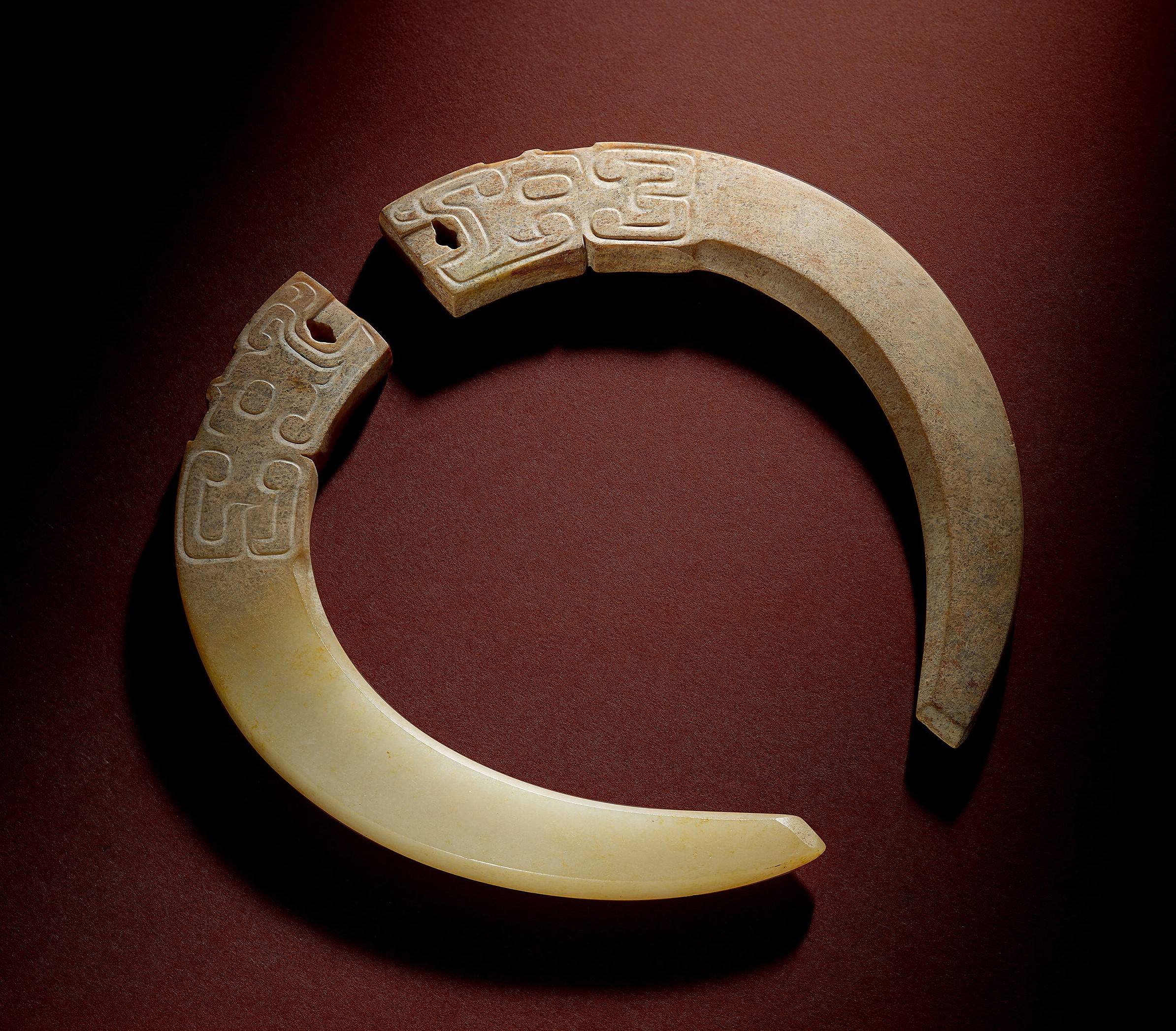
Length: 10.8 cm each.
A jade xi is a gently curved, tapering implement, also known as chongya. The museum’s account traces the form to the Neolithic Liangzhu culture and describes its continued use through the Shang, Western Zhou, Spring and Autumn, Warring States and Han periods. Originally carried to loosen knots, it gradually became an ornamental component of pendant sets. Despite variations in form, xi generally retain a broad upper section and a pointed lower end.
The present pair is carved from white jade. One has extensive greyish-white alteration, while the other shows areas of white and yellowish-brown alteration. Each flattened, crescent-shaped body has a broad head and a narrowing tail. A dragon head is carved at the wider end, with kui-dragon ornament worked in low relief and incised lines. A suspension hole passes through the mouth area. The body then tapers into a slender, largely undecorated point.
The flowing contours and carefully controlled carving give these pendants a lively sense of movement. The museum catalogues the pair as Western Zhou dynasty.
Provenance:
China Guardian Hong Kong, 2024, Chinese Archaic Jades from the Zanjixuan Collection III.
Zanjixuan Collection, Taipei, acquired before 1999.