
An Auspicious Treasure of the Han: A Jade Bixie Carved in the Round
An Auspicious Treasure of the Han: A Jade Bixie Carved in the Round
By Yu Jie
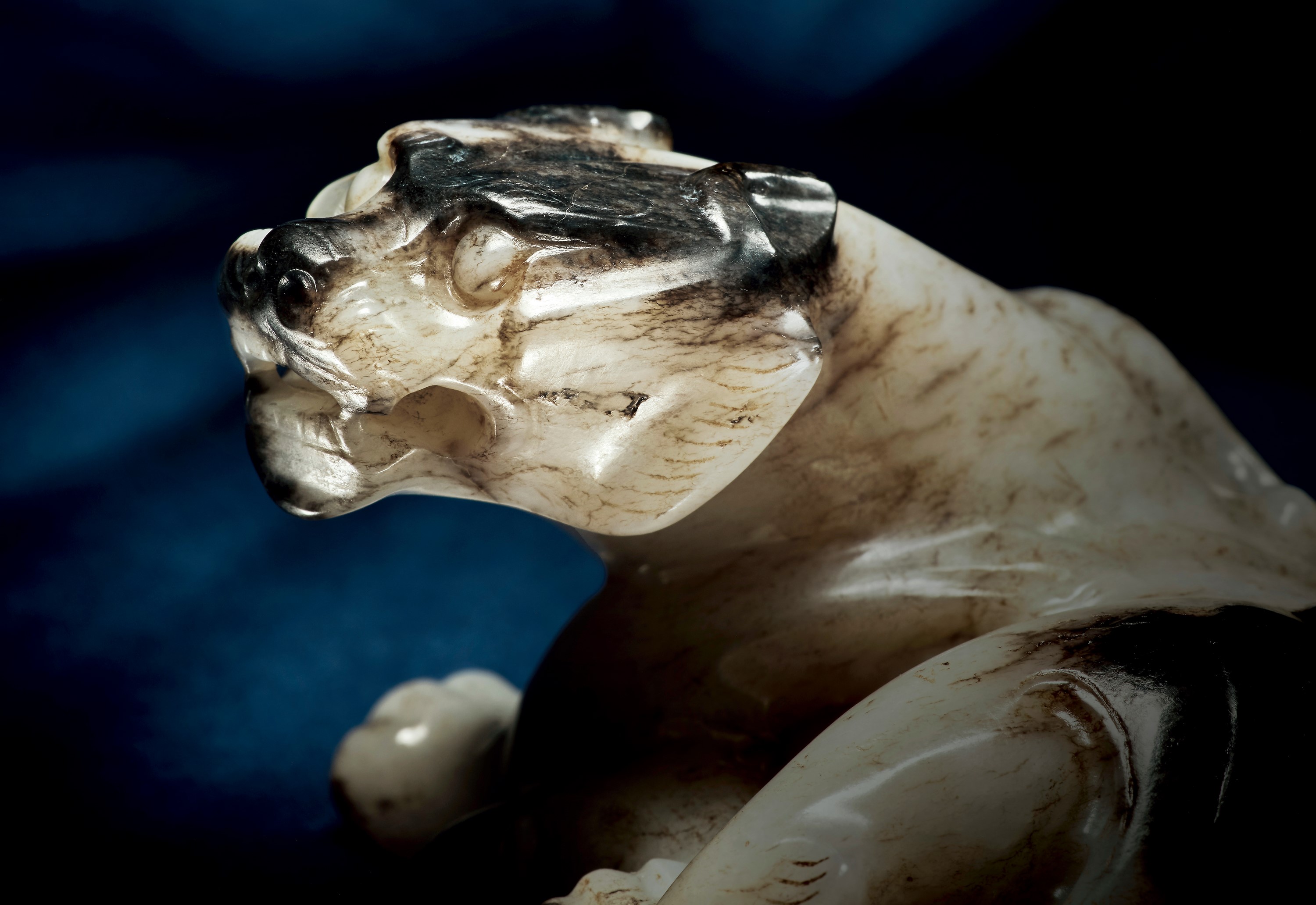
Carved from dense, softly lustrous white jade, this bixie has areas of dark alteration and a naturally mellow surface. The winged creature reclines with its head raised and chest lifted. Its lion-like face has prominent rounded eyes set within elongated triangular sockets, cut with slanting strokes. Curled brows rise towards the ears; fine diagonal lines fill the brows, whose ends turn into ruyi-shaped curls. A long groove runs from the forehead towards the back of the neck.
A small nose and squared muzzle sit above a slightly open mouth showing teeth. Raised carving at the bridge of the nose suggests folds of skin. The ears project backwards and are hollowed within. The neck is slightly elongated, with a short beard beneath the jaw. Powerful feet have four claws, and the hind joints carry projecting spurs decorated with mane-like lines.
The right foreleg is tucked beneath the abdomen, while the left extends to support the upper body. Turning back towards the upper left, the creature appears watchful. Wings lie close along the flanks. Short incised strokes articulate the wings, cheeks, legs, abdomen and tail. The tail curves left beneath the hind foot, while its root is defined by recessed carving in a cloud-scroll form around the haunches. Areas of alteration enhance the impression of a fantastic animal.
The twisting body, extended claws and differently positioned limbs capture movement in a stationary form. Strong lines along the legs, back and paws convey muscular force. Compared with more upright bixie, its low centre of gravity creates a stable composition; the author suggests that it may have served as a display object or weight for courtly or elite use.
Han jade carving in the round marked a significant development from earlier, more stylised forms. Its animal subjects included both observed creatures and imagined auspicious beasts. The bixie combines the forms of powerful animals with elements associated with artistic exchange. Compositions often depart from strict symmetry, yet remain visually balanced. By turning the body and varying the direction of the feet, carvers gave compact forms a persuasive sense of motion.
The present creature has a rounded, substantial body, a raised and backward-turning head, and strongly modelled claws. Subtle transitions suggest the muscles beneath the surface. Incision, shallow and high relief, carving in the round and drilled openwork contribute to its expressive effect. Dark alteration across the head, haunches and wings contrasts with the pale jade; fine streaks on the back can suggest a mane. The result is a striking interaction between material and form.
Comparative works discussed in the Chinese article include:
Figure 1: An Eastern Han turquoise bixie in the Lantian Shanfang Collection, Taiwan, with a comparable backward-turning head (群玉別藏續集, p. 234, pl. 153).
Figures 2–3: Two Western Han jade bixie in the Xianyang Museum, Shaanxi, one seated with its head raised and one crouching. Their head forms and leg ornament provide comparisons (陝西出土漢代玉器, pp. 276–279, pl. 244; pp. 280–282, pl. 245).
Figure 4: A late Western Han jade bixie in the Jinhuatang Collection, Taiwan (群玉別藏續集, p. 232, pl. 151).
Figure 5: A Western Han bixie in the National Palace Museum, Taipei, with related treatment of the head (敬天格物:中國歷代玉器, p. 76, fig. 5-4-9).
Figure 6: An Eastern Han jade bixie in the National Palace Museum, with its head raised and low horns close to the back of the skull (精彩一百:國寶總動員, pp. 80–81, pl. 18).
The modelling of the eyes, forehead, neck and ears also invites comparison with Han sword fittings bearing high-relief chi dragons. Figure 7 is an Eastern Han jade sword slide with chi-dragon decoration in the Palace Museum, Beijing, formerly in the Qing imperial collection (故宮博物院藏品大系:玉器編4:漢魏晉南北朝, p. 193, pl. 246). Figure 8 is a horse-head jade belt hook with a bronze core in the Xingping Museum, Shaanxi, cited for related facial ornament, especially ruyi-shaped brows (陝西出土漢代玉器, p. 249, pl. 226).
Art reflects the ideas and aspirations of its time. Han imaginings of immortality and transcendence encouraged a rich vocabulary of divine figures, flying immortals and fantastic beasts. In this bixie, cloud and feather motifs, varied curved surfaces and assured lines create depth and movement. The author identifies its style with early Han jade carving and sees its unusual form as evidence of the interplay between established traditions and new artistic influences.
References
Studies:
Zhou Nanquan, 漢代玉辟邪, in 古玉博覽, 1999, pp. 191–193.
Li Ling, 論中國的有翼神獸, in 中國學術, vol. 5, edited by Liu Dong, Beijing: Commercial Press, 2001, pp. 62–134.
Wang Rong, 論漢代的翼獸——基於文化交流視角下的個案觀察, in 靈動飛揚:漢代玉器掠影, Beijing Publishing Group, 2014, pp. 184–210.
Sun Ji, 漢代物質文化資料圖說, Beijing: Cultural Relics Press, 1991, p. 420.
Catalogues:
Liu Yunhui, 陝西出土漢代玉器, 2009, pp. 248–249, pl. 226; pp. 276–279, pl. 244; pp. 280–282, pl. 245.
Palace Museum, 故宮博物院藏品大系:玉器編4:漢魏晉南北朝, Hefei: Anhui Fine Arts Publishing House, 2011, p. 193, pl. 246.
Teng Shu-ping, 群玉別藏續集, National Palace Museum, 1999, p. 232, pl. 151; p. 234, pl. 153.
Teng Shu-ping, ed., 敬天格物:中國歷代玉器, Taipei: National Palace Museum, 2012, p. 76, fig. 5-4-9.
Tsai Mei-fen, ed., 精彩一百:國寶總動員, National Palace Museum, 2012, pp. 80–81, pl. 18.