
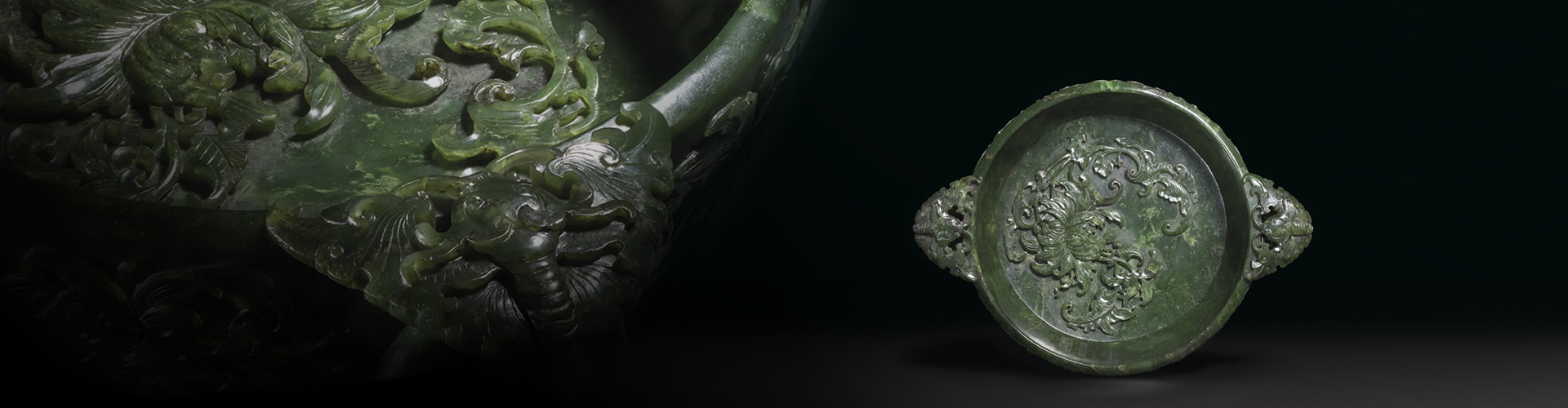
Jade Bixie, Han Dynasty
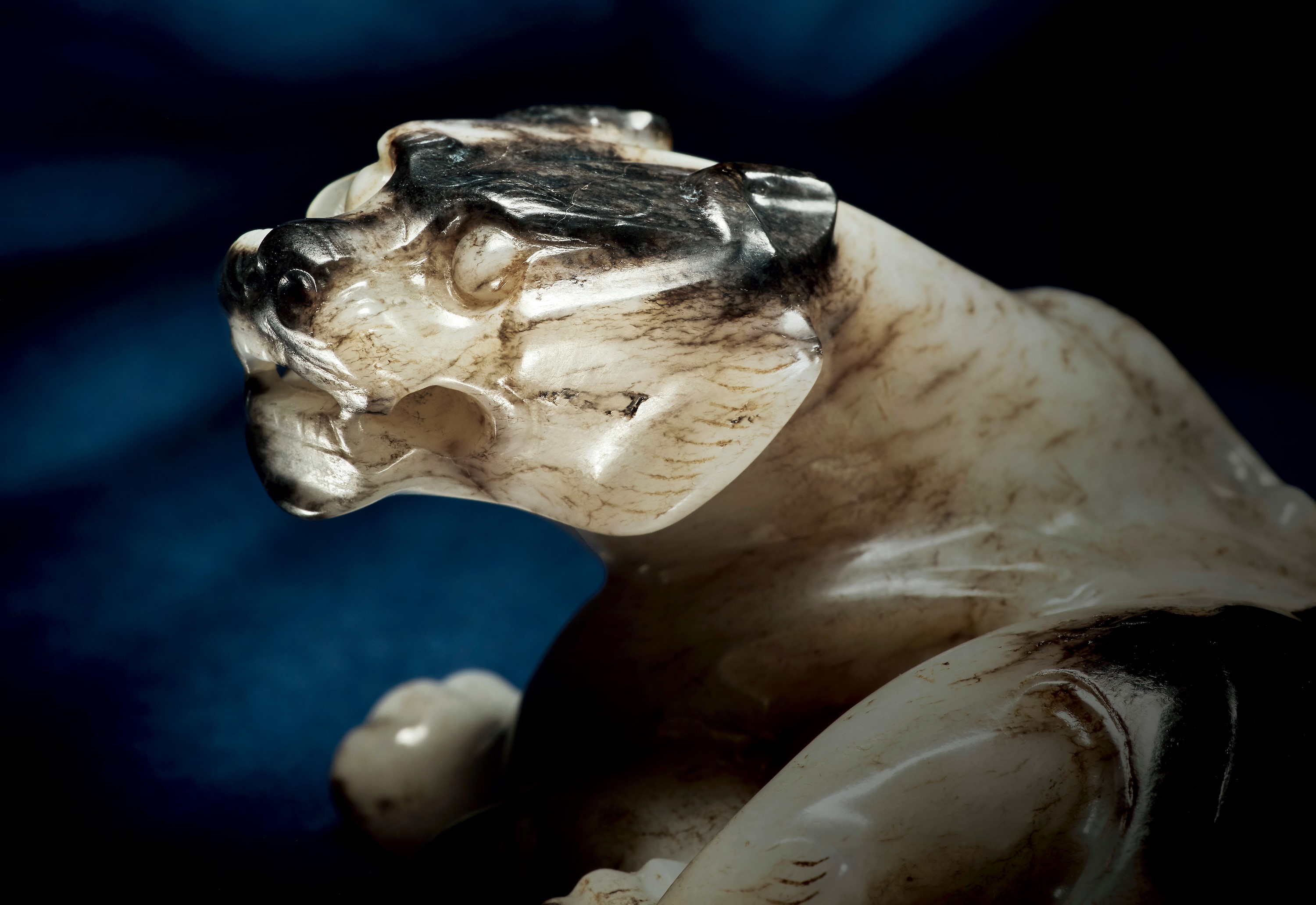
This reclining bixie is carved in the round from dense white jade with a softly lustrous surface and areas of dark alteration. Its lion-like head is raised, the chest lifted and the body turned towards the left. Rounded eyes sit within elongated triangular sockets. Curled brows filled with diagonal strokes connect visually with the ears, and a groove extends from the forehead towards the back of the neck.
The small nose, squared muzzle and slightly open, tooth-bearing mouth give the face a distinctive character. Backward-projecting ears are hollowed within. A short beard appears below the jaw, while powerful four-clawed feet and projecting hind-leg spurs reinforce the animal’s strength.
The right foreleg rests beneath the abdomen and the left extends to support the upper body. Wings lie along the flanks. Short incised lines articulate the cheeks, wings, legs and tail. The tail curves left beneath the hind foot; recessed carving around its root forms a ruyi-shaped cloud scroll at the haunches.
The different directions of the limbs and the backward turn of the head suggest an animal that has paused in motion to look around. Strong contours along the back, legs and claws capture vitality within a compact, stable form. Its lower centre of gravity distinguishes it from standing bixie. The Chinese account proposes that it may have served as a display object or weight for courtly or elite use.
Han carvers brought renewed energy and three-dimensional complexity to jade animals. Real creatures such as birds, tigers and oxen shared this artistic world with imaginary auspicious beasts. Bixie draw on powerful animals and incorporate elements linked to wider artistic exchange. Asymmetry, twisting bodies and varied foot positions enable these figures to appear dynamic without losing balance.
In the present work, incision, shallow and high relief, carving in the round and drilled openwork contribute to an assured sculptural effect. Muscles are suggested beneath the rounded surface. Dark areas across the head, wings and haunches contrast with the white jade, while fine streaks on the back recall a mane.
Comparative works cited in the Chinese account include an Eastern Han turquoise bixie in the Lantian Shanfang Collection, Taiwan, with a similar backward glance (群玉別藏續集, p. 234, pl. 153); two Western Han jade bixie in the Xianyang Museum, Shaanxi (陝西出土漢代玉器, pp. 276–279, pl. 244; pp. 280–282, pl. 245); and a late Western Han example in the Jinhuatang Collection, Taiwan (群玉別藏續集, p. 232, pl. 151).
Further comparisons are a Western Han bixie in the National Palace Museum, Taipei (敬天格物:中國歷代玉器, p. 76, fig. 5-4-9), and an Eastern Han example in the same museum with a raised head and low horns close to the skull (精彩一百:國寶總動員, pp. 80–81, pl. 18).
The facial modelling is also compared with an Eastern Han jade sword slide bearing chi-dragon decoration in the Palace Museum, Beijing (故宮博物院藏品大系:玉器編4:漢魏晉南北朝, p. 193, pl. 246). Ruyi-shaped brow ornament is related to that on a horse-head jade belt hook with a bronze core in the Xingping Museum, Shaanxi (陝西出土漢代玉器, p. 249, pl. 226).
Han beliefs concerning immortality and transcendence encouraged richly imaginative depictions of divine figures, flying immortals and fantastic animals. The cloud and feather ornament, curved surfaces and forceful lines of this bixie embody that imaginative world. The Chinese account identifies its style with early Han jade carving and regards its unusual form as an expression of the interaction between inherited traditions and new artistic influences.